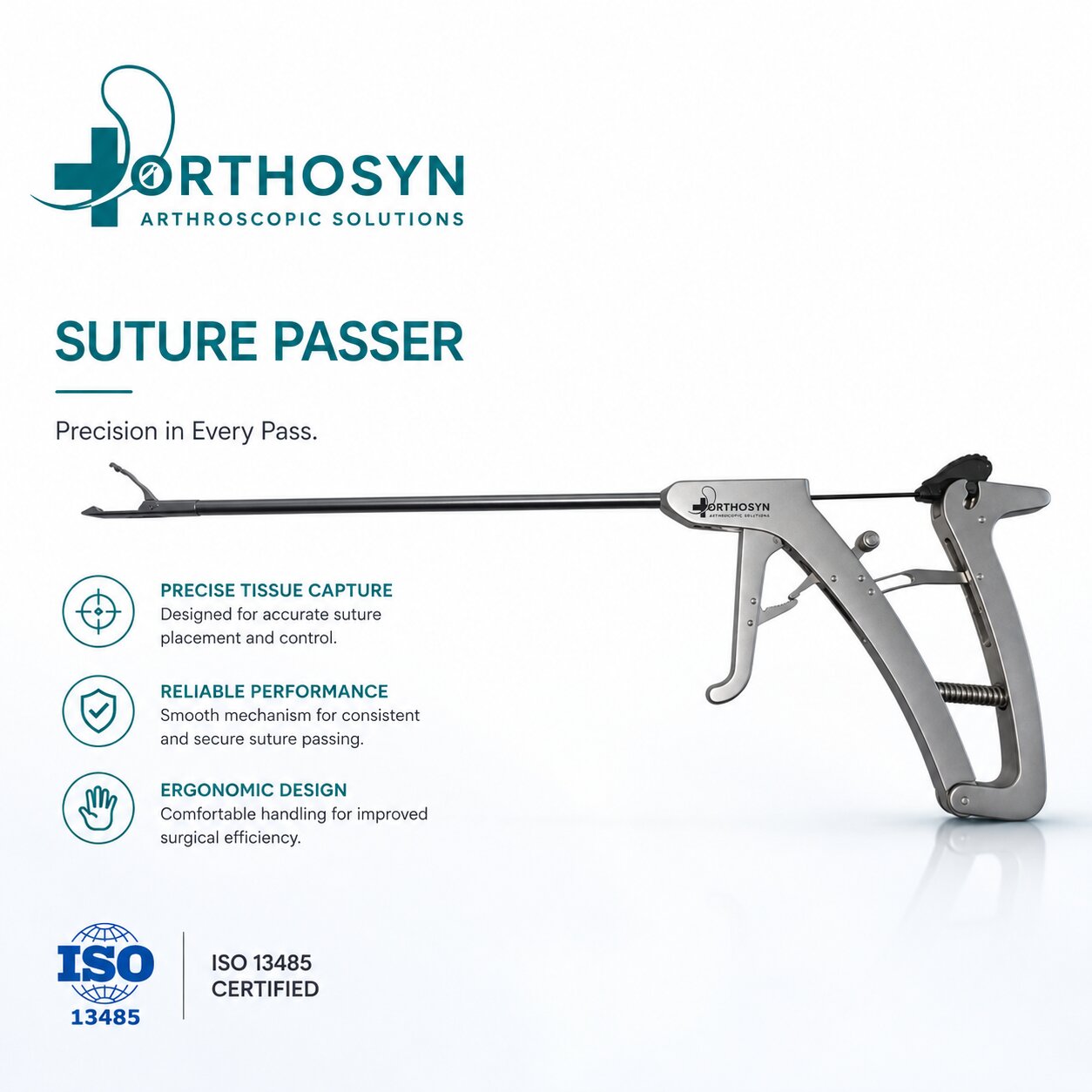
Successful arthroscopic soft tissue repair depends on more than high-quality implants. Precise suture management is equally important, and one of the key instruments that makes this possible is the arthroscopic suture passer.
Designed to shuttle sutures accurately through soft tissue, suture passers help surgeons perform reliable repairs while working within the limited space of the shoulder joint. Their precision contributes to efficient procedures, secure fixation, and improved surgical workflow.
An arthroscopic suture passer is a specialized instrument used to pass suture through tendons, ligaments, or other soft tissues during minimally invasive procedures.
The instrument enables surgeons to capture tissue accurately while maintaining excellent control inside the joint through small arthroscopic portals.
Depending on the procedure, different tip configurations may be selected to optimize access and tissue penetration.
Accurate suture placement is one of the most critical steps in arthroscopic repair.
A suture passer helps surgeons:
Reliable suture management supports stronger and more reproducible repairs.
Allows precise suture passage through torn rotator cuff tendons before anchor fixation.
Facilitates secure suture placement through the detached labrum during stabilization procedures.
Helps restore anterior shoulder stability by accurately passing sutures through capsulolabral tissue.
Supports precise management of superior labral tissue while preserving surrounding anatomical structures.
Useful whenever accurate arthroscopic tissue penetration and suture management are required.
A well-designed suture passer should provide:
These characteristics improve both surgeon confidence and procedural efficiency.
Accurate tissue capture helps optimize repair quality.
Controlled penetration minimizes unnecessary tissue damage.
Efficient suture passing reduces operative time.
Standardized suture placement contributes to reproducible clinical outcomes.
Orthosyn Medikal offers a comprehensive portfolio of arthroscopic hand instruments developed for precision and reliability.
The portfolio includes:
Each instrument is designed to support minimally invasive procedures while providing ergonomic handling and dependable performance.
The arthroscopic suture passer is one of the most important instruments used during soft tissue repair.
By enabling accurate suture placement, minimizing tissue trauma, and improving surgical efficiency, it helps surgeons achieve secure repairs and predictable clinical outcomes.