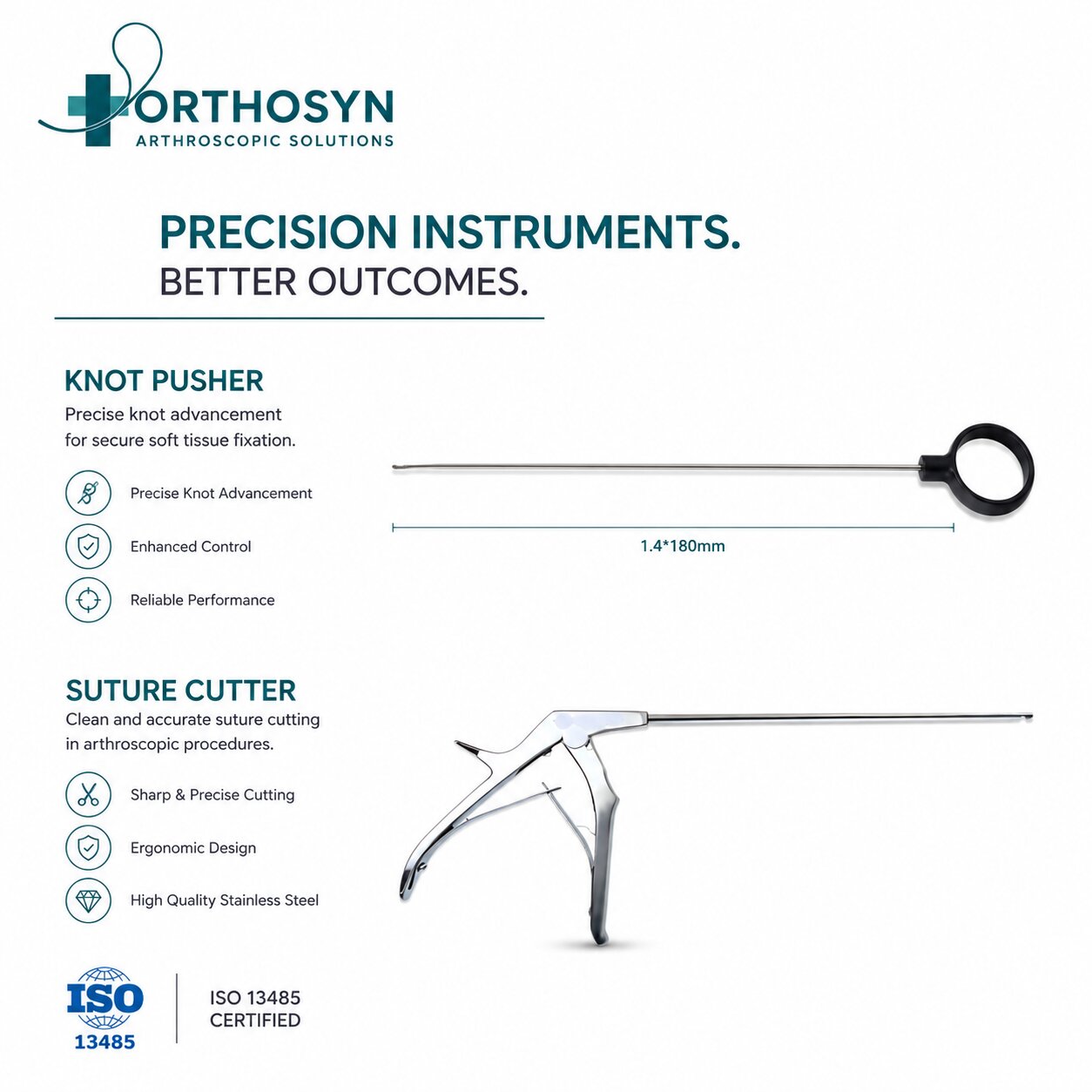
Arthroscopic shoulder surgery requires not only high-quality implants but also specialized instruments that enable surgeons to work accurately within a confined joint space. Among these instruments, the arthroscopic knot pusher plays a crucial role in securing soft tissue repairs by allowing precise advancement and tightening of surgical knots.
Although often considered a simple instrument, the knot pusher directly influences knot quality, repair stability, and overall surgical efficiency.
An arthroscopic knot pusher is a specialized hand instrument designed to advance pre-tied or manually tied surgical knots along the suture and securely position them against soft tissue during arthroscopic procedures.
It allows surgeons to maintain excellent control while tying knots through small arthroscopic portals without losing tension on the repair.
During arthroscopic surgery, direct hand access to the repair site is impossible. Instead, surgeons rely on specialized instruments to manipulate sutures within the joint.
A knot pusher helps surgeons:
Reliable knot advancement contributes to a stronger and more stable repair.
Arthroscopic knot pushers are routinely used in:
To secure tendon fixation after suture anchor placement.
To stabilize the repaired labrum against the glenoid rim.
To restore anterior shoulder stability by securely fixing detached soft tissue.
To tighten and stabilize the joint capsule during instability procedures.
Whenever secure arthroscopic knot tying is required.
A high-quality knot pusher should provide:
These features help surgeons perform efficient and reproducible repairs.
Using an appropriate knot pusher offers several benefits:
Accurate knot seating helps maintain tissue fixation throughout healing.
Surgeons can position knots exactly where fixation is required.
Efficient knot management contributes to a smoother surgical workflow.
Consistent knot placement supports reliable soft tissue healing.
Orthosyn Medikal provides a complete range of arthroscopic hand instruments developed for precision and reliability.
The portfolio includes:
Designed for minimally invasive procedures, these instruments help surgeons perform efficient soft tissue repairs with confidence.
While suture anchors provide fixation, successful arthroscopic repair also depends on the instruments used to manage sutures throughout the procedure.
The arthroscopic knot pusher remains an indispensable tool for advancing, positioning, and securing knots with precision, ultimately contributing to stronger repairs and improved surgical outcomes.