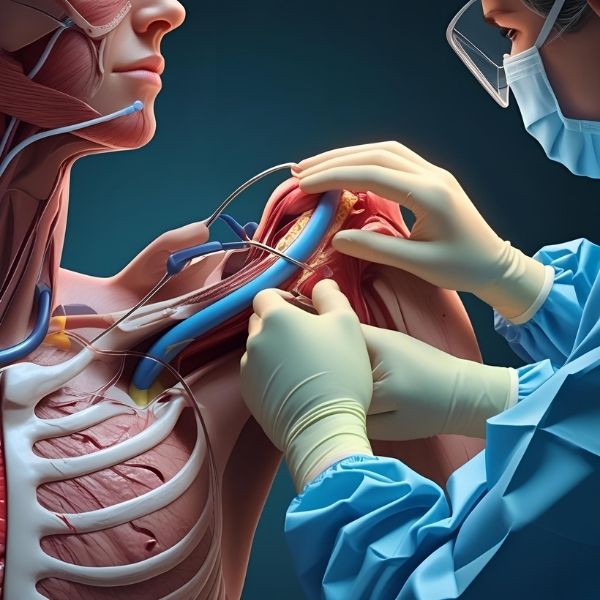
Shoulder arthroscopy has transformed the treatment of many orthopedic conditions by allowing surgeons to perform complex procedures through small incisions. While implants and surgical instruments often receive significant attention, one fundamental aspect of every successful arthroscopic procedure is proper portal placement.
Well-positioned portals provide optimal visualization, improve instrument access, facilitate efficient tissue handling, and contribute to safer surgical procedures. Even with advanced implants and high-quality instruments, incorrect portal positioning can make an otherwise straightforward procedure unnecessarily difficult.
Arthroscopic portals are small incisions created to introduce the arthroscope and surgical instruments into the shoulder joint.
Each portal serves a specific purpose depending on the surgical procedure. Proper portal selection allows surgeons to visualize anatomical structures clearly while accessing the target tissue from the most appropriate angle.
Different shoulder procedures may require different portal configurations depending on the pathology being treated.
Accurate portal placement directly influences the efficiency and safety of arthroscopic surgery.
Properly positioned portals help surgeons:
Poor portal positioning may increase procedure time and create unnecessary technical challenges.
The posterior portal is typically established first and is commonly used for diagnostic arthroscopy. It provides an excellent overall view of the glenohumeral joint.
The anterior portal allows access to the anterior labrum, capsule, and rotator interval. It is frequently used during Bankart and SLAP repairs.
The lateral portal is widely used during rotator cuff repair, providing direct access to the subacromial space and greater tuberosity.
Additional portals may be created depending on the complexity of the procedure and the surgeon's preferred technique.
Correct portal positioning provides clear visualization of critical anatomical structures throughout the procedure.
Well-aligned portals allow instruments to approach tissues from optimal angles, improving precision during repair.
Appropriate portal selection minimizes unnecessary manipulation of surrounding tissues.
Efficient portal planning reduces unnecessary instrument exchanges and shortens procedural time.
Cannulas are commonly inserted through arthroscopic portals to protect soft tissues while facilitating repeated instrument exchanges.
Their benefits include:
Modern arthroscopic cannulas have become an essential component of minimally invasive shoulder surgery.
Orthosyn Medikal provides a comprehensive portfolio of arthroscopy instruments designed to support efficient portal management and minimally invasive shoulder procedures.
The portfolio includes:
These instruments are designed to improve surgical workflow while providing precision, durability, and ergonomic performance.
Successful shoulder arthroscopy begins long before anchor placement or tissue repair. Proper portal planning establishes the foundation for safe visualization, efficient instrument handling, and accurate tissue fixation.
Combined with high-quality arthroscopic instruments, well-positioned portals help surgeons perform minimally invasive procedures with greater confidence and consistency.