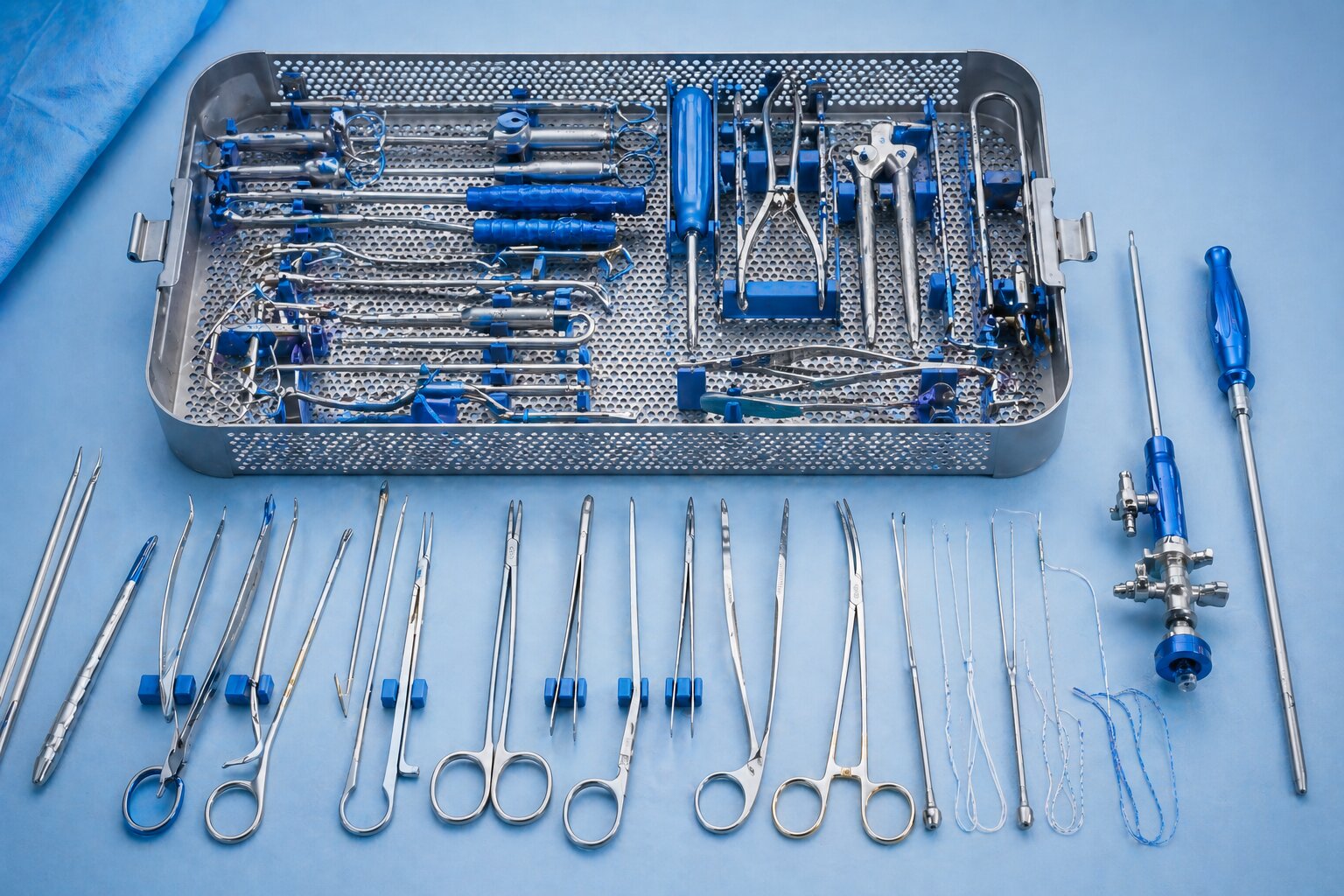
Modern shoulder arthroscopy depends on more than advanced implants alone. The success of minimally invasive procedures also relies on the precision and reliability of the surgical instruments used throughout the operation. Among these instruments, arthroscopic graspers play a critical role in tissue manipulation, suture management, and procedural efficiency.
Although graspers may appear to be simple instruments, they are indispensable during many stages of arthroscopic surgery. Their ability to securely hold, retrieve, position, and manipulate soft tissue allows surgeons to perform complex repairs with greater control and accuracy.
An arthroscopic grasper is a handheld surgical instrument designed to grasp and manipulate tissues or surgical materials through small arthroscopic portals.
Available in different jaw configurations and lengths, graspers are developed for specific surgical tasks while allowing surgeons to work effectively within the limited space of the shoulder joint.
Arthroscopic graspers are routinely used during numerous shoulder procedures, including:
They assist surgeons during both tissue preparation and final fixation.
A well-designed grasper provides firm yet controlled tissue capture without unnecessary trauma.
Reliable jaw control allows accurate positioning of tendons, ligaments, and sutures before fixation.
Graspers help retrieve and organize suture limbs, reducing tangling and simplifying complex repairs.
Precise tissue manipulation improves visualization inside the joint, making each surgical step more controlled.
Reliable instruments reduce unnecessary exchanges and contribute to smoother surgical procedures.
Surgeons typically evaluate graspers based on:
Selecting the appropriate instrument helps improve both surgeon comfort and procedural consistency.
During rotator cuff repair, graspers are frequently used to:
Their role becomes particularly important during large or retracted tendon tears.
Orthosyn Medikal offers a comprehensive portfolio of arthroscopic hand instruments designed for modern minimally invasive surgery.
The portfolio includes:
These instruments are developed to provide reliability, precision, and ergonomic handling during shoulder arthroscopy.
Although implants often receive the most attention, high-quality arthroscopic instruments are equally important for successful shoulder surgery.
Reliable graspers improve tissue handling, simplify suture management, enhance visualization, and contribute to efficient surgical workflows. As arthroscopic techniques continue to evolve, precision instruments will remain essential components of modern sports medicine.