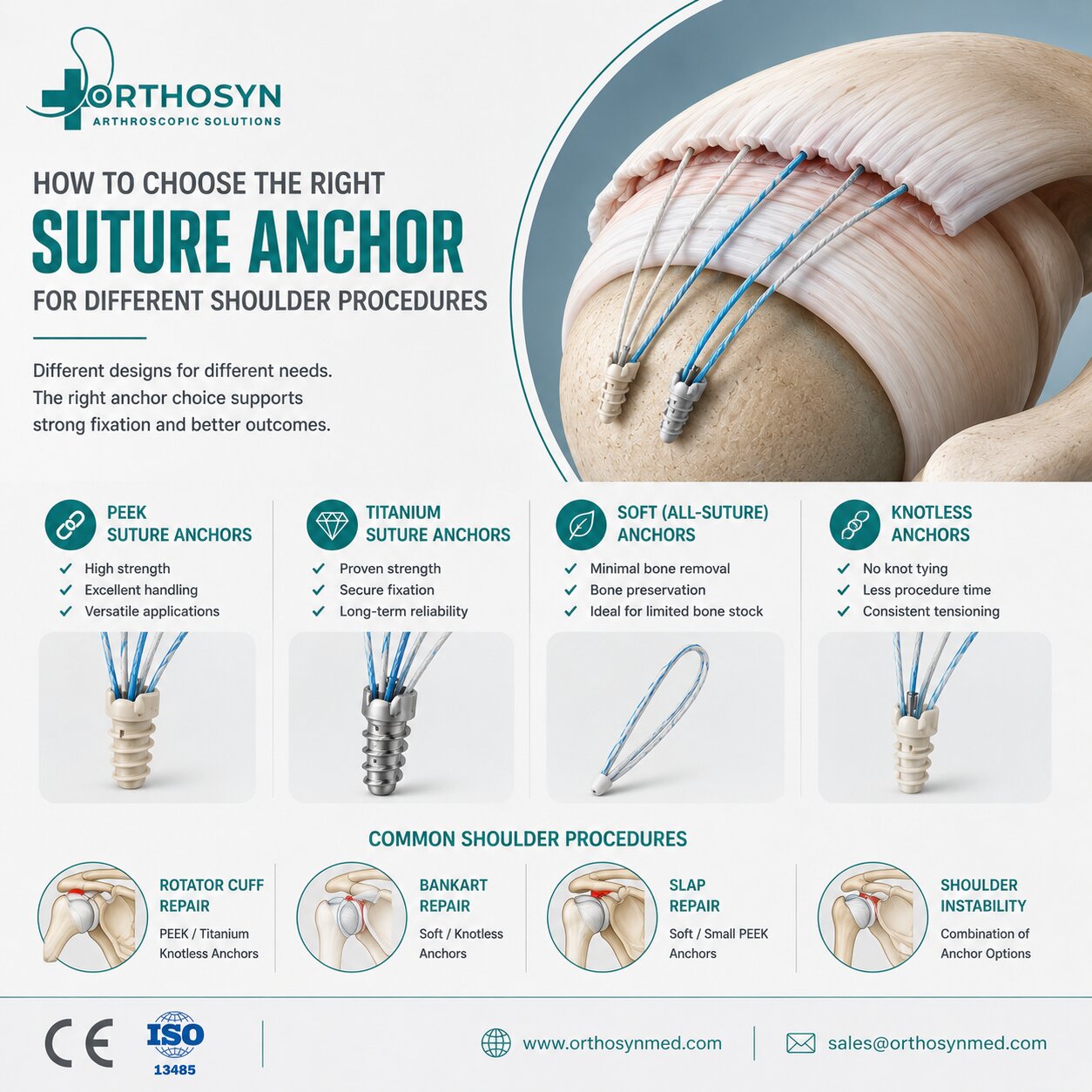
Suture anchors have become one of the most important implants in modern shoulder arthroscopy. They provide secure fixation between soft tissue and bone, enabling surgeons to repair damaged tendons and ligaments through minimally invasive techniques.
Today, surgeons can choose from various anchor designs, materials, and fixation mechanisms. Understanding when to use each type is essential for achieving reliable fixation and optimizing surgical outcomes.
No single suture anchor is ideal for every clinical situation. The choice depends on several factors, including:
Selecting the appropriate anchor helps improve fixation stability, surgical efficiency, and long-term repair integrity.
PEEK (Polyether Ether Ketone) anchors are widely used because of their excellent mechanical strength and dimensional stability.
Advantages include:
PEEK anchors are frequently used in rotator cuff repairs and shoulder instability surgery.
Titanium anchors have been used successfully for many years and remain a trusted option in shoulder arthroscopy.
Benefits include:
Titanium anchors continue to be preferred in selected clinical cases where maximum mechanical strength is desired.
Soft anchors consist primarily of high-strength suture material rather than a rigid implant body.
Their advantages include:
Soft anchors are commonly selected for labral repair and shoulder instability procedures.
Knotless technology eliminates the need for arthroscopic knot tying.
Potential benefits include:
These systems are increasingly popular for rotator cuff repair and Bankart reconstruction.
Rotator cuff repair often requires strong fixation capable of resisting cyclic loading during tendon healing.
Commonly used options include:
Labral repair procedures typically prioritize minimal bone removal and accurate soft tissue fixation.
Soft anchors and knotless anchors are frequently selected.
SLAP lesions require secure fixation while preserving surrounding anatomy.
Soft anchors and small-diameter PEEK anchors are commonly preferred.
Depending on patient anatomy and tissue quality, surgeons may combine different anchor types to optimize fixation.
Besides implant design, surgeons also consider:
Every repair should be individualized according to the patient's anatomy and surgical objectives.
Orthosyn Medikal provides a comprehensive portfolio of shoulder fixation systems designed to support modern arthroscopic procedures.
The portfolio includes:
These products allow surgeons to select the most appropriate fixation solution for each clinical indication while maintaining surgical efficiency and reliable soft tissue fixation.
Selecting the appropriate suture anchor is an important part of successful shoulder arthroscopy. Every implant design offers unique advantages depending on the clinical indication, tissue quality, and surgical goals.
By understanding the characteristics of different anchor systems and matching them to each procedure, surgeons can optimize fixation, improve workflow, and support successful patient outcomes.