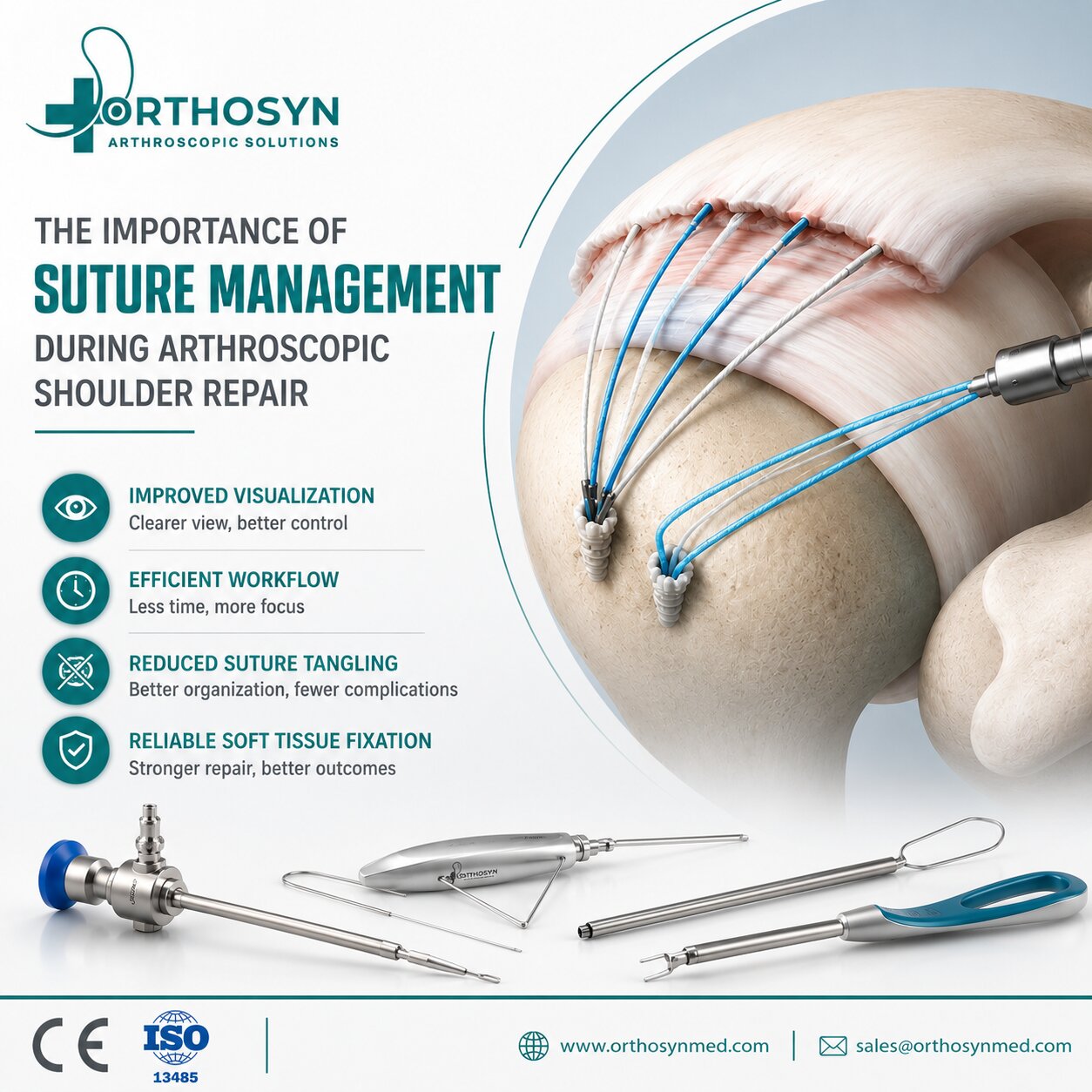
Shoulder arthroscopy has become the gold standard for treating a wide range of conditions, including rotator cuff tears, labral injuries, and shoulder instability. While implant technology has advanced significantly over the years, successful outcomes depend not only on the quality of implants but also on efficient suture management throughout the procedure.
Poor suture organization can increase operative time, create unnecessary complications, and make technically demanding procedures even more challenging. Effective suture management allows surgeons to maintain a clear surgical field, improve workflow, and reduce the risk of technical errors.
Modern shoulder arthroscopy often requires multiple anchors, several suture limbs, and various arthroscopic instruments to be used simultaneously. As the number of sutures increases, the possibility of tangling, twisting, or crossing also rises.
Without an organized approach, surgeons may spend valuable operative time identifying individual sutures instead of focusing on tissue repair.
Good suture management contributes to:
Several situations may complicate suture handling during surgery:
Large rotator cuff tears frequently require several anchors. Managing numerous suture limbs can become increasingly difficult if each strand is not properly organized.
The confined space inside the shoulder joint leaves little room for unnecessary instrument movement or misplaced sutures.
Frequent changes between graspers, suture passers, retrievers, and cutters may increase procedure time if sutures are not clearly separated.
Crossed or twisted sutures can complicate knot tying or tensioning, potentially affecting repair quality.
Following the same repair sequence during every procedure helps minimize confusion and reduces the likelihood of crossing sutures.
After each anchor deployment, identify and separate individual suture limbs before proceeding to the next step.
Arthroscopic cannulas help maintain portal organization while protecting soft tissues and preventing sutures from becoming trapped within portal edges.
Reducing unnecessary instrument exchanges helps preserve visualization and decreases the risk of accidental suture entanglement.
Keeping all active sutures visible throughout the procedure enables early identification of potential problems before they become significant.
Today's arthroscopic instruments are specifically designed to simplify suture management.
Devices such as:
all contribute to creating a more organized and efficient surgical workflow.
Knotless anchor systems further reduce procedural complexity by eliminating knot tying in selected repair techniques while maintaining secure fixation.
Proper suture management may provide several advantages:
Although surgical skill remains the primary determinant of success, organized suture handling supports more consistent outcomes.
Orthosyn Medikal offers a comprehensive arthroscopy portfolio designed to facilitate efficient shoulder repair procedures.
The portfolio includes:
These products are developed to help surgeons perform modern arthroscopic procedures with precision, reliability, and efficiency.
Successful shoulder arthroscopy depends on much more than implant selection alone. Proper suture management plays a vital role in maintaining workflow, reducing technical challenges, and improving overall procedural efficiency.
By combining careful surgical technique with well-designed arthroscopic instruments, surgeons can optimize both the surgical experience and patient outcomes.