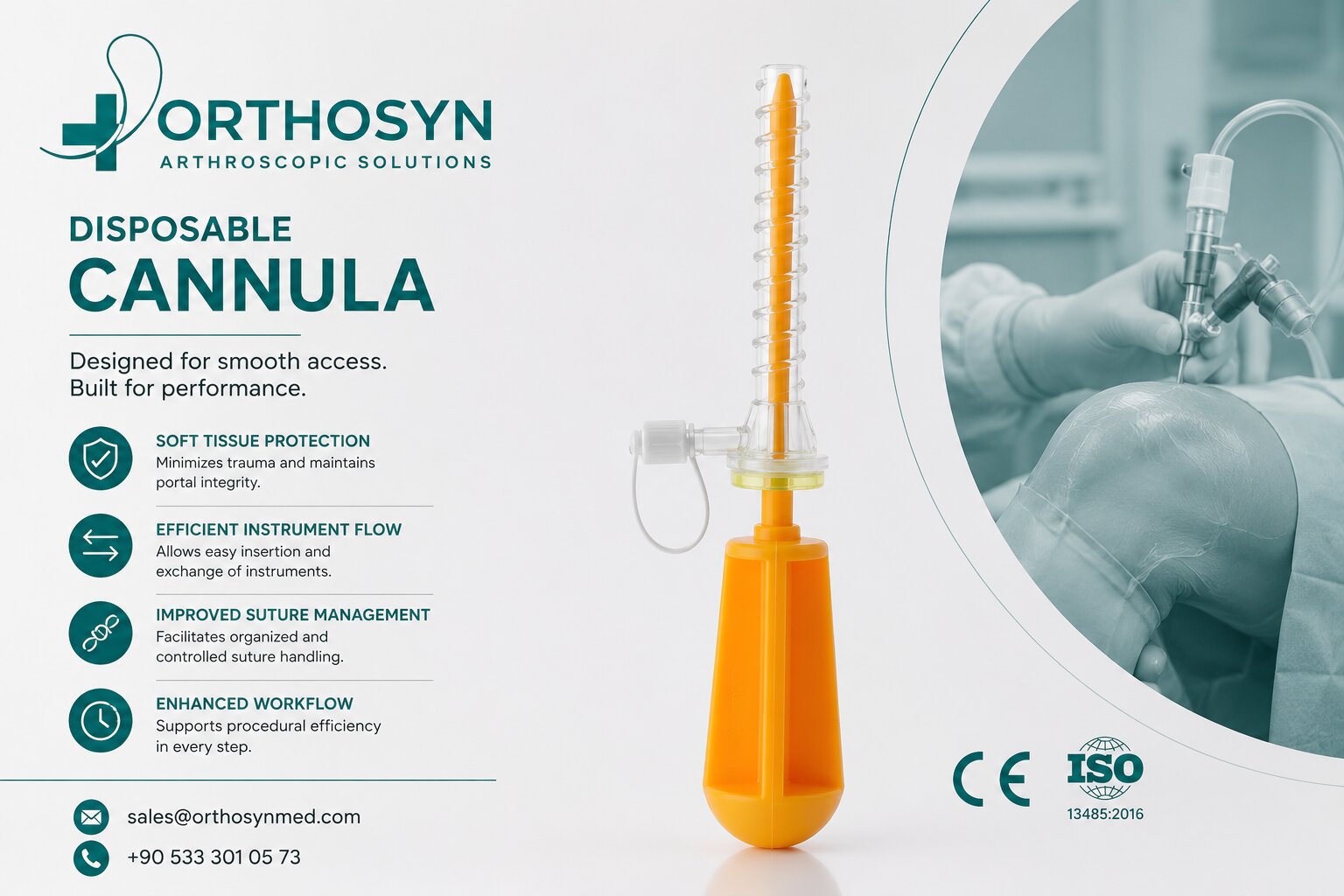
Shoulder arthroscopy relies on precision, visualization, and efficient instrument management. While implants such as anchors often receive most of the attention, arthroscopic cannulas play an equally important role in facilitating safe and efficient surgical procedures.
Cannulas act as working channels that allow repeated insertion and removal of instruments while protecting surrounding soft tissues and maintaining portal integrity throughout the procedure.
Today, disposable arthroscopic cannulas are considered standard equipment in many shoulder arthroscopy procedures.
An arthroscopic cannula is a sterile tubular device inserted through an arthroscopic portal.
It creates a protected pathway for surgical instruments and sutures to pass into and out of the joint.
Cannulas are commonly manufactured from medical-grade polymer materials and are available in different diameters and lengths depending on the surgical application.
Without a cannula, repeated instrument exchanges may:
Cannulas help create a stable working portal throughout the procedure.
Cannulas allow smooth insertion and removal of arthroscopic instruments.
They minimize repeated trauma to muscles, capsule, and skin around the portal.
Cannulas help organize multiple sutures during complex repairs such as rotator cuff reconstruction.
By providing a dedicated working channel, cannulas reduce friction during instrument exchange.
Well-positioned cannulas simplify workflow and improve procedural consistency.
Arthroscopic cannulas are routinely used in:
Different portal locations may require different cannula diameters depending on the instruments being used.
Selection depends on several factors:
Larger cannulas may facilitate complex suture management, while smaller cannulas can be appropriate for diagnostic or less demanding procedures.
Orthosyn Medikal offers disposable arthroscopic cannulas developed for modern shoulder surgery.
Available in multiple sizes, including 6.5 mm and 8.5 mm, these cannulas are designed to support efficient instrument exchange, reliable suture management, and minimally invasive arthroscopic techniques.
Although often overlooked, arthroscopic cannulas are essential components of successful shoulder arthroscopy.
By improving instrument access, protecting soft tissues, and simplifying suture management, they contribute to safer and more efficient procedures.
Selecting the appropriate cannula according to the surgical technique helps optimize workflow and supports high-quality arthroscopic surgery.