Rotator cuff tears are among the most common shoulder injuries treated by orthopedic surgeons. Advances in arthroscopic techniques have significantly improved repair strategies, not only through implant innovations but also through the evolution of suture materials.
One of the most important developments has been the introduction of suture tape, a broad, flat, high-strength suture designed to distribute forces more evenly across repaired tissue.
Today, suture tape is widely used in modern rotator cuff repair because it combines excellent mechanical strength with improved tissue compression.
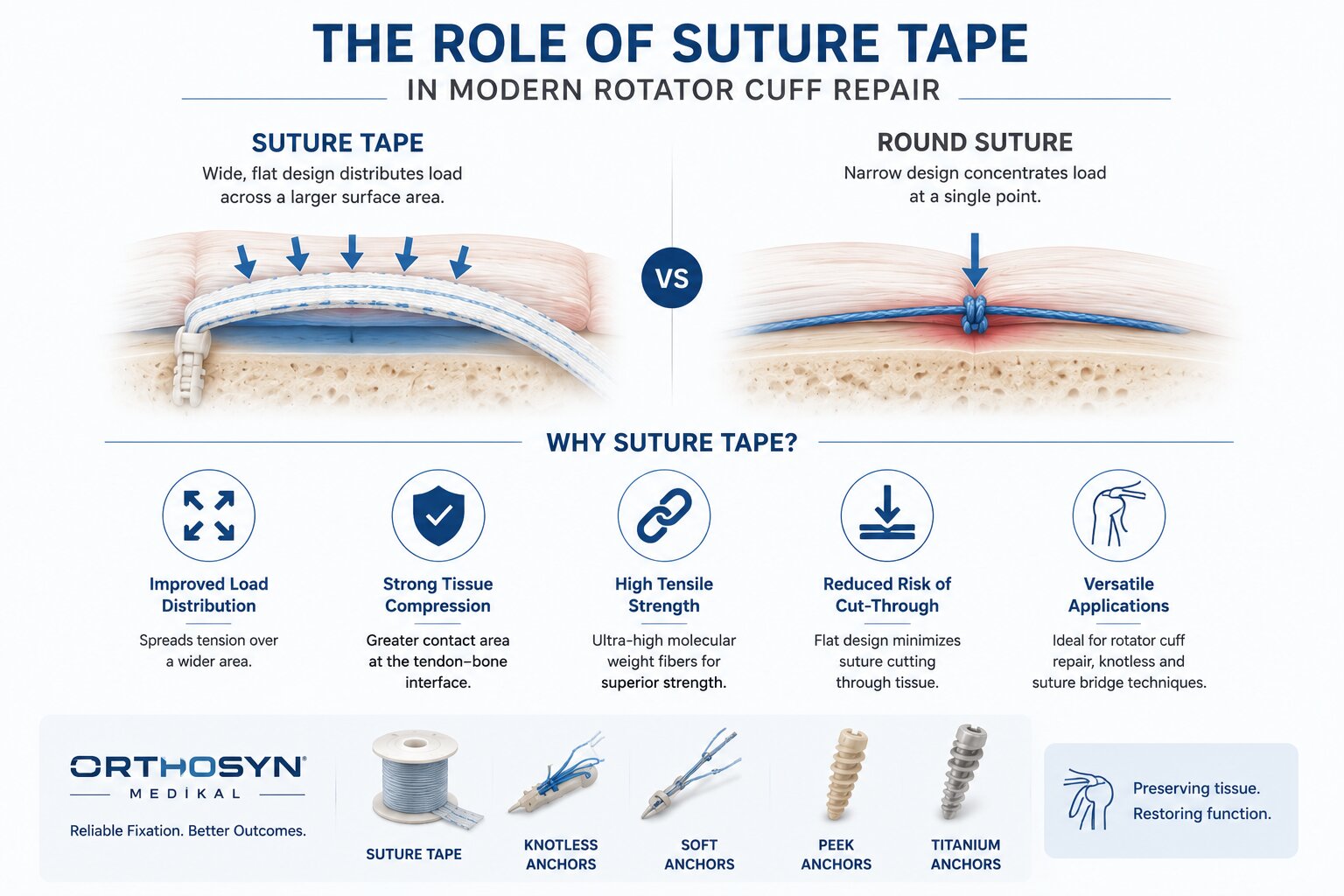
Unlike conventional round sutures, suture tape has a wider, flat profile.
This design increases the contact surface between the suture and the tendon, allowing forces to be distributed over a larger area.
Rather than concentrating stress at a single point, suture tape helps reduce localized pressure on repaired tissue.
The broader profile spreads tension across the tendon, reducing stress concentration.
Suture tape creates a larger compression area between the tendon and bone footprint.
Modern ultra-high molecular weight polyethylene (UHMWPE) fibers provide excellent mechanical performance.
The flat design may reduce the possibility of the suture cutting through tendon tissue under load.
Suture tape is commonly used in:
Suture tape is frequently combined with knotless anchor systems.
Together they allow:
This combination has become increasingly popular in contemporary shoulder arthroscopy.
Selection depends on:
No single suture is ideal for every repair.
Orthosyn Medikal offers modern arthroscopic fixation systems including suture tape-compatible anchor solutions, soft anchors, PEEK anchors, titanium anchors and knotless anchors designed for shoulder reconstruction procedures.
These systems support reliable fixation while providing surgeons with flexibility for different repair techniques.
Suture tape has become an important component of modern rotator cuff repair by improving load distribution and tendon compression while maintaining excellent mechanical strength.
Combined with advanced anchor technologies, it contributes to reliable soft tissue fixation and supports contemporary arthroscopic repair techniques.