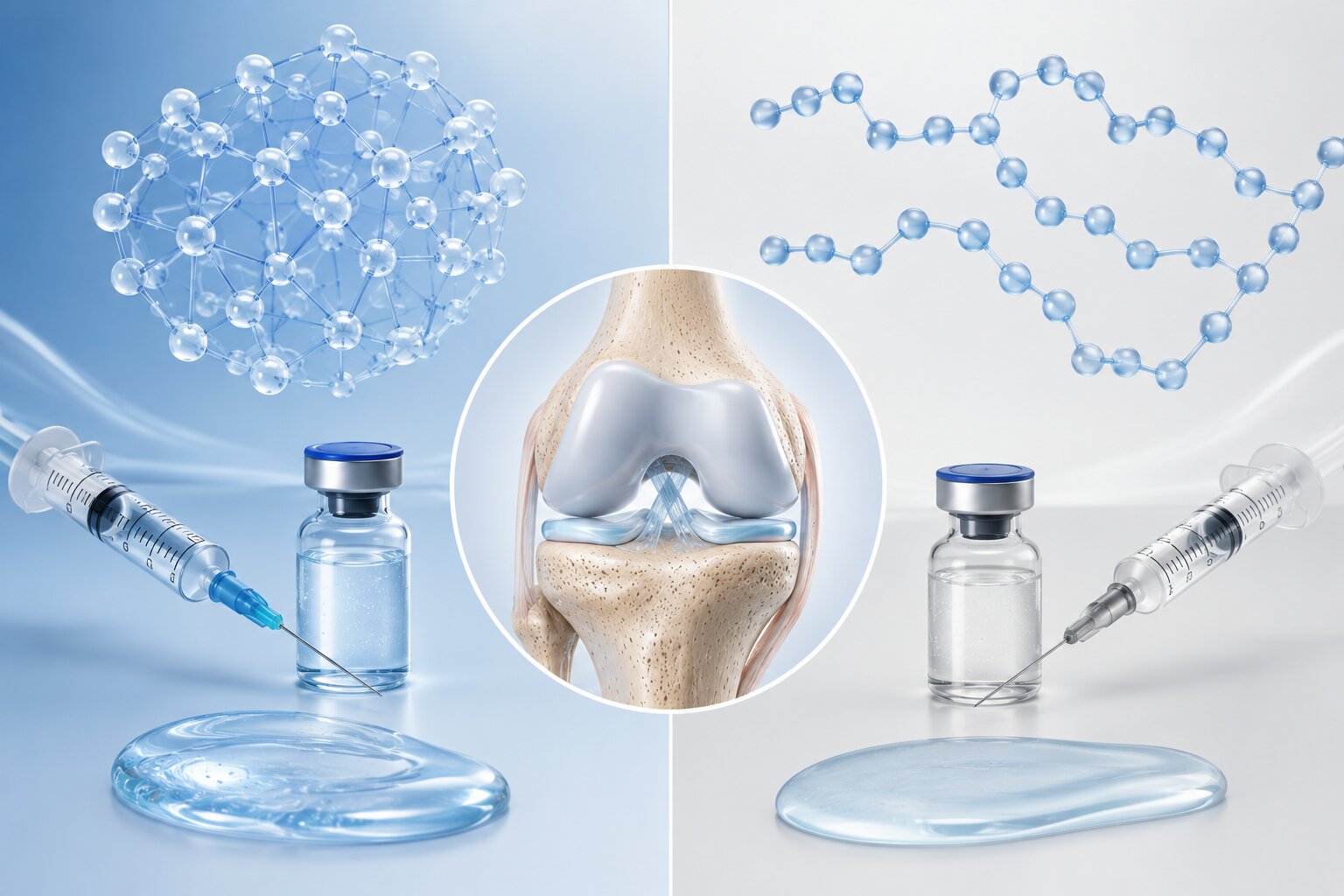
Hyaluronic acid injections have become one of the most widely used non-surgical treatment options for knee osteoarthritis. As viscosupplementation products have evolved, physicians can choose between cross-linked and non cross-linked (linear) formulations depending on the patient's clinical needs.
Although both products contain hyaluronic acid and aim to improve joint lubrication, their molecular structure, residence time within the joint, and clinical characteristics differ.
Understanding these differences helps physicians select the most appropriate treatment strategy for each patient.
Hyaluronic acid is a naturally occurring polysaccharide found in synovial fluid, cartilage, skin, and connective tissues.
Inside healthy joints, it performs several important functions:
In osteoarthritis, both the concentration and molecular quality of natural hyaluronic acid decrease, reducing the protective properties of synovial fluid.
Non cross-linked hyaluronic acid, also called linear hyaluronic acid, maintains its natural molecular structure.
After injection, it provides lubrication and improves the viscoelastic properties of synovial fluid.
Because it is not chemically cross-linked, it is gradually broken down by normal biological processes.
Linear formulations remain widely used in osteoarthritis management around the world.
Cross-linked hyaluronic acid undergoes a controlled manufacturing process in which individual HA chains are chemically connected to form a three-dimensional network.
This structure increases resistance to enzymatic degradation.
As a result, cross-linked formulations generally remain inside the joint longer than linear products.
Cross-linking helps the product resist degradation and remain within the joint for an extended period.
Many cross-linked products are designed to provide prolonged viscosupplementation after a single injection.
The three-dimensional network contributes to enhanced viscoelastic properties.
Many cross-linked formulations are administered as a single injection.
Treatment selection depends on several factors:
Both formulations continue to play important roles in modern osteoarthritis management.
Not necessarily.
While cross-linked formulations often remain in the joint longer, treatment success depends on many variables, including:
No single formulation is ideal for every patient.
Orthosyn Medikal offers both cross-linked and non cross-linked hyaluronic acid formulations developed for intra-articular viscosupplementation.
Available concentrations include:
These products are designed to support joint lubrication, reduce osteoarthritis symptoms, and provide physicians with flexible treatment options based on individual patient needs.
Both cross-linked and non cross-linked hyaluronic acid injections remain valuable treatment options for osteoarthritis.
Linear formulations closely resemble natural hyaluronic acid and have a long history of successful clinical use, while cross-linked formulations are designed to remain longer within the joint and may provide prolonged symptom relief.
The most appropriate product should always be selected according to the patient's clinical condition, physician assessment, and treatment goals.