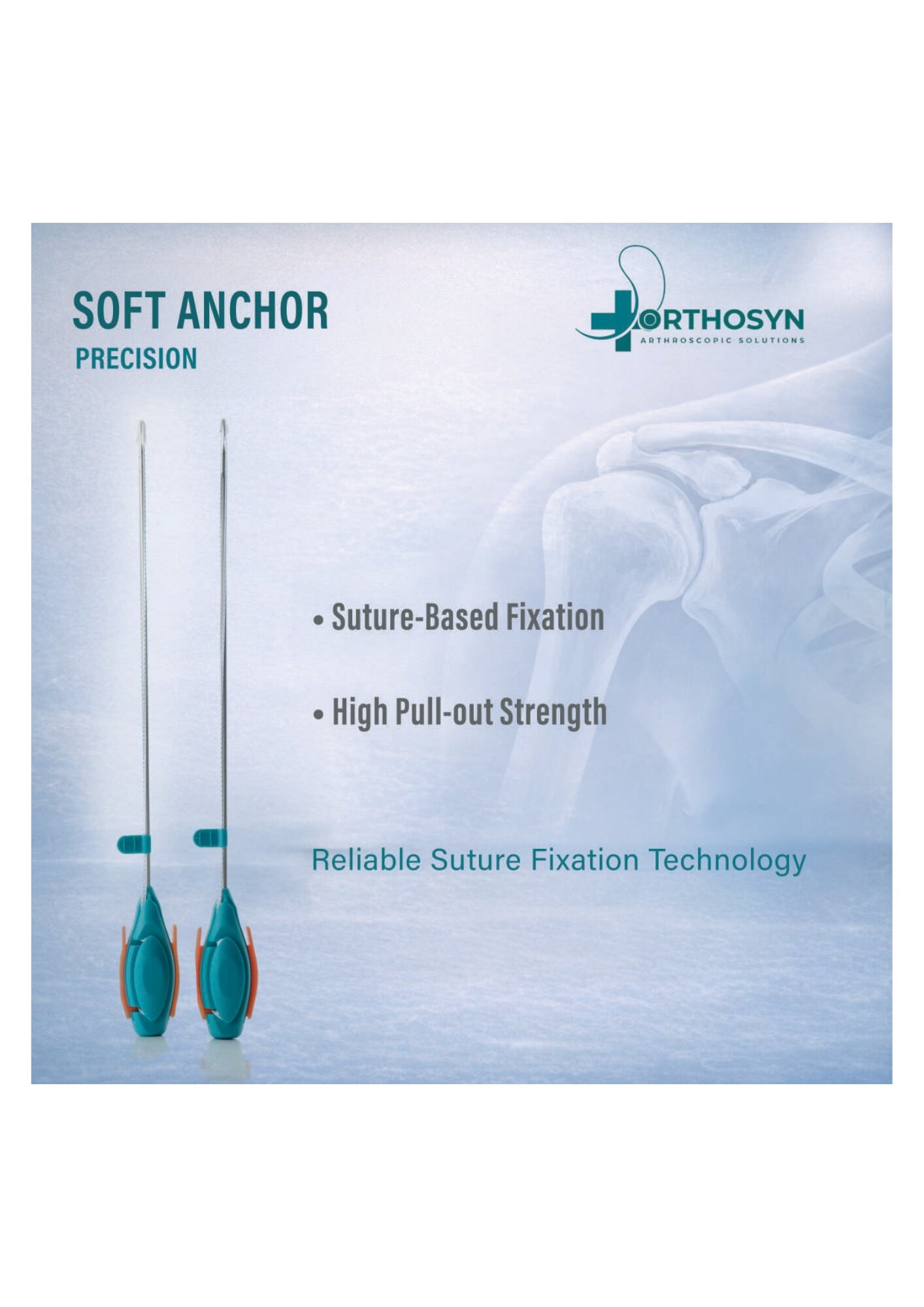
Over the last decade, shoulder arthroscopy has undergone remarkable advancements in both surgical techniques and implant technologies. One of the most significant developments has been the introduction of soft anchors, also known as all-suture anchors.
Traditional anchors manufactured from titanium or PEEK continue to play a major role in arthroscopic surgery. However, soft anchors have expanded the options available to surgeons by providing secure fixation while preserving more bone.
Rather than replacing conventional anchors, soft anchors have become an important addition to the surgeon's implant selection.
A soft anchor is an all-suture fixation device that contains no rigid metal or polymer body.
Instead, the implant consists of high-strength sutures that expand beneath the cortical bone after insertion, creating stable fixation.
Because only a very small drill hole is required, soft anchors remove considerably less bone than conventional anchor systems.
Traditional suture anchors typically consist of a solid implant body manufactured from materials such as:
These anchors are inserted into prepared bone tunnels and provide fixation by mechanical engagement with the surrounding bone.
They have been successfully used in shoulder surgery for many years.
One of the greatest advantages of soft anchors is the minimal amount of bone removal required during implantation.
Smaller drill holes help preserve bone stock, which may be particularly beneficial in revision surgery or in patients with limited bone quality.
Because soft anchors contain no rigid body, they occupy less space inside the bone.
This allows surgeons greater flexibility when placing multiple anchors close together.
Modern soft anchor systems have demonstrated excellent fixation strength in numerous biomechanical studies.
When properly implanted, they provide reliable soft tissue fixation for many shoulder procedures.
Soft anchors are commonly used in:
Traditional anchors continue to offer several important advantages.
Titanium and PEEK anchors have decades of documented clinical success.
Rigid anchor bodies provide highly predictable fixation characteristics.
Traditional anchors are available in numerous sizes, thread designs and configurations.
This allows surgeons to select implants based on specific surgical requirements.
Choosing between soft and traditional anchors depends on several considerations.
Poor bone quality may influence fixation strategy.
Large rotator cuff tears may require different fixation constructs than isolated labral lesions.
Bone preservation becomes increasingly important in revision procedures.
When multiple anchors must be inserted into a limited footprint, smaller drill diameters may offer advantages.
Ultimately, implant selection depends on the surgeon's experience and preferred surgical technique.
| Feature | Soft Anchor | Traditional Anchor |
|---|---|---|
| Bone Removal | Minimal | Greater |
| Implant Body | All-Suture | Titanium / PEEK / Bio |
| Drill Hole Size | Very Small | Larger |
| Bone Preservation | Excellent | Good |
| Mechanical Fixation | High | High |
| Revision Friendly | Excellent | Good |
Both systems provide secure fixation when used appropriately.
Orthosyn Medikal offers advanced Soft Anchor Systems designed for modern arthroscopic shoulder surgery.
These all-suture anchors are developed to provide reliable fixation while preserving bone stock through minimally invasive implantation.
Together with Orthosyn's portfolio of PEEK anchors, titanium anchors and knotless anchors, surgeons can select the most appropriate fixation system according to each clinical indication.
As arthroscopic surgery continues to evolve, implant design increasingly focuses on preserving anatomy while maintaining strong fixation.
Soft anchors represent this philosophy by minimizing bone removal without compromising fixation strength.
For many modern shoulder procedures, they have become an important component of the surgeon's implant arsenal.
Soft anchors have significantly expanded the available fixation options in shoulder arthroscopy.
Their ability to preserve bone, reduce implant size and provide reliable fixation makes them particularly valuable in labral repair, Bankart repair and selected rotator cuff procedures.
Traditional titanium and PEEK anchors continue to play a critical role, and both systems remain essential in modern shoulder surgery.
The ideal implant should always be selected according to patient anatomy, tissue quality, surgical objectives and surgeon experience.