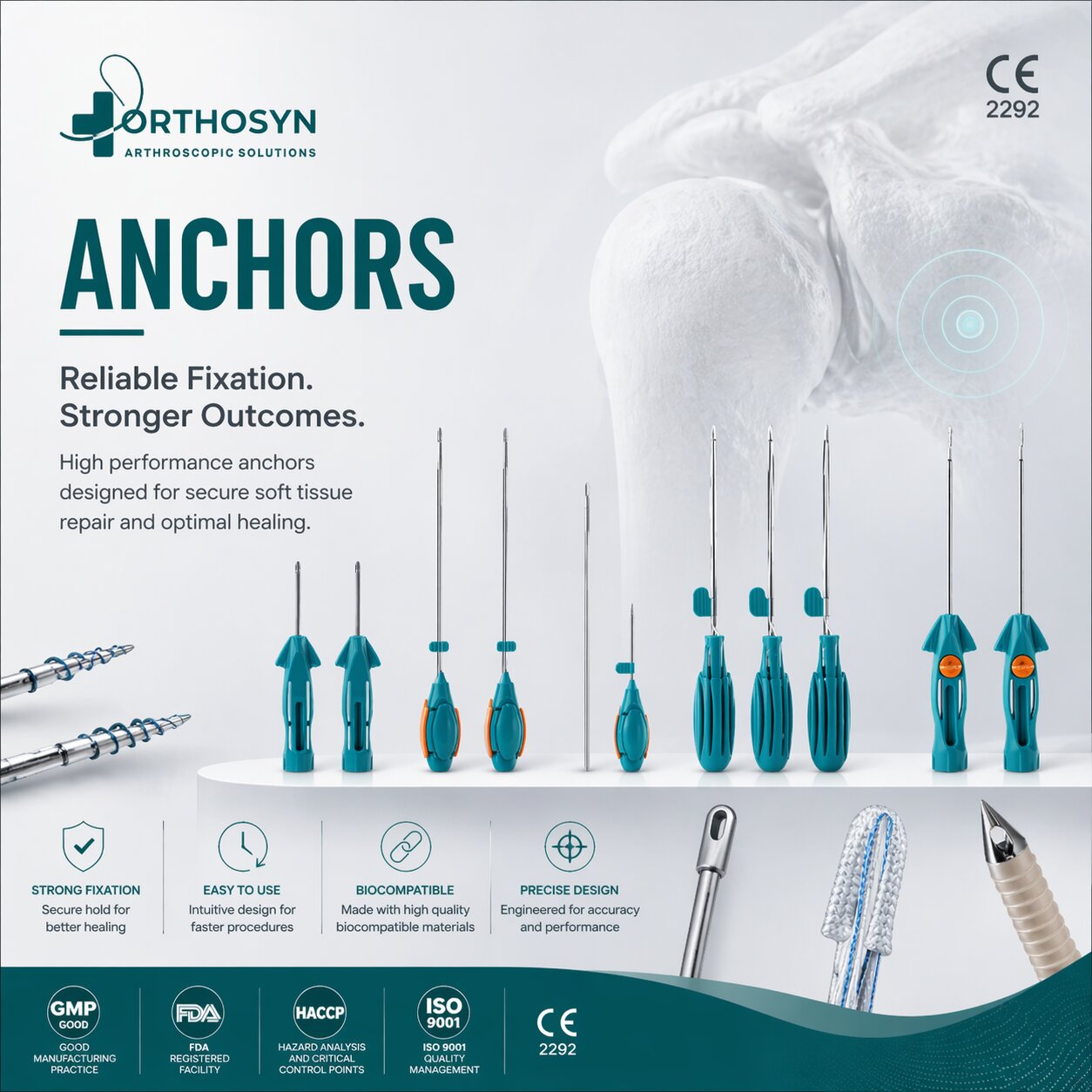
Suture anchors are among the most commonly used implants in arthroscopic shoulder surgery. Whether repairing a torn rotator cuff, stabilizing a Bankart lesion, or reconstructing soft tissues around the shoulder, reliable fixation is essential for successful healing.
Among the available anchor materials, PEEK (Polyether Ether Ketone) and Titanium remain two of the most widely used options. Both have proven clinical performance, but each offers different characteristics that may influence implant selection depending on the surgical procedure and surgeon preference.
Understanding the strengths of each material helps surgeons choose the most appropriate fixation solution.
Suture anchors are designed to secure soft tissue to bone.
They are commonly used in:
Their objective is to maintain tissue fixation until biological healing occurs.
PEEK is a high-performance medical polymer that has become increasingly popular in orthopedic surgery.
PEEK anchors provide excellent mechanical properties while remaining radiolucent, allowing postoperative imaging with minimal artifact.
Unlike bioabsorbable materials, PEEK does not degrade over time.
PEEK creates minimal imaging artifacts, allowing physicians to evaluate surrounding tissues more clearly.
The material provides reliable fixation throughout the healing process.
PEEK is biologically inert and well tolerated by surrounding tissues.
Because it does not degrade, the implant maintains its original structure over time.
Although highly successful, PEEK anchors remain permanently within the bone unless removed surgically.
Revision surgery may therefore require implant management depending on the clinical situation.
Titanium has been used successfully in orthopedic implants for decades.
Its outstanding mechanical properties and extensive clinical history make it one of the most trusted implant materials in shoulder surgery.
Titanium anchors have demonstrated excellent long-term outcomes across numerous shoulder procedures.
Titanium provides extremely high fixation strength.
The material maintains its structural integrity for many years.
Because titanium anchors have been used for decades, surgeons are highly familiar with their handling characteristics.
Modern titanium anchors are highly effective, but metallic implants may generate imaging artifacts during MRI evaluation.
Although these artifacts are generally manageable, imaging characteristics may influence implant selection in certain clinical situations.
| Feature | PEEK | Titanium |
|---|---|---|
| Material | Medical Polymer | Titanium Alloy |
| MRI Compatibility | Excellent | Good |
| Imaging Artifact | Minimal | Possible |
| Mechanical Strength | High | Very High |
| Biocompatibility | Excellent | Excellent |
| Long-Term Stability | Excellent | Excellent |
There is no universally superior material.
Selection depends on:
Both PEEK and titanium anchors continue to play an important role in modern shoulder arthroscopy.
Orthosyn Medikal offers a comprehensive range of arthroscopic fixation systems including:
These implants are developed to support reliable fixation in modern shoulder arthroscopy and sports medicine procedures.
Both PEEK and titanium suture anchors have demonstrated excellent clinical performance in arthroscopic shoulder surgery.
PEEK offers outstanding imaging compatibility and long-term dimensional stability, while titanium provides exceptional mechanical strength backed by decades of clinical experience.
The optimal choice depends on patient-specific factors, surgical objectives, and the surgeon's preferred repair technique.