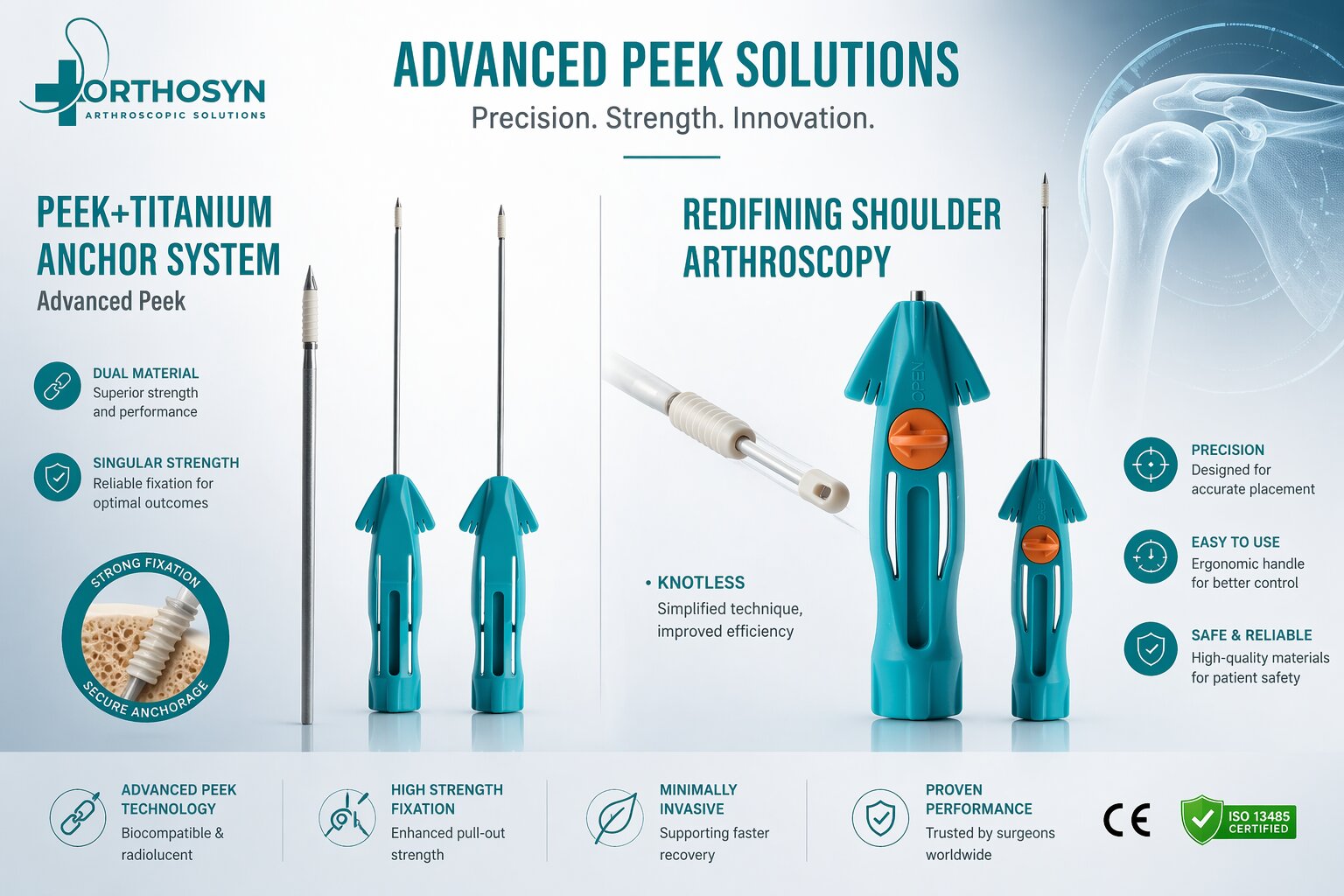
Shoulder arthroscopy has evolved significantly over the past two decades. Improvements in surgical techniques, visualization systems, and implant technologies have enabled orthopedic surgeons to perform increasingly complex procedures through minimally invasive approaches.
Among these innovations, knotless anchor systems have become one of the most important advancements in soft tissue fixation. By eliminating the need for arthroscopic knot tying, these implants simplify surgical workflows while maintaining secure fixation for a wide range of shoulder procedures.
Today, knotless anchors are widely used in rotator cuff repair, Bankart repair, SLAP repair, and shoulder instability surgery.
A knotless anchor is a suture anchor that secures soft tissue to bone without requiring arthroscopic knots.
Instead of tying multiple knots after passing the sutures through the tissue, the suture is tensioned and locked directly within the anchor.
This design allows surgeons to obtain stable fixation while reducing the technical complexity of the procedure.
Traditional arthroscopic repairs require multiple knot-tying steps.
Although effective, arthroscopic knot tying can be technically demanding and may:
Knotless technology was developed to address these challenges while maintaining reliable fixation.
The elimination of arthroscopic knot tying allows a more streamlined surgical workflow.
This can be especially beneficial during complex repairs involving multiple anchors.
Because knots do not need to be tied, many procedures can be completed more efficiently.
Shorter operative time may contribute to improved operating room efficiency.
The surgeon can adjust tissue tension before locking the suture inside the anchor.
This allows a more reproducible repair construct.
Traditional knot stacks may occasionally create irritation beneath surrounding tissues.
Knotless systems eliminate this concern by removing external knots.
Modern knotless anchor designs provide reliable fixation suitable for many shoulder reconstruction procedures.
Knotless anchors are widely used in:
Providing tendon fixation while simplifying double-row and suture bridge techniques.
Allowing secure labral fixation during shoulder instability surgery.
Supporting fixation of the superior labrum when clinically indicated.
Helping restore capsular stability.
Selection depends on several variables:
No single implant is ideal for every patient.
| Feature | Knotless Anchors | Traditional Anchors |
|---|---|---|
| Arthroscopic Knot Tying | Not Required | Required |
| Surgical Workflow | Simplified | More Complex |
| Operative Time | Often Shorter | Often Longer |
| Suture Tension Adjustment | Easy | Technique Dependent |
| Knot Stack | None | Present |
Both systems remain valuable, and implant selection should be individualized according to the clinical situation.
Orthosyn Medikal offers knotless anchor systems developed for modern arthroscopic shoulder surgery.
Designed to support reliable soft tissue fixation, these implants are suitable for procedures such as rotator cuff repair, Bankart repair, and shoulder instability reconstruction.
Together with Orthosyn's portfolio of soft anchors, PEEK anchors, and titanium anchors, knotless systems provide surgeons with multiple fixation options for different surgical techniques.
As arthroscopic technology continues to evolve, surgeons increasingly seek implants that improve efficiency while maintaining reliable clinical performance.
Knotless anchor systems represent an important step toward simplified procedures, reproducible fixation, and minimally invasive soft tissue repair.
Knotless anchors have transformed many aspects of modern shoulder arthroscopy by eliminating one of the most technically demanding parts of arthroscopic surgery.
Their ability to provide secure fixation while simplifying the procedure has made them an increasingly popular choice in rotator cuff repair, Bankart repair, and other shoulder stabilization procedures.
When selected appropriately, knotless anchor systems contribute to efficient surgery and dependable fixation while supporting contemporary arthroscopic techniques.