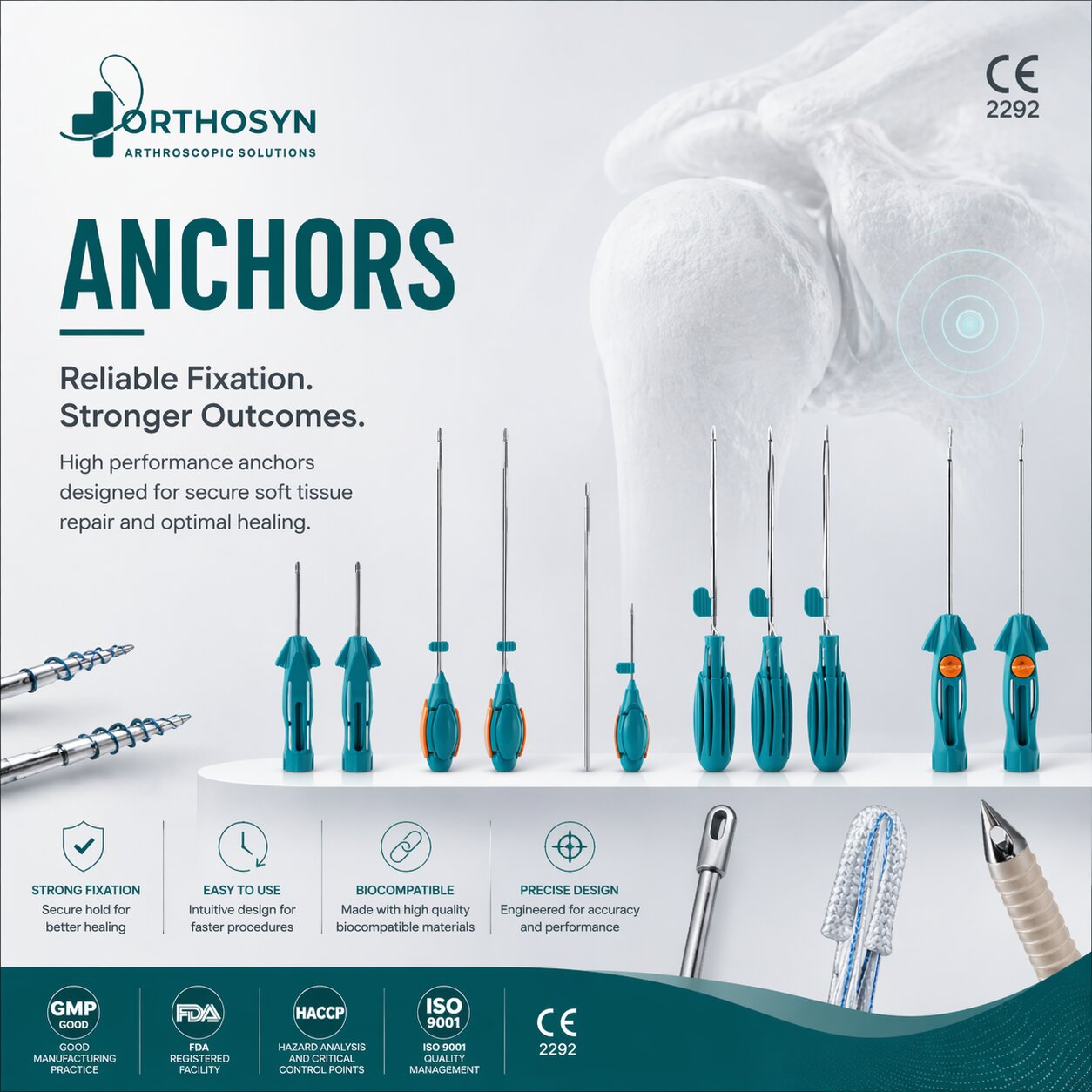
Suture anchors are among the most frequently used implants in shoulder arthroscopy. They are essential for procedures such as rotator cuff repair, Bankart repair, SLAP repair, and other soft tissue reconstructions where secure fixation between tendon or labrum and bone is required.
With the continuous evolution of arthroscopic surgery, surgeons can now choose from several anchor designs and materials. Soft anchors, PEEK anchors, titanium anchors, and knotless anchors each provide specific advantages depending on the clinical situation.
Selecting the appropriate anchor is not simply a matter of preference. Factors such as bone quality, tear configuration, tissue quality, surgical technique, and surgeon experience all influence the ideal implant choice.
Suture anchors are designed to reattach soft tissue to bone during arthroscopic procedures.
They are commonly used for:
Their primary objective is to provide immediate fixation while biological healing occurs.
Soft anchors are all-suture fixation systems that require minimal bone removal during implantation.
Advantages include:
Soft anchors are frequently preferred for labral repair and selected rotator cuff procedures.
PEEK anchors are manufactured from Polyether Ether Ketone, a high-performance medical polymer.
Advantages include:
PEEK anchors are commonly selected for rotator cuff repair and shoulder instability procedures.
Titanium anchors have been used successfully in orthopedic surgery for decades.
Benefits include:
They remain one of the preferred options in many shoulder reconstruction procedures.
Knotless anchor systems eliminate the need for arthroscopic knot tying.
Benefits include:
These systems are increasingly used in modern rotator cuff repair techniques.
Several variables should be considered:
Poor bone quality may require anchors with greater pull-out resistance.
Massive rotator cuff tears may benefit from different fixation strategies than small labral lesions.
Degenerated tendon tissue may require stronger fixation constructs.
Single-row, double-row and suture bridge repairs may require different anchor combinations.
Experience with a particular implant system often influences final implant selection.
Orthosyn Medikal offers a comprehensive range of arthroscopic fixation solutions including:
Each system is developed to support modern shoulder arthroscopy and sports medicine procedures while providing secure soft tissue fixation.
No single suture anchor is ideal for every clinical situation.
Soft anchors preserve bone stock, PEEK anchors provide excellent imaging compatibility, titanium anchors deliver long-term mechanical reliability, and knotless anchors simplify surgical workflow.
Selecting the most appropriate implant requires careful evaluation of the patient's anatomy, tissue quality, surgical goals, and surgeon preference.
Modern arthroscopic surgery benefits from having multiple fixation options available to optimize clinical outcomes.