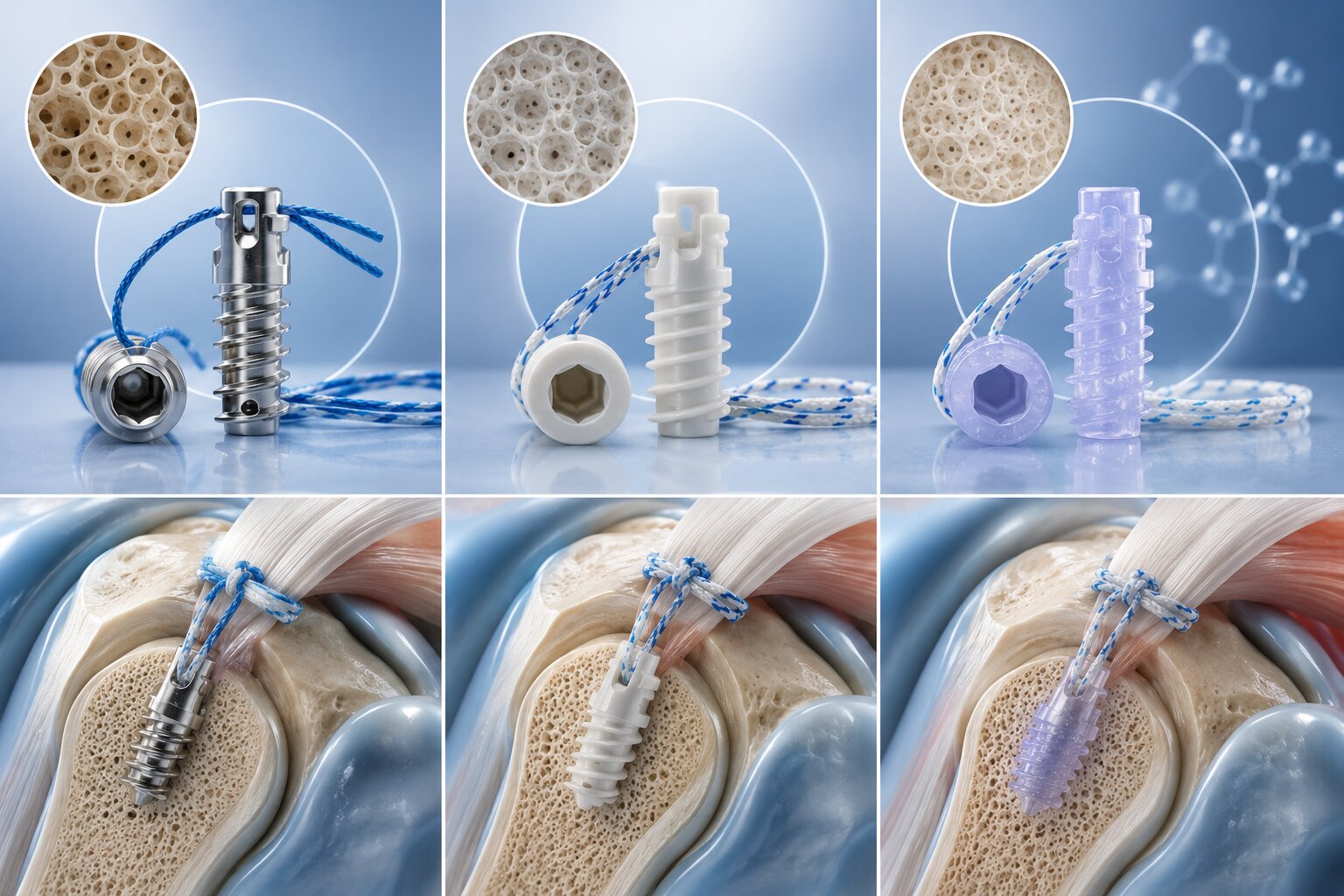
Interference screws are among the most important fixation devices used in modern arthroscopic ligament reconstruction procedures. Whether performing an ACL reconstruction, PCL reconstruction, or other tendon fixation procedures, the choice of interference screw can significantly influence surgical handling, fixation stability, imaging characteristics, and future revision options.
Today, two of the most commonly used materials are bioabsorbable polymers and PEEK (Polyether Ether Ketone). Each offers distinct advantages and potential limitations. Understanding these differences helps surgeons select the most appropriate solution for each clinical situation.
An interference screw is designed to secure a tendon graft within a bone tunnel. During ACL or PCL reconstruction, the graft is positioned inside tunnels drilled into the femur and tibia. The interference screw compresses the graft against the tunnel wall, creating immediate fixation and allowing biological incorporation during healing.
Interference screws are widely used in:
Bioabsorbable interference screws are manufactured from biodegradable polymers such as PLDLLA or bio-composite materials containing β-TCP.
These implants provide mechanical fixation during the critical healing period and gradually degrade over time.
The degradation process allows the implant to be replaced by biological tissue, eliminating the presence of permanent hardware.
The screw gradually resorbs after fulfilling its fixation function.
Many surgeons prefer avoiding permanent implants, particularly in younger patients.
Bioabsorbable materials generally create minimal interference during MRI evaluation.
Certain bio-composite materials may support bone remodeling during degradation.
Although highly successful, bioabsorbable implants may present certain considerations:
PEEK (Polyether Ether Ketone) is a high-performance medical-grade polymer widely used in orthopedic implants.
Unlike bioabsorbable screws, PEEK implants do not degrade. They remain permanently within the bone unless surgically removed.
PEEK has gained popularity because it combines excellent mechanical strength with favorable imaging properties.
PEEK provides consistent fixation strength throughout the healing process.
The material is biologically inert and well tolerated by surrounding tissues.
PEEK does not create significant imaging artifacts and allows postoperative evaluation of graft position and tunnel healing.
Because the material does not degrade, it maintains its original strength and dimensions indefinitely.
Possible considerations include:
However, many surgeons consider these characteristics advantages due to predictable long-term stability.
| Feature | Bioabsorbable | PEEK |
|---|---|---|
| Material Degradation | Yes | No |
| Permanent Implant | No | Yes |
| Mechanical Stability | High | High |
| MRI Compatibility | Excellent | Excellent |
| Revision Visibility | Lower | Higher |
| Biological Resorption | Yes | No |
| Long-Term Hardware Presence | None | Permanent |
There is no universally superior choice.
The ideal implant depends on:
Many surgeons prefer bioabsorbable screws for younger patients and primary reconstructions, while others favor PEEK due to its predictable mechanical stability and long-term performance.
Both materials have demonstrated excellent clinical outcomes when used appropriately.
Orthosyn Medikal offers a complete range of interference screw solutions for arthroscopic ligament reconstruction procedures.
Available options include:
These systems are designed to support reliable graft fixation in ACL and PCL reconstruction procedures while meeting the demands of modern sports medicine surgery.
Both bioabsorbable and PEEK interference screws remain excellent options for ligament reconstruction procedures.
Bioabsorbable screws offer temporary fixation with gradual resorption, while PEEK screws provide permanent structural stability and long-term predictability.
The optimal choice depends on patient-specific factors, surgical objectives, and surgeon preference. Understanding the characteristics of each material allows for informed decision-making and successful surgical outcomes.