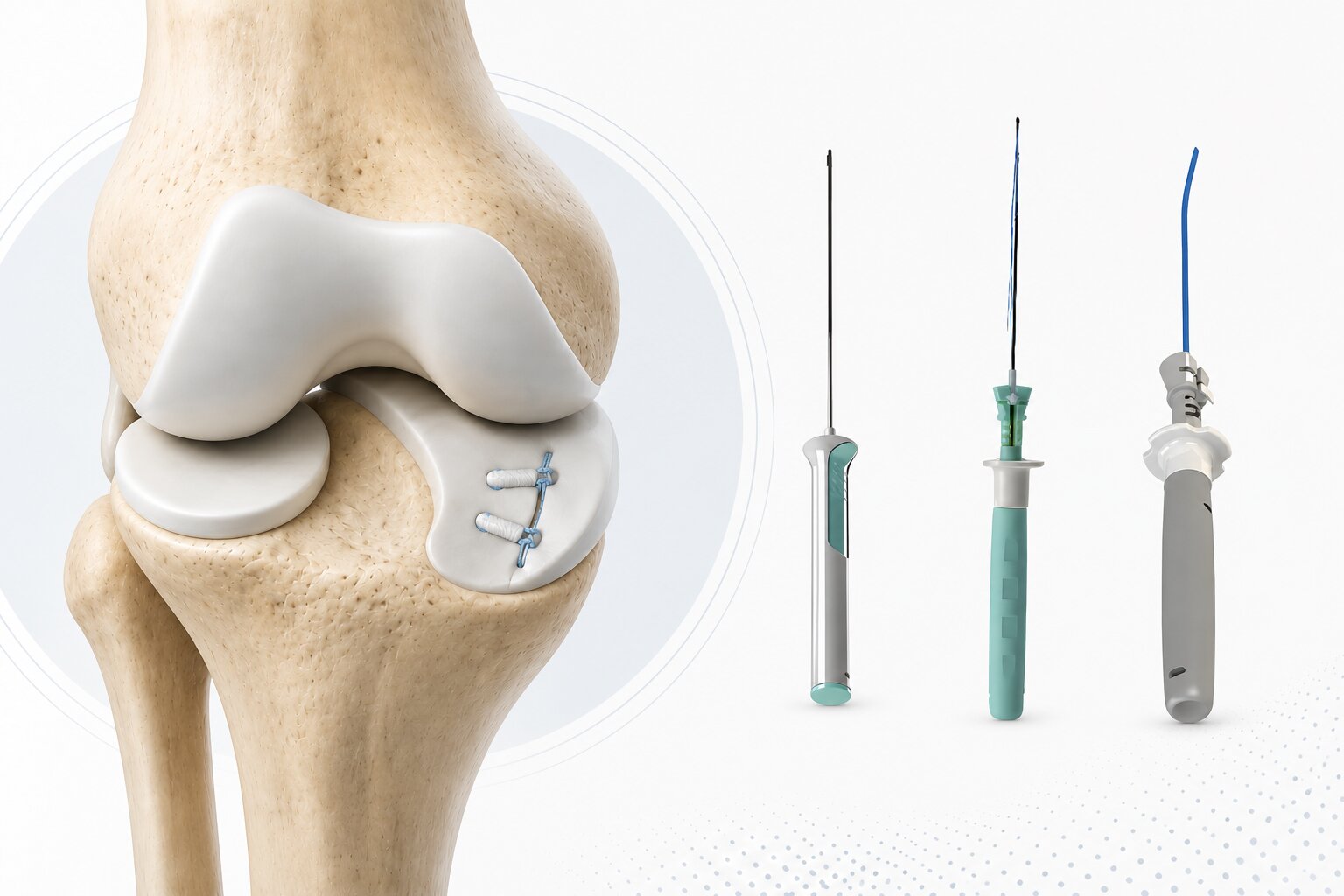
Meniscal preservation has become one of the primary goals of modern orthopedic surgery. As our understanding of knee biomechanics continues to evolve, surgeons increasingly focus on repairing the meniscus whenever possible rather than removing damaged tissue.
Among the available repair methods, the all-inside meniscal repair technique has become one of the most widely used procedures in arthroscopic knee surgery.
Its popularity is driven by advances in implant design, simplified surgical workflow, and improved patient outcomes.
The meniscus plays a critical role in maintaining healthy knee function.
Its responsibilities include:
When meniscal tissue is removed, the knee experiences increased contact pressure between cartilage surfaces.
This may contribute to:
For this reason, modern surgeons attempt to preserve meniscal tissue whenever clinically feasible.
All-inside meniscal repair is an arthroscopic technique in which both fixation implants remain entirely within the joint.
Unlike traditional repair methods that require additional incisions outside the joint capsule, all-inside systems allow fixation through standard arthroscopic portals.
Modern devices typically use:
This simplifies the procedure while maintaining secure fixation.
Historically, meniscal repair was performed using:
Long considered the gold standard.
Advantages:
Limitations:
Often used for anterior horn tears.
Advantages:
Limitations:
Developed to reduce surgical complexity while maintaining effective fixation.
Today, it is one of the most commonly used meniscal repair techniques worldwide.
The technique is performed through standard arthroscopic portals.
This reduces:
Modern all-inside systems are designed for efficient deployment.
This can shorten procedure duration and improve operating room efficiency.
Traditional inside-out repairs require needles to exit the joint capsule.
All-inside systems minimize this requirement and may reduce the risk of injury to surrounding structures.
Modern implants allow surgeons to achieve consistent fixation with simplified instrumentation.
This improves procedural reproducibility.
Smaller incisions and reduced tissue trauma may contribute to a smoother postoperative recovery process.
All-inside repair may be appropriate for:
Particularly those located in vascular regions.
One of the most common indications.
Modern devices provide excellent access to posterior meniscal lesions.
Especially in younger and active patients.
Successful healing depends on several variables.
Tears located in the vascular red-red zone generally have better healing potential.
Simple longitudinal tears often respond better than complex degenerative tears.
Younger patients frequently demonstrate higher healing rates.
Meniscal repairs performed together with ACL reconstruction often show improved healing environments.
Regardless of technique, stable fixation remains essential.
The repair must:
Modern all-inside devices are designed specifically to achieve these goals.
All-inside systems offer several practical benefits:
These advantages have contributed significantly to widespread adoption.
Patients may benefit from:
Orthosyn Medikal provides all-inside meniscal repair systems designed for modern arthroscopic knee surgery.
The Orthosyn Meniscal Repair System supports secure fixation while maintaining a minimally invasive surgical approach.
Designed for arthroscopic procedures, these systems help surgeons perform reliable meniscal preservation techniques during sports medicine and knee reconstruction surgeries.
| Feature | All-Inside Repair | Partial Meniscectomy |
|---|---|---|
| Meniscus Preservation | Yes | No |
| Long-Term Joint Protection | Higher | Lower |
| Osteoarthritis Risk | Lower | Higher |
| Tissue Removal | Minimal | Required |
| Recovery Time | Longer | Shorter |
| Biological Healing | Required | Not Required |
The all-inside meniscal repair technique has transformed modern meniscus surgery.
By combining minimally invasive arthroscopy with reliable fixation technology, surgeons can preserve meniscal tissue more effectively while reducing surgical complexity.
As the orthopedic community continues to prioritize joint preservation, all-inside repair remains one of the most valuable tools for treating meniscal injuries and protecting long-term knee health.