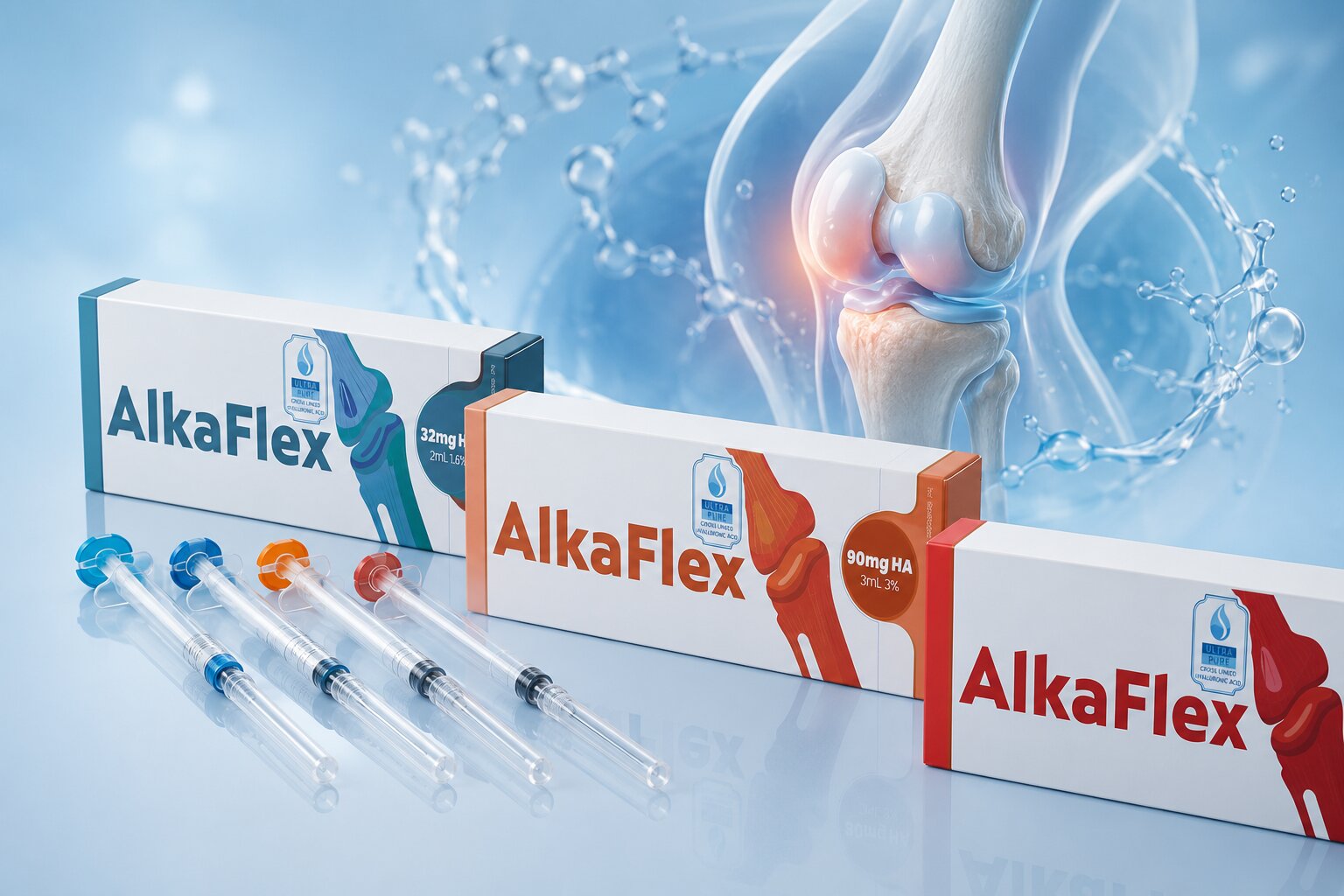
Hyaluronic acid injections have become one of the most widely used non-surgical treatment options for knee osteoarthritis and joint pain management.
However, not all hyaluronic acid products are identical. One of the most important differences between available formulations is whether the hyaluronic acid is cross-linked or non cross-linked.
Understanding these differences can help physicians, distributors, and patients better evaluate treatment options and expected outcomes.
Hyaluronic acid is a naturally occurring polysaccharide found throughout the human body.
It is particularly abundant in:
Inside the joint, hyaluronic acid plays a crucial role in lubrication and shock absorption.
Healthy synovial fluid contains high-quality hyaluronic acid that allows smooth and painless movement.
As osteoarthritis progresses, both the concentration and molecular quality of hyaluronic acid decrease.
This contributes to:
Viscosupplementation aims to restore these properties through intra-articular injections.
Non cross-linked hyaluronic acid closely resembles the naturally occurring HA found in healthy joints.
The molecules remain in their original linear form.
Characteristics include:
Non cross-linked formulations have been used successfully for many years in osteoarthritis treatment.
Its structure closely resembles endogenous hyaluronic acid.
This contributes to excellent tolerability.
The product integrates efficiently within the synovial environment.
This supports smooth joint movement.
Millions of injections have been administered worldwide using linear hyaluronic acid products.
The primary limitation is residence time.
Because the molecules remain in a linear form, they may be degraded more rapidly by enzymatic activity inside the joint.
This can result in:
Cross-linking is a manufacturing process that creates chemical bridges between hyaluronic acid chains.
This process forms a stronger three-dimensional network.
The resulting product becomes:
Cross-linked HA was developed to improve durability and extend clinical benefit.
Cross-linked formulations remain inside the joint for a longer period.
This may contribute to prolonged symptom relief.
The molecular network increases resistance against enzymatic breakdown.
Many patients experience symptom improvement lasting several months.
Some clinical studies have reported benefits extending beyond six months and in selected cases up to one year.
Cross-linked products are frequently used in single-injection protocols.
This may improve patient comfort and compliance.
Although highly effective, cross-linked formulations have certain considerations.
These may include:
Different manufacturers use different cross-linking methods and concentrations.
Molecular weight and cross-linking are related but distinct characteristics.
A product may have:
Both factors influence:
Both formulations are commonly used in:
The choice depends on:
There is no universal answer.
Cross-linked HA may be preferred when:
Non cross-linked HA may be preferred when:
Both options have demonstrated clinical effectiveness.
Orthosyn Medikal offers both cross-linked and non cross-linked hyaluronic acid formulations.
Available options include:
Various concentrations suitable for different treatment protocols.
Manufactured to support modern viscosupplementation applications worldwide.
Both cross-linked and non cross-linked hyaluronic acid products play important roles in modern osteoarthritis management.
Cross-linked formulations are designed to provide greater stability and longer-lasting effects, while non cross-linked products closely resemble natural hyaluronic acid and continue to demonstrate excellent clinical outcomes.
The ideal choice depends on treatment goals, patient characteristics, and physician preference.