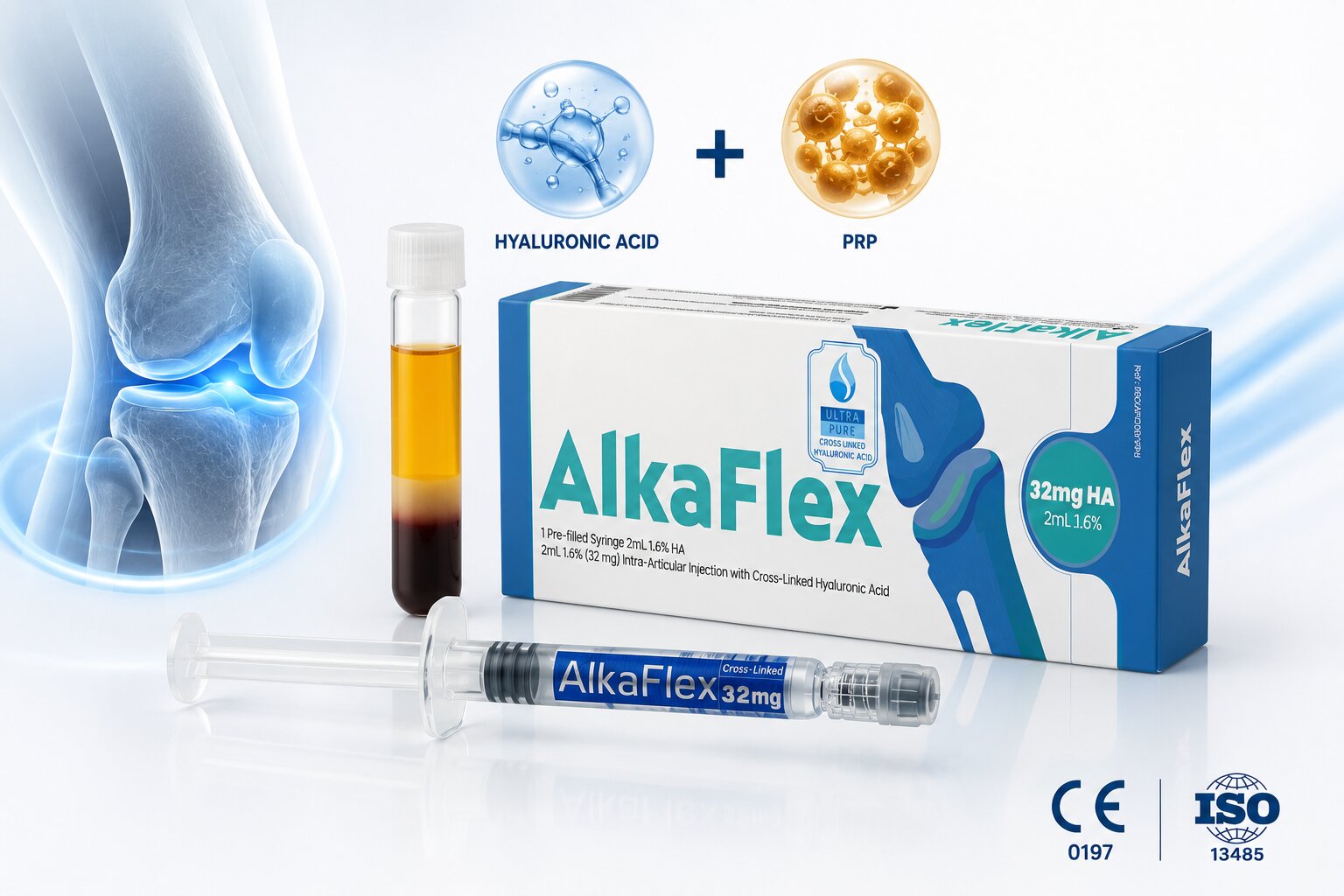
Hyaluronic acid (HA) injections and Platelet-Rich Plasma (PRP) injections are two commonly used non-surgical treatment options for patients suffering from knee osteoarthritis and chronic joint pain.
Although both treatments are administered through intra-articular injections, they work through different mechanisms.
Hyaluronic acid primarily improves lubrication and shock absorption inside the joint, while PRP aims to deliver concentrated growth factors derived from the patient's own blood.
Because they target different aspects of joint health, physicians have increasingly explored whether these therapies can be used together.
Healthy synovial fluid contains naturally occurring hyaluronic acid.
Its primary functions include:
In osteoarthritis, both the concentration and quality of endogenous hyaluronic acid decrease.
Viscosupplementation attempts to restore these properties through injection.
PRP is produced by collecting a patient's blood and concentrating platelets through centrifugation.
Platelets contain growth factors that may support:
PRP is widely used in sports medicine and orthopedic applications.
The rationale behind combination therapy is straightforward.
HA and PRP address different aspects of joint degeneration.
Potential theoretical advantages include:
For this reason, many physicians have investigated combined treatment protocols.
Several studies have suggested that combining HA and PRP may offer advantages compared with either treatment alone.
Potential benefits include:
Patients may experience greater symptom reduction.
Some studies have reported improvements in mobility and daily activities.
Combination therapy may provide longer-lasting benefits in selected patients.
Better clinical outcomes may translate into higher patient satisfaction.
Clinical research continues to evolve.
Some studies have reported superior outcomes for combined HA and PRP treatment compared with HA alone.
Other studies have shown comparable results.
Because treatment protocols vary significantly, definitive conclusions remain challenging.
Factors affecting outcomes include:
Further research is still ongoing.
Combination therapy may be considered for:
Treatment decisions should always be individualized.
Both HA and PRP are generally considered safe when administered appropriately.
Potential side effects may include:
Serious complications are uncommon.
Advantages:
Advantages:
Advantages:
The optimal approach depends on patient-specific factors and physician assessment.
Orthosyn Medikal offers advanced viscosupplementation solutions developed for orthopedic and sports medicine applications.
Available options include:
Designed to support long-term joint lubrication and mobility.
Hyaluronic acid and PRP represent two different approaches to non-surgical osteoarthritis management. Because they target different biological and mechanical aspects of joint degeneration, combining them may offer additional benefits in selected patients.
Although research is ongoing, combination therapy continues to attract interest among orthopedic specialists seeking to optimize patient outcomes while delaying surgical intervention.