


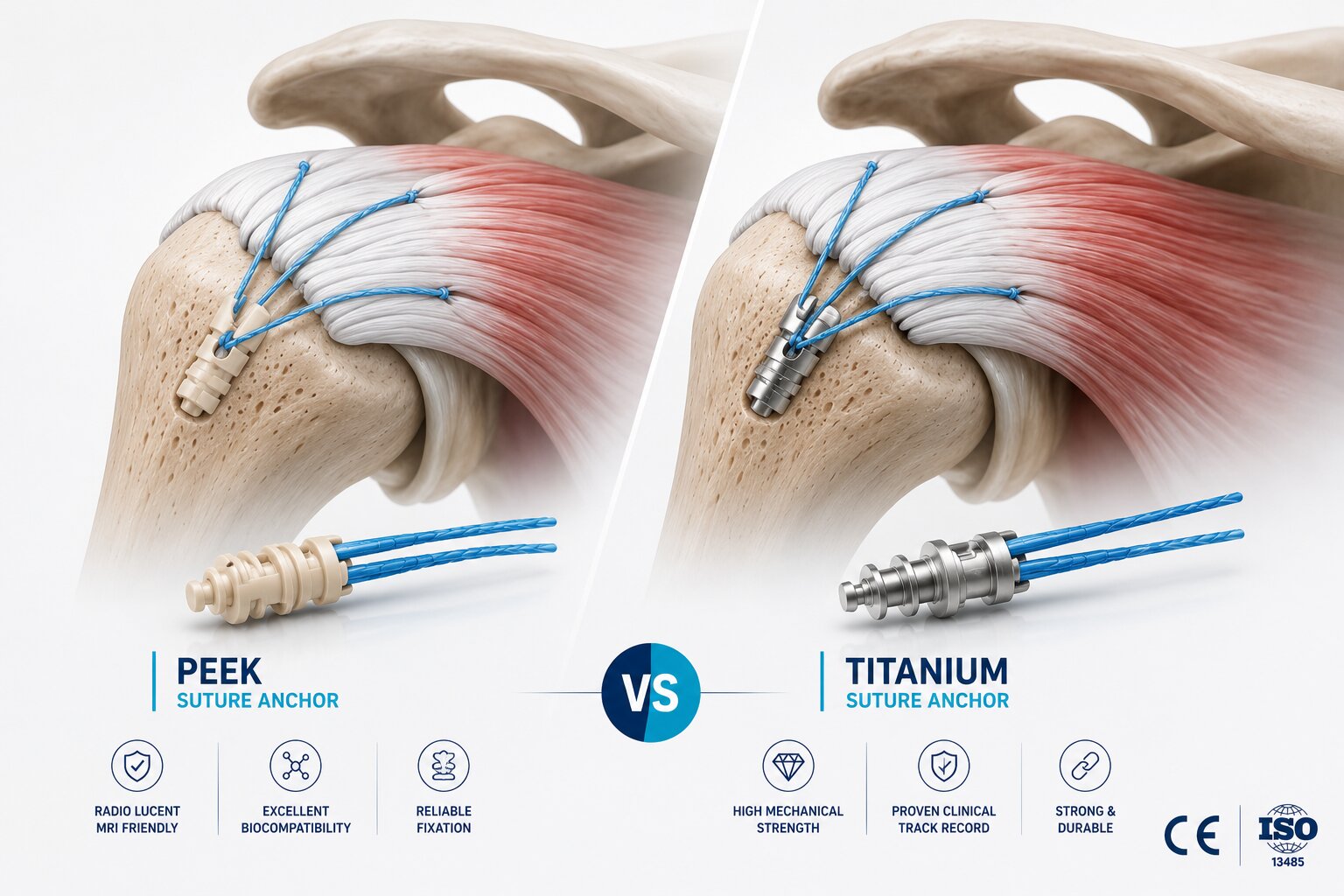
Suture anchors are among the most frequently used implants in modern arthroscopic surgery. They play a critical role in procedures such as rotator cuff repair, Bankart repair, SLAP repair, and other soft tissue fixation techniques.
Among the various anchor materials available today, PEEK (Polyether Ether Ketone) and titanium remain two of the most commonly used options. Both have demonstrated excellent clinical performance, but each offers unique characteristics that may influence implant selection.
Understanding the differences between these materials can help surgeons choose the most appropriate fixation solution for specific clinical situations.
Suture anchors are designed to secure soft tissue to bone.
Common applications include:
The anchor provides fixation while biological healing occurs between tissue and bone.
Because anchor performance directly affects repair stability, material selection is an important consideration.
Titanium anchors have been used successfully in orthopedic surgery for decades.
Titanium is a strong metallic material known for:
These characteristics have made titanium anchors a trusted option in shoulder arthroscopy and sports medicine procedures.
Titanium provides excellent pull-out resistance and fixation stability.
This can be particularly useful in patients with poor bone quality.
Titanium anchors have been used for many years with proven clinical outcomes.
Numerous published studies support their safety and effectiveness.
Titanium anchors offer consistent fixation performance across a wide range of procedures.
Despite their advantages, titanium anchors have certain limitations.
Titanium may create artifacts on MRI and CT imaging.
Although modern imaging technology has reduced this issue, artifacts may still affect postoperative evaluation.
Titanium remains permanently within the bone unless surgically removed.
For most patients this is not problematic, but some surgeons prefer non-metallic alternatives.
PEEK (Polyether Ether Ketone) is a high-performance thermoplastic polymer that has become increasingly popular in orthopedic implant design.
PEEK combines excellent mechanical properties with advanced imaging compatibility.
Today, PEEK anchors are widely used in shoulder and knee arthroscopy.
One of the most important advantages of PEEK is radiolucency.
PEEK does not create significant imaging artifacts.
Benefits include:
Modern PEEK anchors provide fixation strength comparable to many metallic systems.
They are designed to withstand physiological loads during healing.
PEEK demonstrates excellent biocompatibility and has been successfully used in orthopedic implants worldwide.
PEEK anchors allow improved postoperative imaging assessment compared with many metallic implants.
Although highly effective, PEEK anchors also have certain considerations.
PEEK manufacturing may be more expensive than traditional metallic implants.
Some surgeons continue to prefer metallic fixation due to familiarity and long-term experience.
| Feature | PEEK Anchor | Titanium Anchor |
|---|---|---|
| Strength | High | Very High |
| MRI Visibility | Excellent | Moderate |
| Imaging Artifacts | Minimal | Possible |
| Biocompatibility | Excellent | Excellent |
| Long-Term History | Growing | Extensive |
| Permanent Implant | Yes | Yes |
| Radiolucency | Yes | No |
Both materials provide excellent fixation when used appropriately.
Both titanium and PEEK anchors are commonly used in rotator cuff repair.
Factors influencing implant selection include:
Neither material has demonstrated universal superiority in all clinical situations.
Bankart repair procedures frequently utilize smaller anchor systems.
PEEK anchors are often selected when postoperative MRI evaluation is important.
Titanium anchors continue to be used successfully worldwide for shoulder instability surgery.
Surgeons may consider:
Younger patients may require long-term imaging follow-up.
Bone density can influence fixation requirements.
Future revision procedures may affect implant choice.
MRI evaluation may favor radiolucent implants such as PEEK.
Orthosyn Medikal offers arthroscopic fixation solutions designed for shoulder and sports medicine procedures.
Available options include:
Available in multiple sizes for shoulder stabilization and rotator cuff repair procedures.
Designed to provide reliable fixation with excellent imaging compatibility.
All-suture fixation systems designed for selected arthroscopic applications.
These solutions support modern arthroscopic repair techniques and surgeon preferences.
Both PEEK and titanium suture anchors have established roles in modern arthroscopic surgery. Titanium anchors offer exceptional strength and a long clinical history, while PEEK anchors provide excellent imaging compatibility and radiolucency.
The optimal choice depends on patient-specific factors, surgical goals, imaging requirements, and surgeon preference. Understanding the advantages and limitations of each material helps support informed implant selection and successful surgical outcomes.