


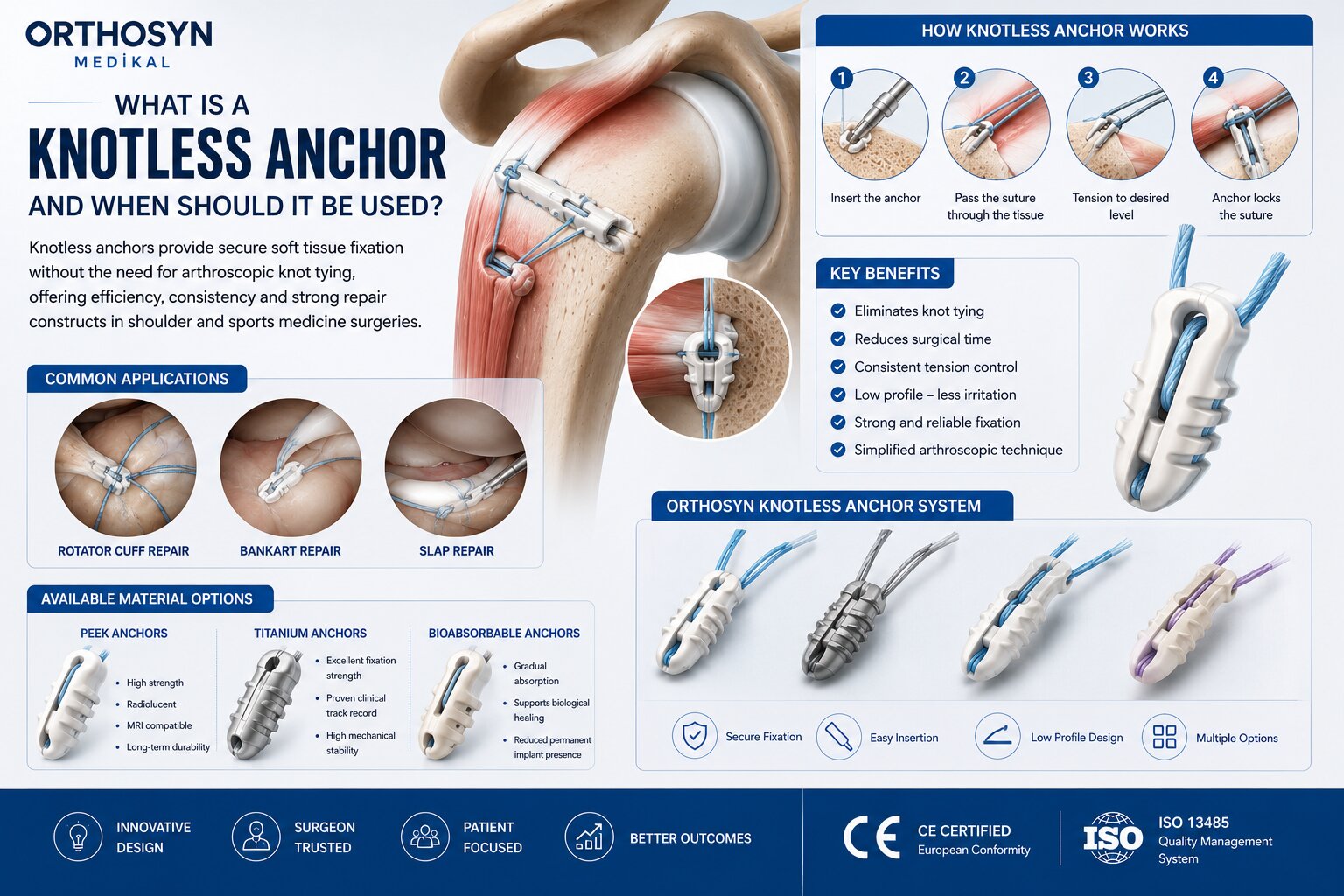
Suture anchors have become one of the most important implants in modern arthroscopic surgery. They are widely used in procedures such as rotator cuff repair, Bankart repair, SLAP repair, and other soft tissue fixation procedures.
Traditionally, surgeons secured tissue using knotted anchor systems. However, advances in implant technology have introduced knotless anchors, which eliminate the need for arthroscopic knot tying while maintaining secure tissue fixation.
Today, knotless anchor systems are increasingly used in shoulder arthroscopy because they simplify procedures and help create reproducible surgical outcomes.
This article explains how knotless anchors work, their advantages, limitations, and common clinical applications.
A knotless anchor is a suture anchor system that allows soft tissue fixation without requiring arthroscopic knot tying.
Unlike traditional anchors, the suture is secured within the anchor mechanism itself.
This allows surgeons to:
The fixation strength is achieved through the anchor's locking mechanism rather than through surgical knots.
The basic principle is relatively simple.
After the anchor is inserted into bone:
This creates a stable repair construct without knot stacks.
Arthroscopic knot tying can be technically demanding.
Challenges may include:
Knotless technology was developed to overcome these limitations and provide a more standardized fixation method.
One of the biggest advantages is procedural efficiency.
By eliminating knot tying, surgeons can often reduce overall operative time.
Shorter procedures may improve workflow and operating room efficiency.
With traditional anchors, tension may vary depending on knot quality.
Knotless systems allow precise adjustment before final fixation.
This may improve tissue compression and repair quality.
Traditional knot stacks may occasionally cause irritation or impingement.
Knotless systems eliminate bulky knot stacks.
Potential benefits include:
Many surgeons appreciate the technical simplicity of knotless fixation.
This may be particularly useful in:
Knotless anchors are frequently used in:
They help create uniform tendon compression across the footprint.
Bankart lesions are common causes of anterior shoulder instability.
Knotless anchors allow surgeons to:
Superior labral repairs may also benefit from knotless fixation systems.
The reduced implant profile can be advantageous in selected cases.
Knotless anchors can be used in various procedures requiring secure soft tissue attachment to bone.
Advantages:
Potential limitations:
Advantages:
Potential limitations:
Modern knotless anchors are available in various materials:
Advantages:
Advantages:
Advantages:
Surgeons consider several factors when selecting an anchor system:
No single anchor type is ideal for every situation.
Orthosyn Medikal provides arthroscopic fixation solutions designed to support modern shoulder and sports medicine procedures.
Available anchor options include:
Designed to support reliable fixation and efficient arthroscopic workflows.
Knotless anchors have transformed modern arthroscopic surgery by simplifying fixation techniques and reducing procedural complexity. Their ability to provide secure fixation without knot tying has made them increasingly popular in rotator cuff repair, Bankart repair, and other soft tissue reconstruction procedures.
As arthroscopic technology continues to evolve, knotless fixation systems are expected to remain an important component of modern sports medicine and orthopedic surgery.