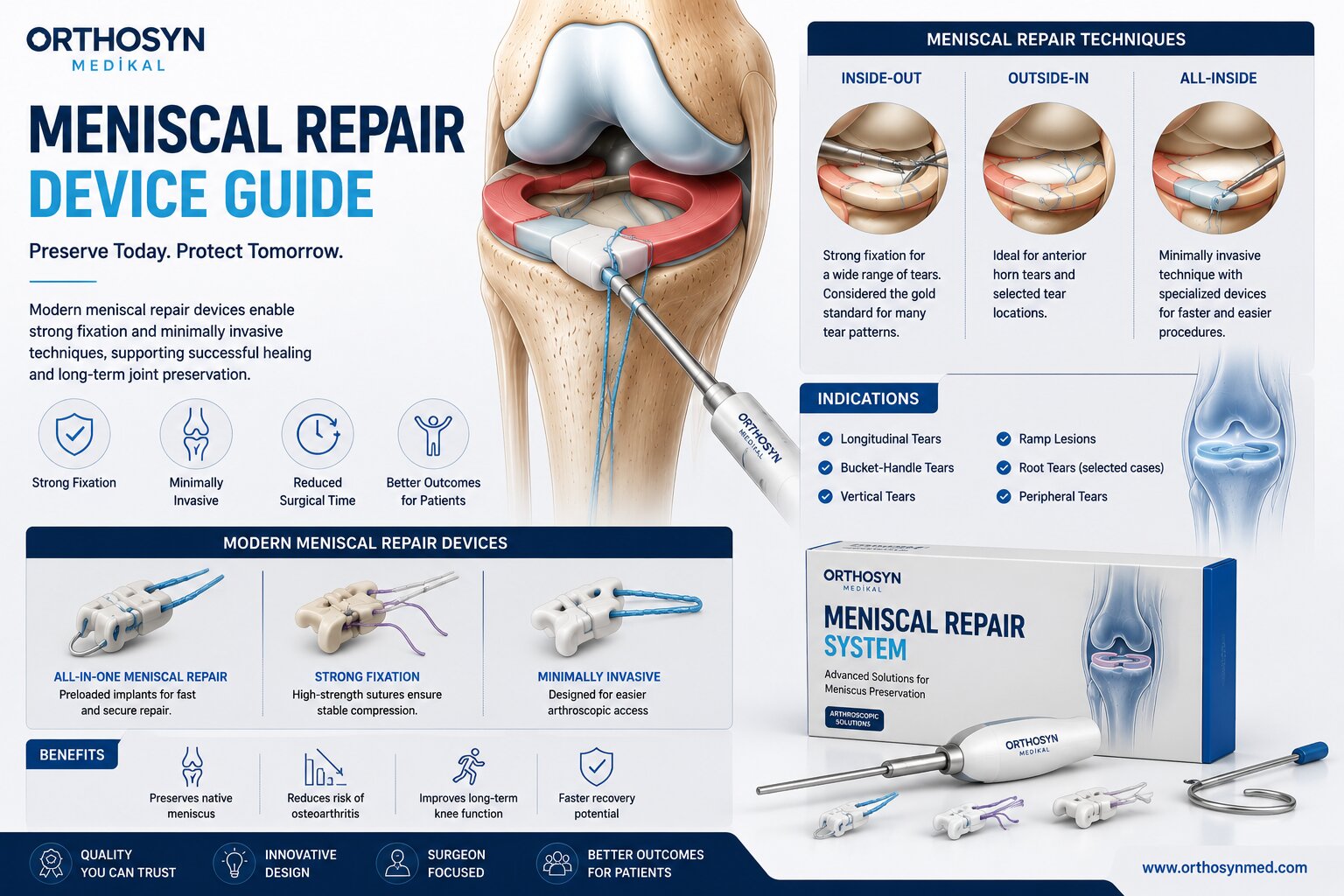
The meniscus plays a critical role in knee stability, load distribution, shock absorption, and joint protection. Historically, many meniscal injuries were treated through partial meniscectomy, where damaged tissue was removed. However, modern orthopedic practice increasingly focuses on meniscus preservation whenever possible.
Advances in arthroscopic surgery and meniscal repair devices have made it possible to repair many tears that were once considered irreparable. As a result, meniscal repair has become one of the most frequently performed procedures in sports medicine and knee arthroscopy.
This guide explains how modern meniscal repair devices work, available repair techniques, and factors that influence device selection.
The meniscus serves several essential functions:
When significant portions of the meniscus are removed, the risk of cartilage degeneration and osteoarthritis increases over time.
For this reason, preserving and repairing the meniscus whenever possible has become a primary treatment objective.
Not all tears are suitable for repair.
Common tear patterns include:
The tear pattern significantly influences the repair strategy and device selection.
A meniscal repair device is a specialized implant system used during arthroscopic surgery to stabilize torn meniscal tissue and promote biological healing.
These devices allow surgeons to:
Modern devices are designed to simplify arthroscopic procedures while providing strong fixation.
Inside-out repair is one of the oldest and most reliable techniques.
Advantages:
Limitations:
Outside-in repair is often used for anterior horn tears.
Advantages:
Limitations:
All-inside repair has become increasingly popular due to advancements in implant technology.
Advantages:
Many modern meniscal repair devices are designed specifically for all-inside procedures.
Most modern all-inside systems use implant-based fixation.
The device is delivered arthroscopically through a specialized applicator.
The implants are deployed on either side of the tear and connected by a high-strength suture.
The surgeon then tensions the construct to compress the tear and stabilize the meniscus.
This creates a secure repair environment that supports biological healing.
Modern repair systems offer several advantages:
Preloaded implant systems simplify deployment and reduce procedural complexity.
Most repairs can be performed through standard arthroscopic portals.
Modern implant materials provide excellent biomechanical stability.
User-friendly delivery systems help streamline surgical workflow.
Successful meniscal healing depends on several factors:
Tears located within the vascular "red-red zone" generally heal better.
Younger patients often demonstrate superior healing potential.
Simple vertical tears typically have better repair outcomes than complex tears.
Meniscal repair performed alongside ACL reconstruction often demonstrates improved healing rates.
Postoperative rehabilitation plays a critical role in treatment success.
Protocols commonly include:
Rehabilitation protocols vary according to tear type and repair technique.
Modern evidence increasingly supports meniscal preservation whenever possible.
Benefits of repair include:
Although meniscectomy may still be necessary in selected cases, repair remains the preferred option whenever feasible.
Orthosyn Medikal offers arthroscopic solutions designed to support modern knee preservation procedures.
Meniscal repair systems are developed to provide:
These systems help surgeons perform reliable meniscal repairs while preserving native knee anatomy.
Modern meniscal repair devices have transformed the treatment of meniscal injuries. Advances in arthroscopic technology now allow surgeons to preserve meniscal tissue more effectively than ever before.
By combining minimally invasive techniques with strong fixation systems, meniscal repair devices help improve patient outcomes, protect joint health, and support long-term knee function.