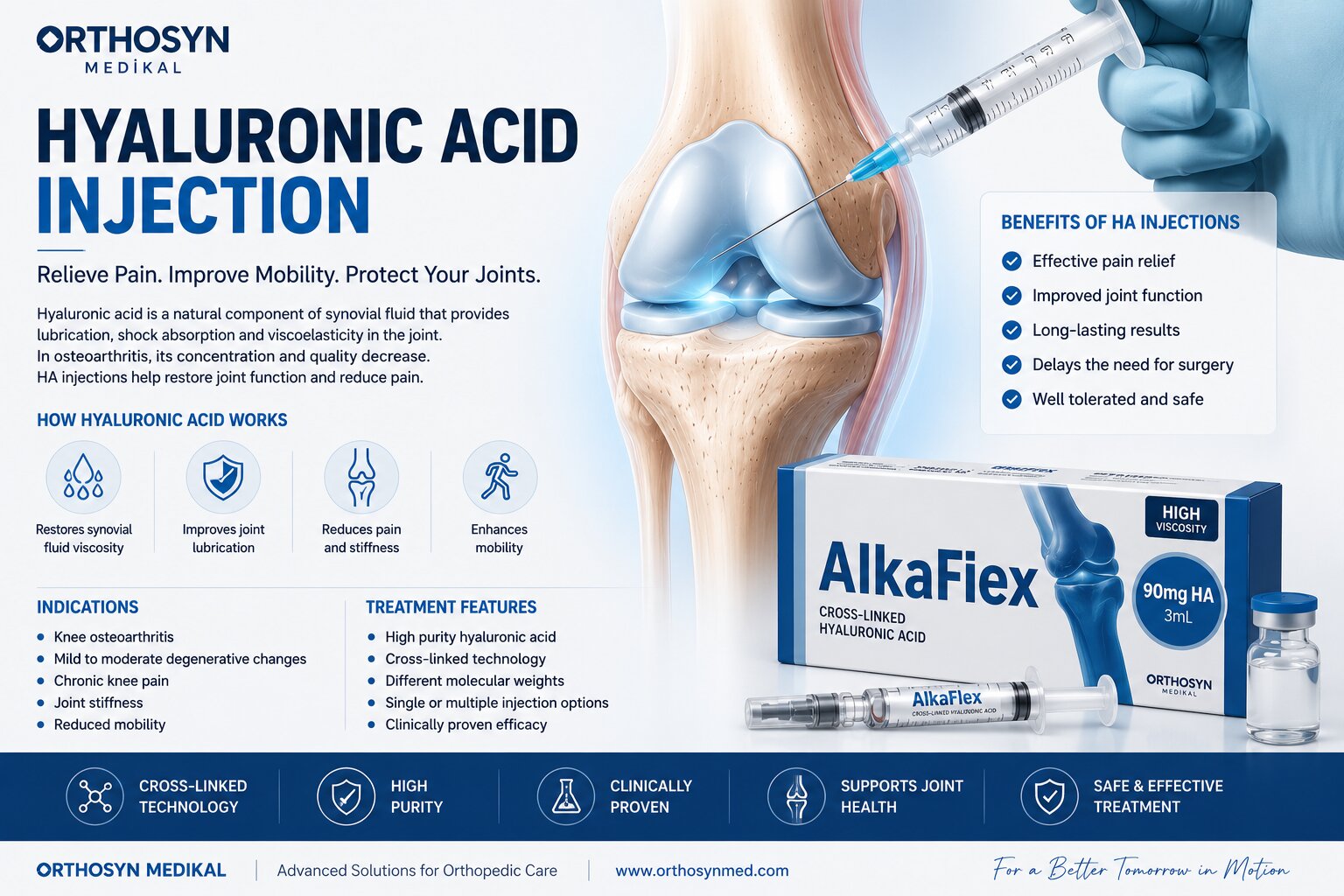
Knee osteoarthritis is one of the most common causes of chronic pain and reduced mobility worldwide. As the disease progresses, patients often seek non-surgical treatment options to relieve pain, improve function, and delay joint replacement surgery.
Among the most frequently used injectable treatments are hyaluronic acid (HA) injections and corticosteroid injections. Both therapies are widely used in orthopedic and sports medicine practices, but they work in different ways and serve different clinical purposes.
Understanding the differences between these treatment options can help physicians and patients make more informed decisions based on individual needs and treatment goals.
Osteoarthritis is a degenerative joint disease characterized by:
As cartilage wears away, friction inside the joint increases, resulting in discomfort and reduced mobility.
Treatment strategies aim to reduce symptoms while preserving joint function.
Corticosteroid injections are anti-inflammatory treatments delivered directly into the joint.
Their primary purpose is to reduce inflammation and provide rapid pain relief.
Common benefits include:
Corticosteroids are often used when inflammation is the dominant clinical problem.
Corticosteroids suppress inflammatory pathways inside the joint.
This leads to:
Many patients notice symptom improvement within a few days.
Although corticosteroids can provide rapid relief, their effect is often temporary.
Potential limitations include:
For this reason, corticosteroids are often viewed as short-term symptom management tools.
Hyaluronic acid injections are a form of viscosupplementation.
Unlike corticosteroids, they do not primarily target inflammation.
Instead, they aim to improve the mechanical environment of the joint by restoring lubrication and viscoelastic properties.
Healthy joints naturally contain hyaluronic acid within synovial fluid.
Its functions include:
In osteoarthritis, HA concentration and quality decrease over time.
Viscosupplementation helps restore these properties.
Potential benefits include:
Many patients experience gradual improvement over several weeks.
Pain relief may occur rapidly, often within days.
However, benefits typically last:
Improvement often develops more gradually.
Benefits may continue for:
Duration depends on product characteristics and patient condition.
When immediate symptom relief is required, corticosteroids often provide faster results.
Patients experiencing severe inflammation may notice improvement within days.
Hyaluronic acid generally requires more time before benefits become noticeable.
However, the effect may last longer.
In many osteoarthritis patients, hyaluronic acid provides a longer duration of symptom control compared with corticosteroids.
This is one reason viscosupplementation remains popular among orthopedic specialists.
In some clinical situations, physicians may utilize both treatment approaches as part of a broader management strategy.
Treatment selection depends on:
Individualized treatment planning remains essential.
Both therapies are generally considered safe when administered appropriately.
Potential side effects of corticosteroids may include:
Potential side effects of HA injections may include:
Serious complications are uncommon with both treatments.
Orthosyn Medikal offers advanced viscosupplementation products designed for modern orthopedic and sports medicine applications.
Available solutions include:
Designed to support long-term joint health and mobility.
Both corticosteroid and hyaluronic acid injections play important roles in knee osteoarthritis treatment. Corticosteroids may provide faster pain relief, particularly during inflammatory flare-ups, while hyaluronic acid injections are often preferred for longer-lasting symptom control and joint lubrication support.
The best treatment choice depends on patient-specific factors, clinical goals, and physician assessment. Understanding the differences between these therapies helps support more effective and individualized osteoarthritis management.