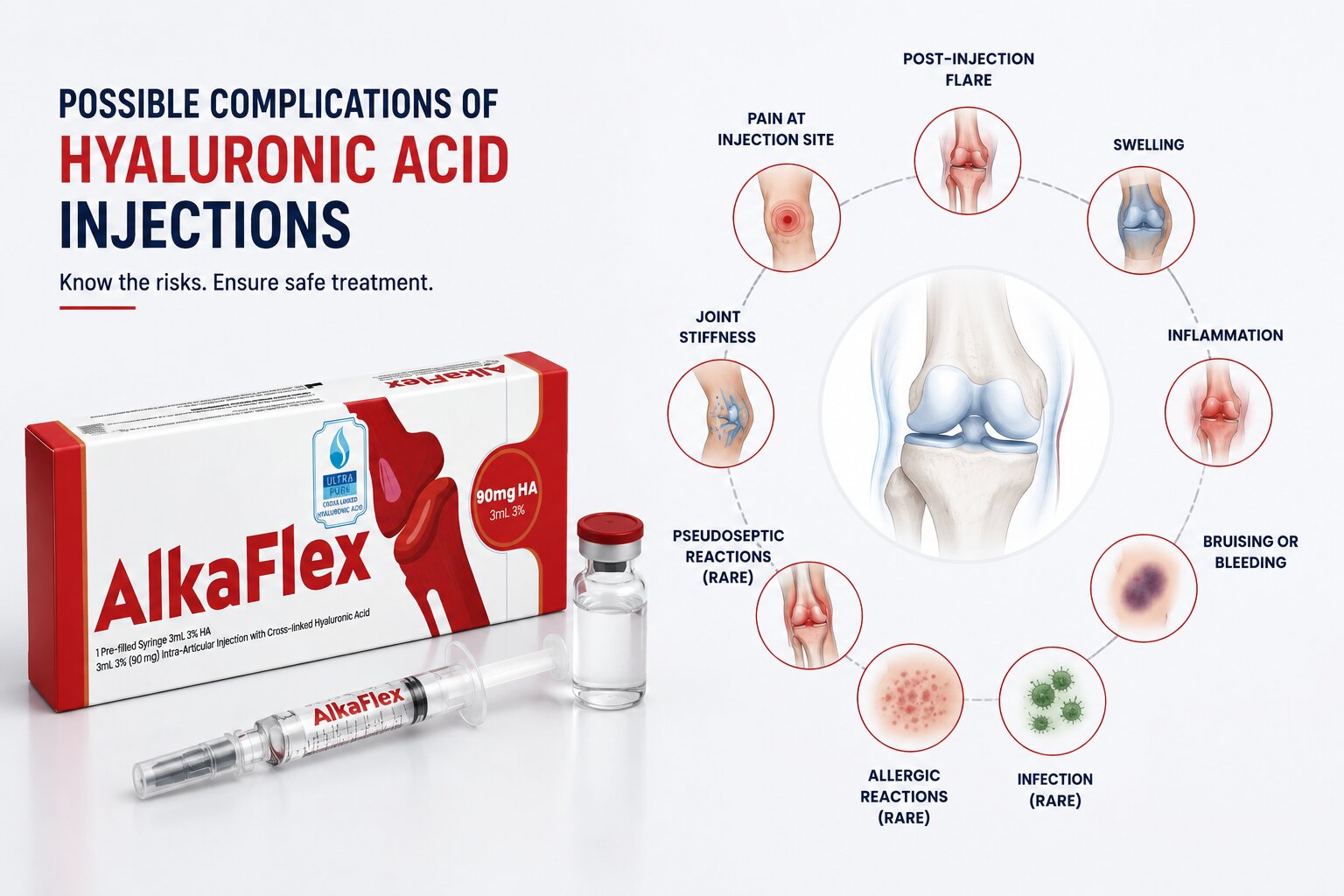
Hyaluronic acid (HA) injections have become one of the most widely used non-surgical treatment options for osteoarthritis and degenerative joint conditions. These injections are commonly used to improve joint lubrication, reduce pain, and enhance mobility in patients suffering from knee osteoarthritis and other joint disorders.
Although hyaluronic acid injections are generally considered safe and well tolerated, like any medical procedure, they may be associated with potential complications and side effects. Understanding these risks helps physicians make informed treatment decisions and allows patients to better understand what to expect before and after treatment.
This article reviews the most common complications associated with hyaluronic acid injections and discusses strategies to minimize risks and optimize clinical outcomes.
Hyaluronic acid is a naturally occurring molecule found in synovial fluid and cartilage. Its primary functions include:
In osteoarthritis patients, the concentration and quality of natural hyaluronic acid gradually decrease. Viscosupplementation aims to restore these properties through intra-articular injection.
Numerous clinical studies have demonstrated that hyaluronic acid injections have a strong safety profile when administered correctly.
Most patients experience no serious adverse effects and can return to normal daily activities shortly after treatment.
However, certain complications may occur.
The majority of side effects are mild and temporary.
These may include:
These symptoms typically resolve within a few hours or several days.
One of the most commonly reported adverse events is a post-injection flare.
Patients may experience:
This reaction is usually self-limiting and resolves without long-term consequences.
Some patients may develop localized inflammatory responses after viscosupplementation.
Potential symptoms include:
These reactions are generally uncommon and often improve with conservative management.
As with any intra-articular injection procedure, infection remains a potential but rare complication.
Signs of infection may include:
Strict sterile technique significantly reduces this risk.
Although septic arthritis is extremely uncommon, it requires immediate medical attention if suspected.
Modern hyaluronic acid products are highly purified and designed to minimize allergic reactions.
However, rare hypersensitivity reactions may occur.
Possible symptoms include:
Severe allergic reactions are extremely rare.
A rare but important complication is a pseudoseptic reaction.
Symptoms may resemble joint infection:
Unlike septic arthritis, pseudoseptic reactions are sterile inflammatory responses rather than infections.
Accurate diagnosis is essential because treatment strategies differ significantly.
Minor bleeding or bruising may occur at the injection site.
Risk factors include:
These events are usually mild and self-limiting.
Several factors may increase the likelihood of complications:
Careful patient evaluation helps reduce these risks.
Clinical outcomes depend not only on the product itself but also on injection accuracy.
Key considerations include:
Many clinicians increasingly use ultrasound guidance to improve placement accuracy and reduce complications.
Patients should seek medical evaluation if they experience:
Early evaluation allows rapid management of potential complications.
Despite the possibility of complications, hyaluronic acid injections remain one of the safest non-surgical treatment options for osteoarthritis.
Potential benefits include:
For appropriately selected patients, the overall benefit-risk profile remains highly favorable.
Orthosyn Medikal offers advanced viscosupplementation solutions developed for modern orthopedic and sports medicine applications.
Product options include:
Designed to support safe and effective joint care.
Hyaluronic acid injections are generally safe, effective, and well tolerated when administered correctly. While complications can occur, most are mild, temporary, and manageable.
Understanding potential side effects, maintaining proper injection technique, and selecting appropriate patients are essential for maximizing treatment success and minimizing risks.