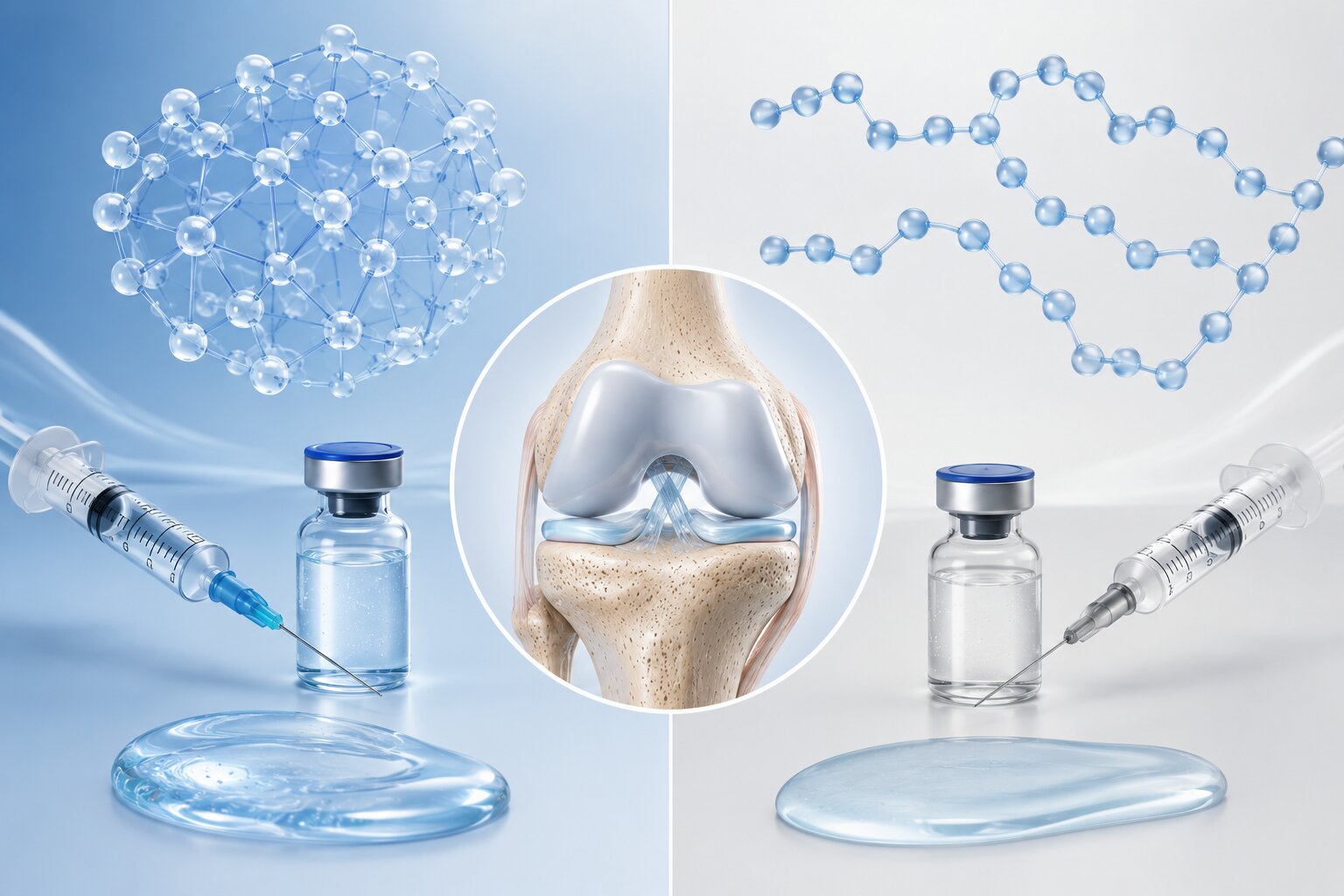
Hyaluronic acid injections are widely used in orthopedic medicine for the treatment of osteoarthritis and joint pain. One of the most important differences between viscosupplementation products is whether the hyaluronic acid formulation is cross-linked or non cross-linked.
Both formulations are designed to improve joint lubrication, reduce pain, and support mobility, but they differ significantly in structure, viscosity, duration, and clinical application.
Understanding the differences between cross-linked and non cross-linked hyaluronic acid helps physicians, distributors, and patients choose the most appropriate treatment option.
Hyaluronic acid (HA) is a naturally occurring molecule found inside synovial fluid and cartilage.
Its primary functions include:
In osteoarthritis, natural HA concentration and viscosity decrease over time.
Cross-linked hyaluronic acid is produced by chemically connecting HA molecules together to create a denser and more stable molecular structure.
This modification increases:
Cross-linking technology is commonly used in high-concentration viscosupplementation products.
Cross-linked products generally remain inside the joint longer than non cross-linked formulations.
This may allow:
The denser structure provides stronger viscoelastic properties.
This may improve:
Many cross-linked formulations are designed for single-injection treatment protocols.
This may improve patient convenience and compliance.
The higher viscosity may create increased injection resistance.
Some patients may experience temporary:
These reactions are usually temporary.
Non cross-linked hyaluronic acid maintains a structure closer to naturally occurring HA found in synovial fluid.
These formulations are generally less dense and more fluid.
The product behaves more similarly to native synovial fluid.
Lower viscosity may allow easier injection and distribution inside the joint.
Non cross-linked products are commonly used in:
Some patients tolerate lower viscosity formulations more comfortably.
Non cross-linked products may degrade faster inside the joint.
This may require:
Both formulations are widely used in:
Selection depends on:
Often preferred for:
Often preferred for:
Hyaluronic acid products may also vary in molecular weight.
Higher molecular weight formulations may provide:
Lower molecular weight products may provide:
The clinical performance of HA injections depends on:
High-quality manufacturing is essential for safety and performance.
Orthosyn Medikal provides viscosupplementation solutions including:
Designed for modern orthopedic and sports medicine applications.
Cross-linked and non cross-linked hyaluronic acid formulations each offer specific advantages depending on treatment goals and patient needs. Cross-linked products generally provide longer-lasting support and higher viscosity, while non cross-linked products offer more natural fluid behavior and flexible injection protocols.
Selecting the appropriate viscosupplementation product requires evaluation of clinical indications, patient condition, and desired treatment outcomes.