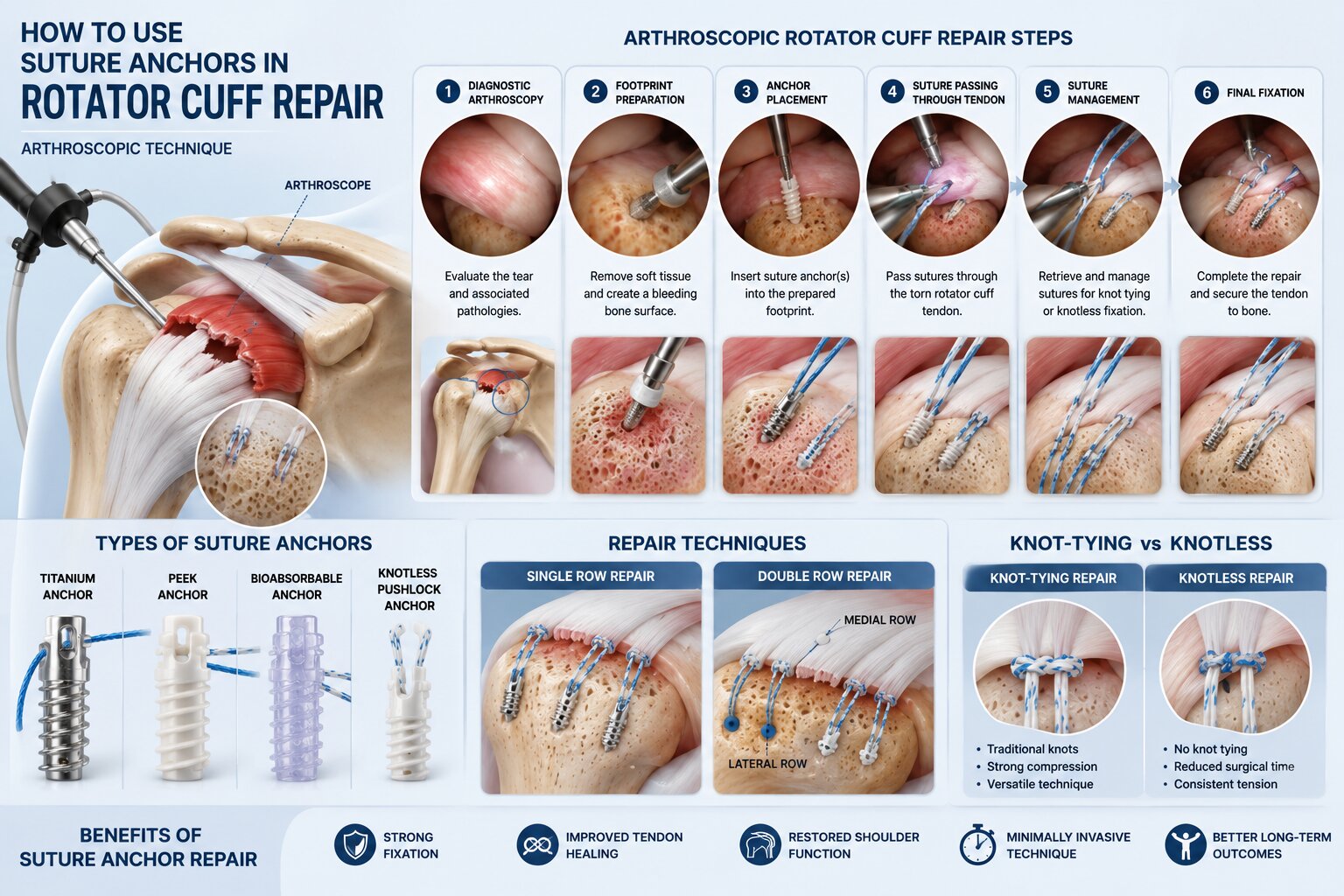
Rotator cuff tears are among the most common shoulder injuries treated in orthopedic sports medicine. Modern arthroscopic rotator cuff repair relies heavily on advanced fixation systems, particularly suture anchors, to achieve stable tendon-to-bone fixation and promote biological healing.
Suture anchors play a critical role in restoring shoulder function, reducing pain, and improving long-term clinical outcomes after rotator cuff repair surgery.
This guide explains how suture anchors are used during arthroscopic rotator cuff repair procedures and compares different anchor systems commonly used in shoulder surgery.
The rotator cuff consists of four muscles and tendons responsible for shoulder stability and movement.
These tendons help control:
Rotator cuff tears may occur due to:
Patients commonly experience:
Suture anchors are fixation implants inserted into bone to secure soft tissue structures such as tendons.
In rotator cuff repair, the anchor is placed into the humeral head while attached sutures are passed through the torn tendon to restore tendon attachment to bone.
Modern anchor systems may include:
The main objectives of repair include:
Stable fixation is essential during the early healing phase.
The procedure begins with arthroscopic evaluation of the shoulder joint.
The surgeon evaluates:
Associated shoulder pathologies may also be treated during the procedure.
The rotator cuff footprint on the greater tuberosity is prepared using shavers or burr systems.
Preparation aims to:
Proper bone bed preparation is important for biological integration.
Suture anchors are inserted into the prepared humeral footprint.
Anchor positioning depends on:
Multiple anchors may be required in larger tears.
Titanium anchors provide:
These anchors are frequently preferred in dense bone and high-demand repairs.
PEEK anchors offer:
PEEK systems are commonly used in modern arthroscopic shoulder surgery.
Bioabsorbable anchors gradually degrade over time.
Potential advantages include:
After anchor insertion, sutures are passed through the torn rotator cuff tendon using specialized arthroscopic instruments.
Common instruments include:
The suture configuration may vary depending on the tear pattern and repair strategy.
In traditional repair techniques:
Advantages include strong compression and versatile fixation patterns.
Modern knotless systems eliminate the need for arthroscopic knot tying.
Advantages may include:
Knotless systems are increasingly used in double-row and bridge repair techniques.
Anchors are placed in a single lateral line along the footprint.
Advantages:
Anchors are placed medially and laterally to maximize footprint compression.
Advantages:
Pushlock and knotless fixation systems are frequently combined with medial row anchors.
Typical strategy:
This creates a transosseous-equivalent repair construct.
Successful rotator cuff healing depends on:
Smoking, age, and chronic tears may affect healing potential.
Postoperative rehabilitation is critical.
Recovery usually includes:
Healing may require several months depending on tear severity.
Compared to open surgery, arthroscopic techniques generally provide:
Modern fixation systems have significantly improved repair stability and outcomes.
Suture anchors are essential components of modern arthroscopic rotator cuff repair surgery. Titanium, PEEK, bioabsorbable, and knotless anchor systems each provide unique advantages depending on surgical strategy and patient needs.
Advanced fixation techniques, combined with proper rehabilitation, help restore shoulder stability, improve tendon healing, and support successful long-term outcomes.
Orthosyn Medikal provides arthroscopy fixation systems, suture anchors, knotless solutions, and orthopedic surgical products designed for modern shoulder and sports medicine procedures.