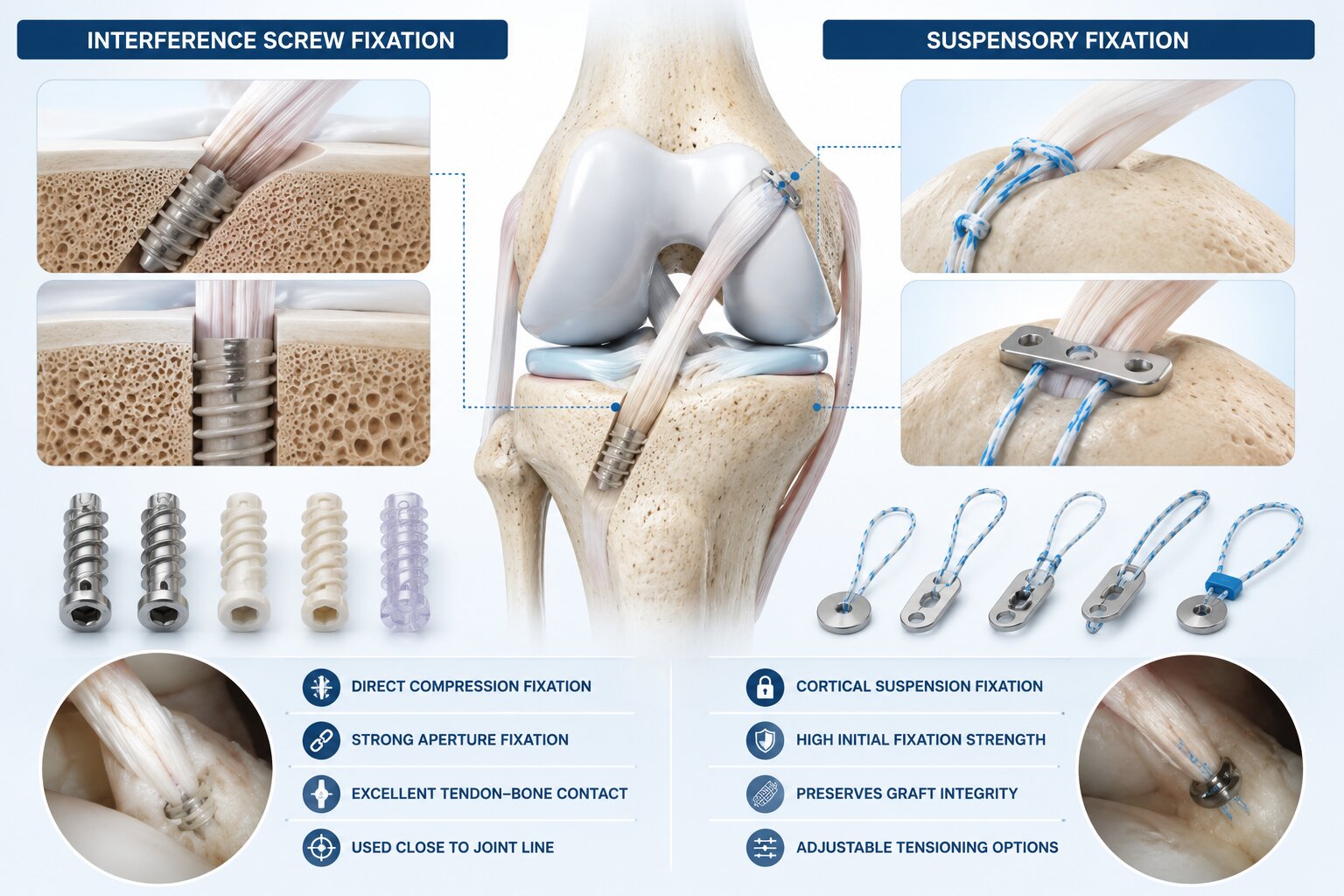
Modern ligament reconstruction procedures, especially ACL reconstruction surgery, require strong and reliable graft fixation systems. Two of the most commonly used fixation methods are interference screws and suspensory fixation systems.
Both techniques are widely used in sports medicine and arthroscopic surgery, but they differ in biomechanics, fixation principles, surgical technique, and clinical applications.
Understanding the differences between interference screw fixation and suspensory fixation helps surgeons choose the most appropriate solution for each patient and reconstruction technique.
An interference screw is a fixation implant inserted between the graft and bone tunnel to compress and stabilize the graft during ligament reconstruction procedures.
Interference screws are commonly used in:
These screws may be manufactured from:
The graft is inserted into the bone tunnel, and the screw is advanced between the graft and tunnel wall.
This creates:
The fixation mechanism relies on compression inside the tunnel.
Interference screws provide fixation close to the joint line, reducing graft micromotion.
Compression inside the tunnel improves biological healing conditions.
Interference screw fixation is one of the most established methods in ligament reconstruction surgery.
Can be used with:
Improper placement or excessive stress may contribute to tunnel widening.
Insertion technique is critical to avoid graft laceration during screw advancement.
Fixation strength may be reduced in poor bone quality.
Suspensory fixation systems stabilize the graft using cortical fixation outside the bone tunnel.
These systems commonly use:
Suspensory fixation is especially common on the femoral side during ACL reconstruction.
The fixation device passes through the tunnel and locks against the cortical bone surface.
The graft remains suspended inside the tunnel while tension is maintained through the fixation system.
Modern suspensory systems provide excellent biomechanical stability.
There is no direct screw compression against the graft.
Adjustable loop systems allow intraoperative graft tension optimization.
Particularly effective in hamstring tendon reconstructions.
Suspensory fixation may allow slight graft motion inside the tunnel.
Micromotion may contribute to tunnel enlargement in some cases.
Fixation occurs outside the tunnel aperture rather than directly at the joint line.
Many modern ACL reconstruction procedures combine both systems.
Common combination:
This hybrid approach aims to maximize fixation stability and biological healing.
Both fixation systems are available in different materials:
The optimal fixation method depends on:
No single system is ideal for every procedure.
Interference screws and suspensory fixation systems are both highly effective solutions for ligament reconstruction procedures. Each method offers unique biomechanical and clinical advantages depending on the surgical indication and graft selection.
Modern arthroscopic surgery often combines these systems to achieve strong fixation, improved healing conditions, and successful long-term outcomes.
Orthosyn Medikal provides interference screws, suspensory fixation systems, and arthroscopy solutions designed for modern sports medicine and orthopedic reconstruction procedures.