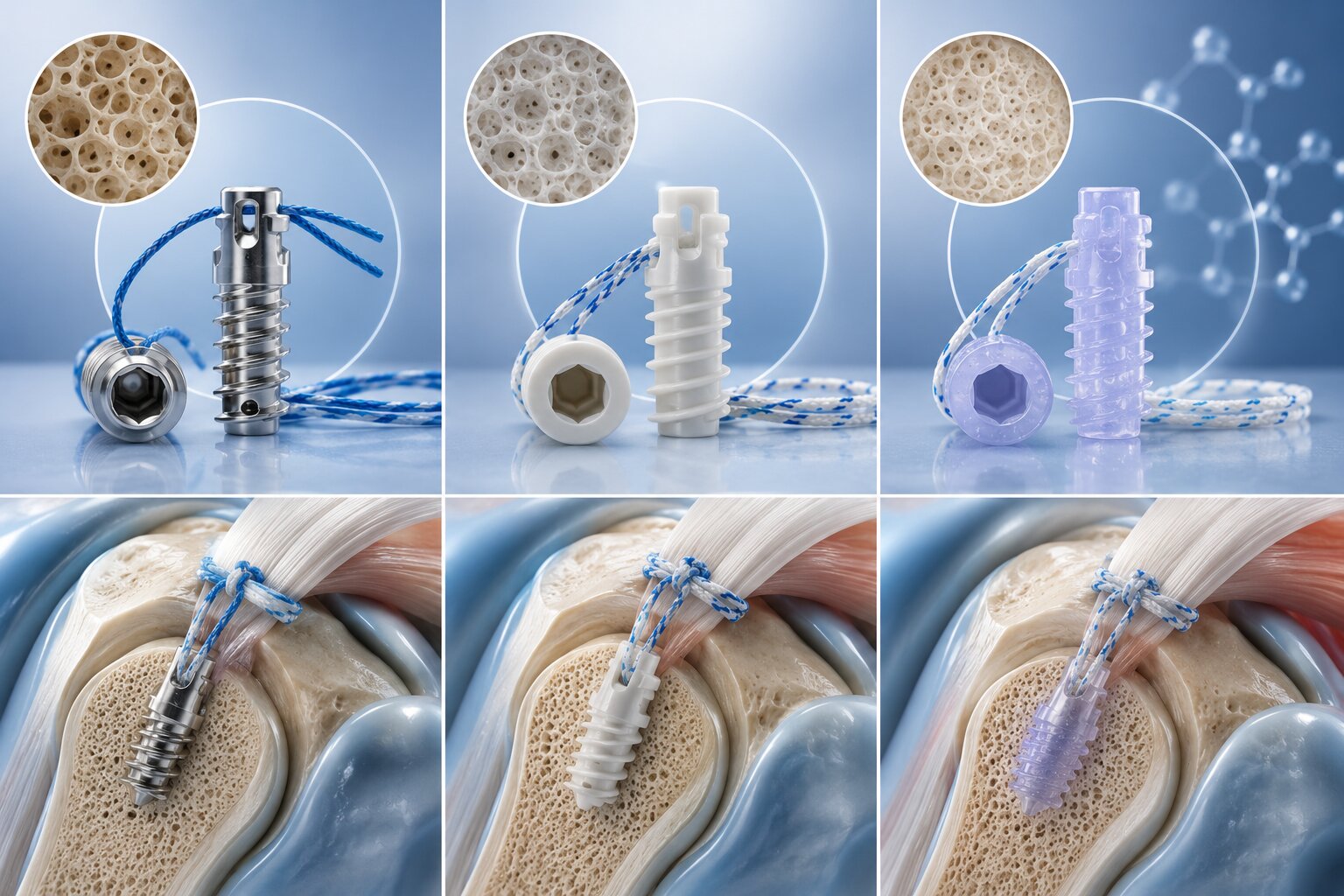
Suture anchors are essential orthopedic implants widely used in arthroscopic and open surgical procedures for soft tissue fixation to bone. They are commonly utilized in shoulder, knee, ankle, elbow, and hip surgeries, particularly in sports medicine applications.
Modern suture anchors are available in different materials including titanium, PEEK, and bioabsorbable polymers. Each material has unique biomechanical properties, imaging characteristics, and clinical advantages.
Understanding the differences between titanium, PEEK, and bioabsorbable suture anchors is important for selecting the appropriate fixation system for each surgical procedure.
A suture anchor is a fixation implant inserted into bone to secure soft tissues such as:
The anchor contains attached sutures that are passed through the tissue and tied or fixed to achieve stable repair.
Suture anchors are commonly used in:
Titanium anchors are among the oldest and most established fixation systems in orthopedic surgery.
These anchors are manufactured from medical-grade titanium alloy materials designed for high mechanical strength and long-term stability.
Titanium provides strong fixation and excellent pullout resistance, especially in dense bone structures.
Titanium anchors are non-absorbable and remain permanently inside the bone.
Titanium implants have been used successfully for many years in orthopedic surgery.
They are often preferred in cases requiring high fixation strength.
Titanium may create MRI or CT imaging artifacts that can affect postoperative evaluation.
The implant remains inside the bone permanently unless surgically removed.
PEEK (Polyether Ether Ketone) anchors are modern non-absorbable implants increasingly used in arthroscopy and sports medicine procedures.
PEEK material offers excellent biocompatibility and radiolucency.
PEEK produces minimal imaging artifacts compared to metal implants.
The material allows improved postoperative imaging evaluation.
PEEK demonstrates good biological tolerance inside the body.
PEEK anchors provide strong fixation suitable for many arthroscopic procedures.
Like titanium, PEEK remains permanently inside the bone.
PEEK implants may be more expensive than traditional metallic implants in some markets.
Bioabsorbable anchors are designed to gradually degrade inside the body over time.
These anchors are commonly manufactured from materials such as:
The implant slowly resorbs over time, reducing permanent foreign material inside the bone.
Bioabsorbable materials generally produce fewer imaging artifacts.
Some materials may support bone remodeling during degradation.
Absorption speed depends on material composition and patient biology.
Certain bioabsorbable systems may have lower initial fixation strength compared to metallic implants.
Inflammatory reactions or cyst formation may occur in rare cases.
Anchor selection depends on several factors:
Modern anchors are also available in:
Knotless anchors may reduce surgical time and improve suture management during arthroscopy.
Titanium, PEEK, and bioabsorbable suture anchors each offer unique advantages depending on the surgical indication and fixation requirements. Modern arthroscopy procedures rely on advanced fixation systems to achieve stable soft tissue repair and improved patient outcomes.
Orthosyn Medikal provides titanium, PEEK, and bioabsorbable arthroscopy solutions designed for modern orthopedic and sports medicine procedures.