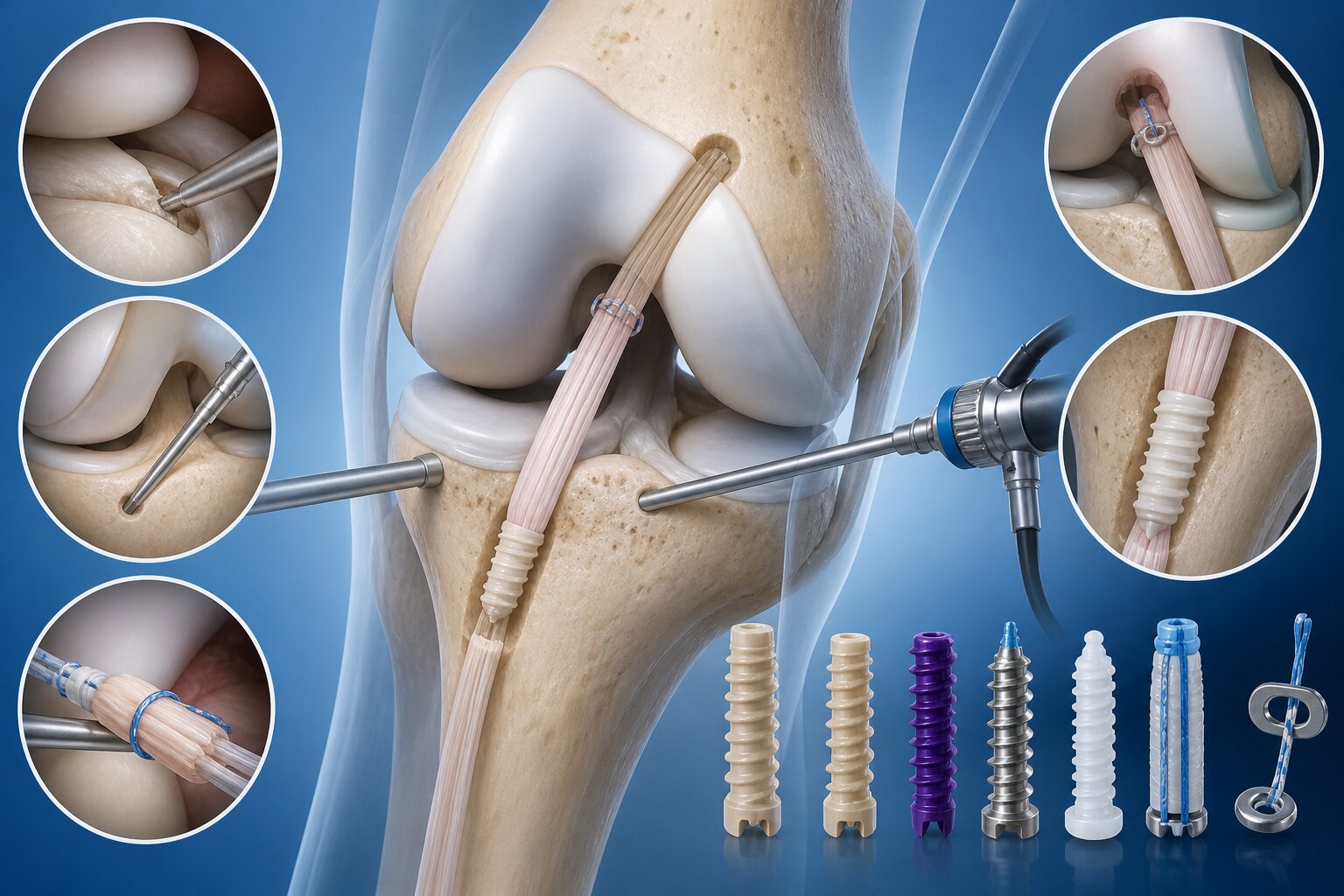
ACL reconstruction is a common arthroscopic procedure used to restore knee stability after anterior cruciate ligament injury. The success of the procedure depends on accurate tunnel placement, proper graft preparation, and secure fixation on both the femoral and tibial sides.
Orthosyn Medikal provides arthroscopy solutions including interference screws, fixation systems, anchors, bioabsorbable products, and instruments designed to support ligament reconstruction procedures.
The ACL is one of the main stabilizing ligaments of the knee. When it is torn, patients may experience instability, pain, swelling, and difficulty returning to sports.
ACL reconstruction aims to replace the damaged ligament with a graft and secure it inside bone tunnels created in the femur and tibia.
The surgeon first evaluates the knee joint arthroscopically. Meniscus, cartilage, and associated ligament injuries are assessed before reconstruction.
Common graft options include hamstring tendon, quadriceps tendon, patellar tendon, or allograft. The graft is sized and prepared according to the tunnel diameter and fixation method.
Accurate tunnel placement is essential. Malpositioned tunnels may cause graft impingement, instability, or limited range of motion.
The prepared graft is passed through the tibial and femoral tunnels to recreate the anatomical position of the ACL.
Fixation is one of the most important stages of ACL reconstruction. Orthosyn offers different implant options that can be used depending on surgeon preference and graft type.
Orthosyn PEEK interference screws are designed for arthroscopic and orthopedic procedures. The PEEK material is non-absorbable and MR safe, while the fully threaded design supports fixation for both soft tissue and BTB grafts.
PEEK screws are useful when imaging compatibility and long-term stability are important.
Orthosyn titanium interference screws are self-tapping screws designed for arthroscopic and sports surgery procedures. They are indicated for fixation of soft tissue grafts, BTB grafts, and ACL/PCL tear repair.
Their atraumatic thread design helps minimize tendon shearing, while the bullet core structure supports strong fixation.
Orthosyn I-BONE bioabsorbable interference screws are designed for tibial tunnel procedures and are available in PLDLA + TCP or PLA material options. They gradually absorb over time, reducing the need for secondary removal surgery.
These screws are especially useful when biological integration and reduced permanent implant presence are desired.
Suspensory fixation systems are commonly used on the femoral side in ACL reconstruction. They provide cortical fixation and are often combined with interference screws on the tibial side.
This combined approach allows strong femoral fixation and secure tibial graft compression.
The choice of fixation depends on:
A typical ACL reconstruction may use suspensory fixation on the femoral side and an interference screw on the tibial side.
Arthroscopic ACL reconstruction requires precision, reliable fixation, and high-quality implants. Orthosyn Medikal’s portfolio, including PEEK, titanium, and bioabsorbable interference screws, supports different surgical needs in modern ligament reconstruction.