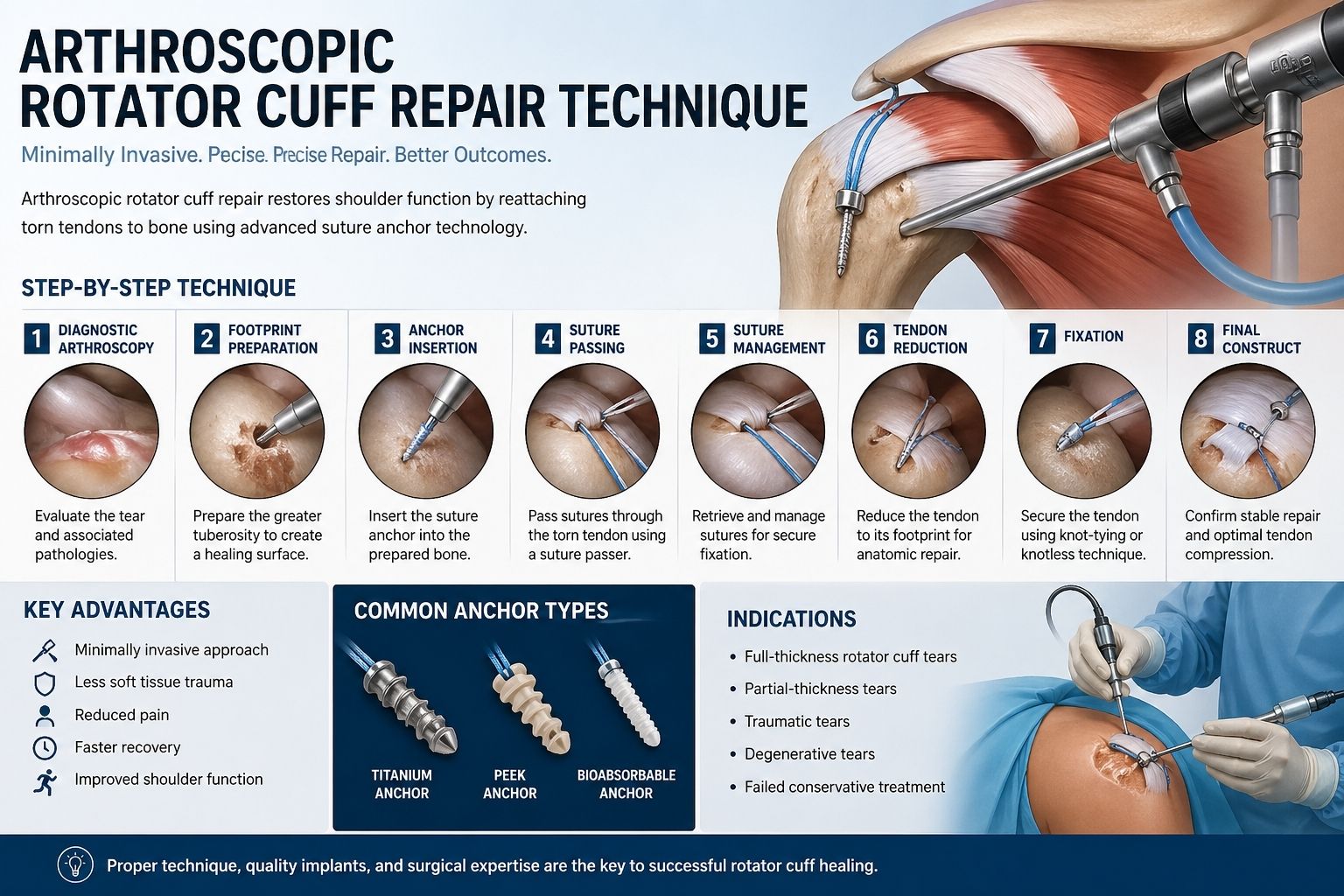
Arthroscopic rotator cuff repair is a minimally invasive procedure used to treat tears of the rotator cuff tendons. It is widely performed in orthopedic shoulder surgery due to its ability to restore function while minimizing tissue damage.
This technique relies on precise portal placement, proper tissue preparation, and secure fixation using suture anchors.
The rotator cuff consists of muscles and tendons that stabilize the shoulder joint. Tears can occur due to degeneration, trauma, or repetitive overhead activity.
Common symptoms include:
Arthroscopic rotator cuff repair is indicated in:
The patient is placed in either:
Proper positioning ensures optimal visualization and access.
Standard arthroscopic portals are established:
The surgeon evaluates:
The greater tuberosity is prepared using a burr to create a bleeding bone surface that enhances tendon healing.
Suture anchors are inserted into the prepared bone.
Common anchor types:
Sutures are passed through the tendon using suture passers or suture hooks.
Proper placement is essential for restoring tendon anatomy.
Different fixation methods can be used:
Double-row and suture bridge techniques improve footprint coverage and fixation strength.
Sutures are secured using:
Modern rotator cuff repair heavily depends on advanced suture anchor systems. Proper implant selection ensures strong fixation and long-term healing.
Orthosyn Medikal provides a range of suture anchors designed for reliable performance in arthroscopic shoulder procedures.
Arthroscopic rotator cuff repair is a highly effective technique when performed with proper surgical planning and instrumentation. Advances in arthroscopy and implant technology continue to improve patient outcomes and surgical efficiency.