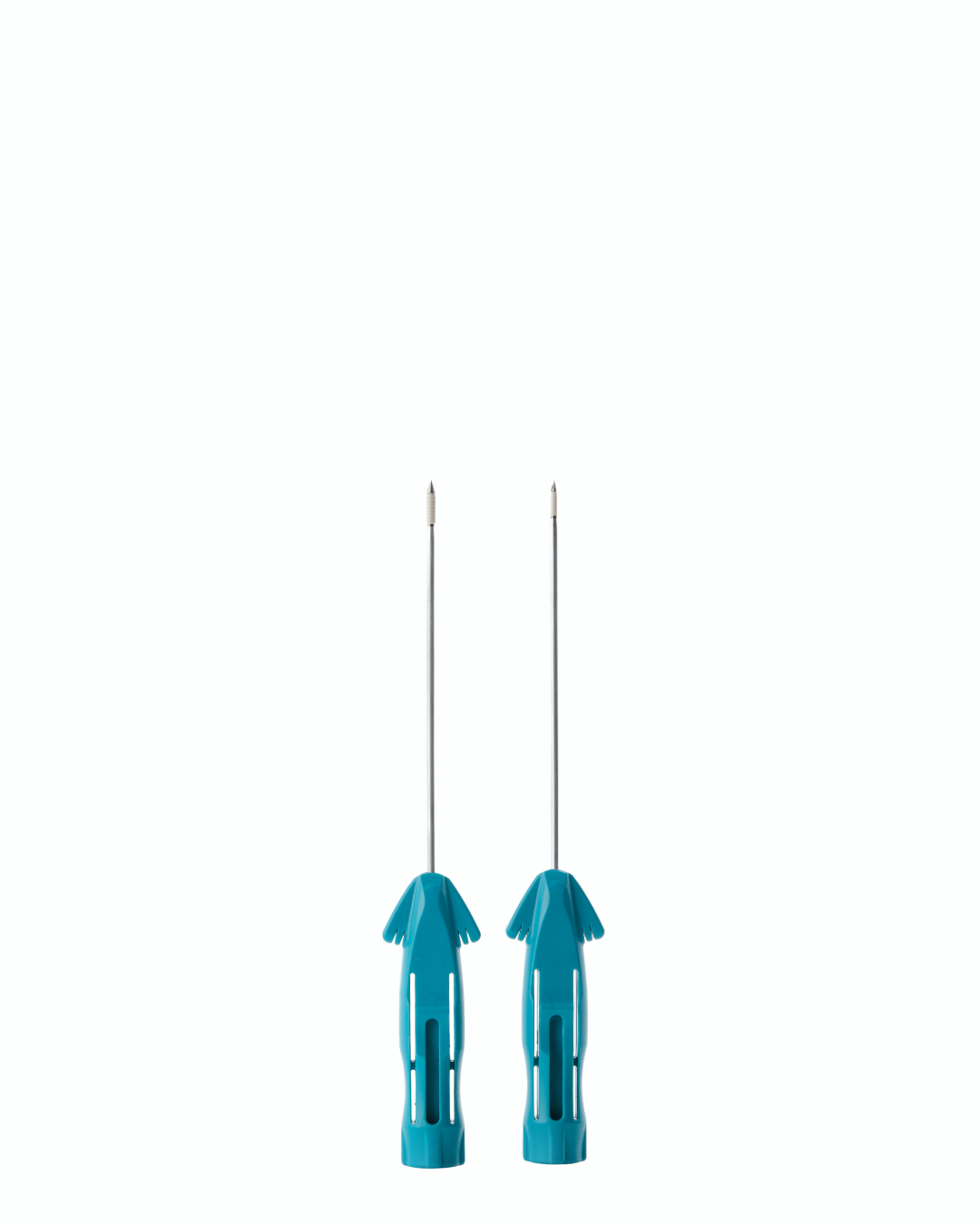
These anchors combine the cutting efficiency of a titanium tip with the biomechanical compatibility of a PEEK body, offering both surgical convenience and reliable long-term fixation.
A self-punching PEEK + Titanium anchor is a hybrid fixation implant featuring:
Titanium distal tip that penetrates cortical bone without pre-drilling or tapping
PEEK (Polyether Ether Ketone) body that provides elastic modulus closer to bone
The titanium tip initiates bone entry, while the PEEK body engages cancellous bone through controlled screw advancement.
The sharp titanium tip allows direct insertion into bone, reducing surgical steps.
Clinical advantages:
Shorter operative time
Fewer instruments required
Reduced risk of bone tunnel mismatch
This is particularly beneficial in small joint arthroscopy and minimally invasive procedures.
PEEK has an elastic modulus closer to cortical bone compared to metals.
Result:
Reduced stress shielding
More physiological load transfer
Lower risk of microfracture around the anchor site
Studies show that polymer-based anchor bodies demonstrate favorable cyclic loading behavior compared to fully metallic anchors.
The titanium tip ensures secure cortical engagement at insertion, while the PEEK screw threads maintain fixation within cancellous bone.
Biomechanical testing has demonstrated:
High pull-out resistance
Stable performance under cyclic loading
Consistent fixation even in lower bone density scenarios
Unlike fully metallic anchors, hybrid designs reduce peak insertion torque.
Titanium tip cuts bone efficiently
PEEK body lowers torsional stress during advancement
This combination significantly decreases anchor fracture risk during insertion, a known complication with rigid metal anchors.
PEEK is radiolucent, producing minimal artifact on MRI and CT.
Clinical benefits include:
Clear postoperative imaging
Improved assessment of soft tissue healing
Easier evaluation in revision surgery planning
The small titanium tip does not significantly compromise imaging quality.
Self-punching PEEK + Titanium anchors are well suited for knotless arthroscopic techniques, which:
Eliminate knot stacks
Reduce soft-tissue irritation
Provide reproducible tension control
Knotless constructs are increasingly preferred in shoulder, labral, and small joint procedures.
These anchors are widely used in:
Rotator cuff repair
Labral repair (Bankart lesions)
SLAP repairs
Small joint arthroscopy (wrist, ankle, elbow)
Soft tissue reattachment requiring precise fixation
Self-punching PEEK + Titanium Knotless anchors represent a next-generation fixation solution, combining the mechanical reliability of titanium with the biological and imaging advantages of PEEK.
By simplifying surgical workflow, enhancing fixation safety, and supporting modern knotless techniques, these anchors offer a balanced and surgeon-oriented approach to arthroscopic fixation.