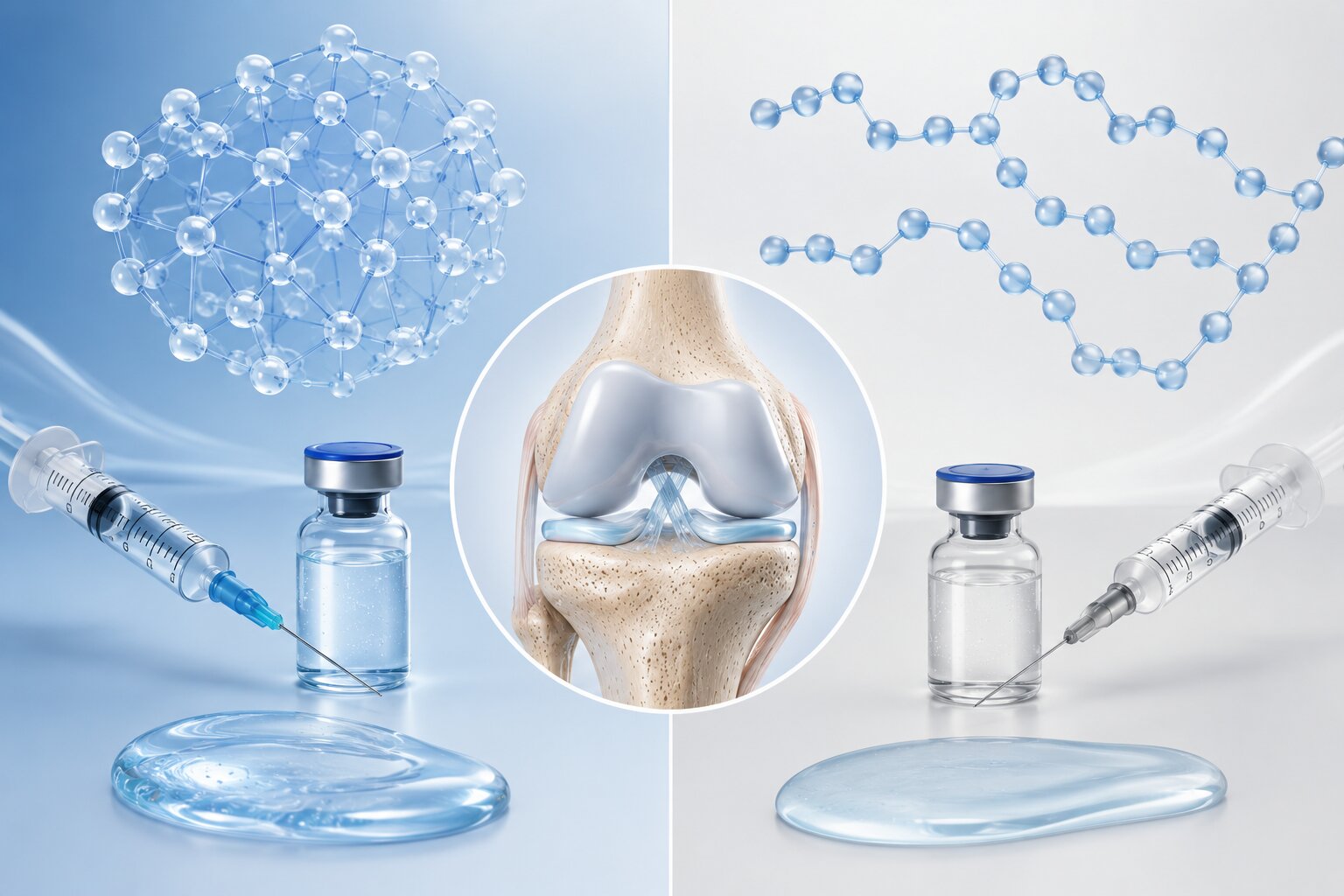
BDDE stands for 1,4-butanediol diglycidyl ether. It is a chemical cross-linking agent used in the production of cross-linked hyaluronic acid formulations.
Naturally occurring hyaluronic acid consists of long polymer chains. BDDE creates chemical connections between these chains, forming a three-dimensional molecular network.
This structural modification can influence viscosity, elasticity, viscoelasticity, structural stability and resistance to degradation.
BDDE contains two reactive epoxy groups that can react with hydroxyl groups on hyaluronic acid chains, forming stable ether bonds.
These chemical connections create bridges between polymer chains, transforming the linear HA structure into an interconnected molecular network.
The resulting network can retain water and exhibit hydrogel-like characteristics.
The primary purpose of BDDE cross-linking is to modify the physical and rheological properties of hyaluronic acid.
Its potential technical advantages include:
Increased structural stability.
Greater resistance to enzymatic degradation.
Modified viscosity and elasticity.
Improved resistance to deformation.
Potentially longer residence time within the joint.
Support for single-injection formulation development.
The extent of these effects depends on the complete formulation and manufacturing process.
By connecting polymer chains, BDDE can restrict their independent movement and modify resistance to flow.
However, the final viscosity is also influenced by HA concentration, molecular weight, cross-link density and measurement conditions.
Therefore, two BDDE cross-linked hyaluronic acid products can have significantly different rheological profiles.
The molecular network created through BDDE cross-linking can deform under mechanical loading and partially recover when the applied force is removed.
This behavior contributes to the elastic component of the formulation.
Two important rheological parameters used to characterize this behavior are:
G′ — Storage Modulus: Represents the elastic component.
G″ — Loss Modulus: Represents the viscous component.
The balance between these parameters helps describe how an HA formulation responds to changing mechanical conditions.
Non-cross-linked hyaluronic acid is susceptible to enzymatic and oxidative degradation.
The molecular network created through BDDE cross-linking can increase resistance to degradation compared with an equivalent non-cross-linked formulation.
This may contribute to longer structural persistence within the joint environment.
However, longer molecular persistence does not automatically establish a longer duration of clinical benefit.
An important distinction in cross-linked HA manufacturing is the difference between BDDE incorporated into the molecular structure and residual unreacted BDDE.
Bound BDDE refers to BDDE-derived chemical structures incorporated into the HA polymer.
Residual BDDE refers to unreacted cross-linking agent remaining after manufacturing and purification.
Purification, residual BDDE testing, biocompatibility assessment and manufacturing quality controls are therefore important aspects of medical-grade cross-linked hyaluronic acid production.
Not necessarily.
Increasing the amount of cross-linking agent does not automatically improve the quality or clinical performance of an HA injection.
The final formulation must achieve an appropriate balance between structural stability, elasticity, viscosity, injectability and biocompatibility.
Cross-link density and the distribution of chemical connections are more informative than the quantity of cross-linking agent alone.
| Characteristic | Linear HA | BDDE Cross-Linked HA |
|---|---|---|
| Molecular structure | Individual polymer chains | Interconnected molecular network |
| BDDE cross-linking | No | Yes |
| Chemical bridges | No intentional cross-links | Ether-based chemical connections |
| Elasticity | Polymer-chain interaction | Influenced by network structure |
| Viscosity | Molecular weight and concentration dependent | Additionally influenced by cross-link density |
| Degradation resistance | Formulation-dependent | Potentially increased |
| Residence time | Product-dependent | Potentially extended |
Both formulation technologies have distinct physical characteristics and should be evaluated according to their complete technical and clinical profiles.
AlkaFlex Cross-Linked Hyaluronic Acid combines non-animal-derived HA produced through bacterial fermentation with BDDE cross-linking technology.
The AlkaFlex cross-linked portfolio includes single-injection intra-articular formulations in different concentrations and volumes.
| HA Dose | Volume | Concentration |
|---|---|---|
| 60 mg | 2 mL | 3% |
| 72 mg | 3 mL | 2.4% |
| 90 mg | 3 mL | 3% |
These formulations represent different dose and volume configurations within the AlkaFlex viscosupplementation portfolio.
Explore AlkaFlex Cross-Linked Hyaluronic Acid:
BDDE cross-linking is a molecular modification technology used to create chemical connections between hyaluronic acid polymer chains.
This process can modify viscosity, elasticity, structural stability, viscoelasticity and resistance to degradation.
However, the performance of cross-linked hyaluronic acid depends on more than the cross-linking agent itself.
Molecular Weight + HA Concentration + Cross-Link Density + Network Architecture + Purification + Rheological Profile
Together, these parameters contribute to the technical characteristics of the final formulation.
Through its BDDE cross-linked formulations, AlkaFlex by Orthosyn Medikal incorporates molecular-network technology into its intra-articular hyaluronic acid portfolio.