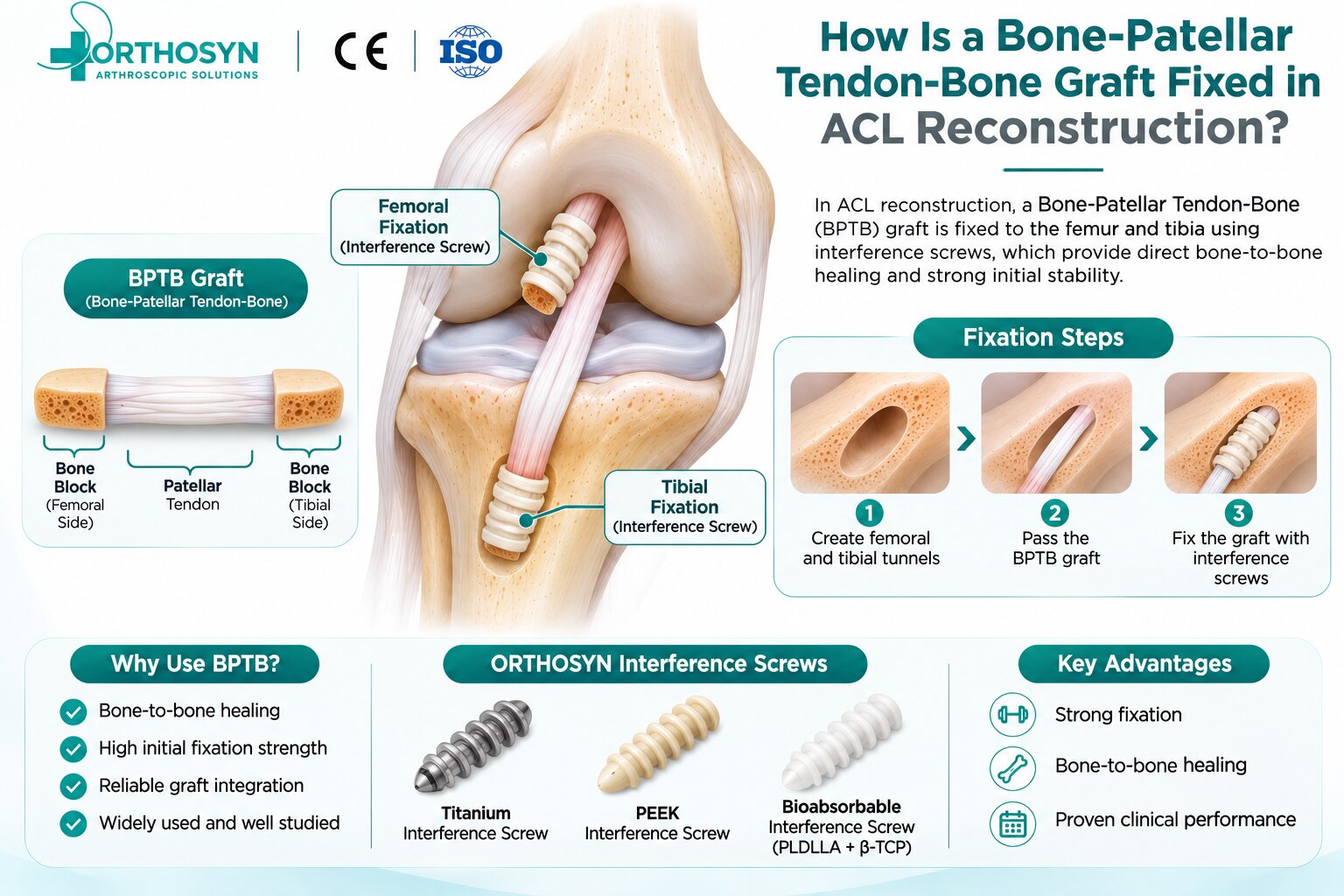
Bone-patellar tendon-bone (BPTB) graft fixation in ACL reconstruction is a surgical technique used to restore anterior cruciate ligament function using a section of the patellar tendon with bone blocks at both ends.
Unlike hamstring tendon grafts, BPTB grafts allow bone-to-bone healing within the femoral and tibial tunnels. Interference screws are commonly used to secure the bone blocks and provide initial mechanical stability during biological healing.
The fundamental fixation concept is:
BPTB Graft Preparation → Femoral and Tibial Tunnel Preparation → Graft Passage → Bone Block Fixation → Bone-to-Bone Healing
A bone-patellar tendon-bone graft, also known as a BPTB or BTB graft, consists of three components:
A bone block harvested from the patella.
A central portion of the patellar tendon.
A bone block harvested from the tibial tubercle.
The tendon portion replaces the damaged ACL, while the bone blocks provide fixation interfaces within the femoral and tibial bone tunnels.
BPTB autografts are commonly considered in ACL reconstruction, particularly in patients participating in demanding sporting activities.
The patellar tendon graft and its two bone blocks are prepared according to the required graft dimensions and tunnel configuration.
Bone tunnels are prepared at the anatomical attachment regions of the anterior cruciate ligament.
Accurate tunnel positioning is important for restoring appropriate knee biomechanics.
The BPTB graft is passed through the prepared tunnels, positioning the bone blocks within the femoral and tibial fixation regions.
Interference screws are commonly positioned between the bone blocks and the tunnel walls.
This creates compression that helps secure the graft and limit movement within the tunnels.
The surgeon evaluates graft tension, fixation stability, knee range of motion, and potential graft impingement.
Interference screws provide aperture fixation by compressing the bone block against the surrounding tunnel wall.
The mechanical principle is:
Bone Tunnel Wall → Interference Screw Compression → Bone Block Stability → Bone-to-Bone Healing
This fixation method aims to provide initial mechanical stability while biological incorporation of the bone blocks develops.
Fixation performance depends on screw dimensions, bone quality, bone block geometry, tunnel diameter, and implant positioning.
Material | Main characteristics |
|---|---|
Titanium | Metallic fixation with established mechanical properties |
PEEK | Nonmetallic, nonabsorbable polymer with relatively low imaging artifacts |
Bioabsorbable polymers | Designed to undergo gradual degradation |
Biocomposite materials | Combine degradable polymers with mineral components such as β-TCP |
Each material has different mechanical and biological characteristics. No single interference screw material is universally superior for every ACL reconstruction procedure.
Characteristic | BPTB Graft | Hamstring Graft |
|---|---|---|
Graft structure | Tendon with two bone blocks | Soft tissue tendon graft |
Healing mechanism | Bone-to-bone | Tendon-to-bone |
Common fixation | Interference screws | Cortical buttons or interference screws |
Donor site | Patellar tendon | Hamstring tendons |
Potential donor-site complication | Anterior knee pain and kneeling discomfort | Hamstring weakness |
Both graft types are established options for ACL reconstruction. Graft selection depends on patient anatomy, activity level, associated injuries, and surgical assessment.
Although interference screws are commonly associated with BPTB graft fixation, specialized cortical suspensory fixation techniques may also be used.
These techniques require compatible implant designs and appropriate bone block preparation.
Conventional soft tissue graft fixation buttons should not automatically be considered suitable for BPTB grafts.
ORTHOSYN offers different interference screw technologies for compatible ligament reconstruction procedures.
Metallic interference screws designed to provide mechanical graft fixation within bone tunnels.
Nonabsorbable polymer-based fixation systems providing an alternative to metallic interference screws.
Bioabsorbable fixation options, including biocomposite formulations containing PLDLLA and 30% β-TCP, designed to undergo gradual degradation.
The suitability of each ORTHOSYN interference screw for BPTB graft fixation must be confirmed according to its product-specific indications, dimensions, and instructions for use.
Explore the ORTHOSYN Arthroscopy Portfolio.
Successful graft incorporation depends on several factors:
Anatomical tunnel positioning
Bone block dimensions and quality
Interference screw fixation stability
Bone-to-bone contact
Appropriate graft tension
Patient-specific biological factors
Postoperative rehabilitation
Although bone-to-bone healing may offer biological advantages, it does not eliminate the need for graft remodeling and functional rehabilitation.
Potential complications associated with BPTB ACL reconstruction include anterior knee pain, kneeling discomfort, graft fixation failure, knee stiffness, and donor-site morbidity.
Patellar fracture and patellar tendon rupture are uncommon but recognized potential complications.
Appropriate graft preparation, fixation selection, and surgical planning are important for managing these risks.
Rehabilitation following BPTB ACL reconstruction generally includes progressive knee mobility, quadriceps strengthening, neuromuscular training, and functional exercises.
Return to demanding pivoting sports commonly requires nine to twelve months or longer, depending on biological healing, muscle strength, functional testing, and clinical assessment.
Bone block incorporation alone does not determine readiness to return to sport.
Bone-patellar tendon-bone graft fixation in ACL reconstruction commonly relies on interference screws to secure the femoral and tibial bone blocks within prepared bone tunnels.
The technique provides initial mechanical stability while supporting bone-to-bone healing.
ORTHOSYN offers titanium, PEEK, and bioabsorbable interference screw technologies for compatible ligament reconstruction applications.
Successful BPTB ACL reconstruction depends on anatomical graft positioning, appropriate implant selection, stable fixation, biological incorporation, and structured rehabilitation.