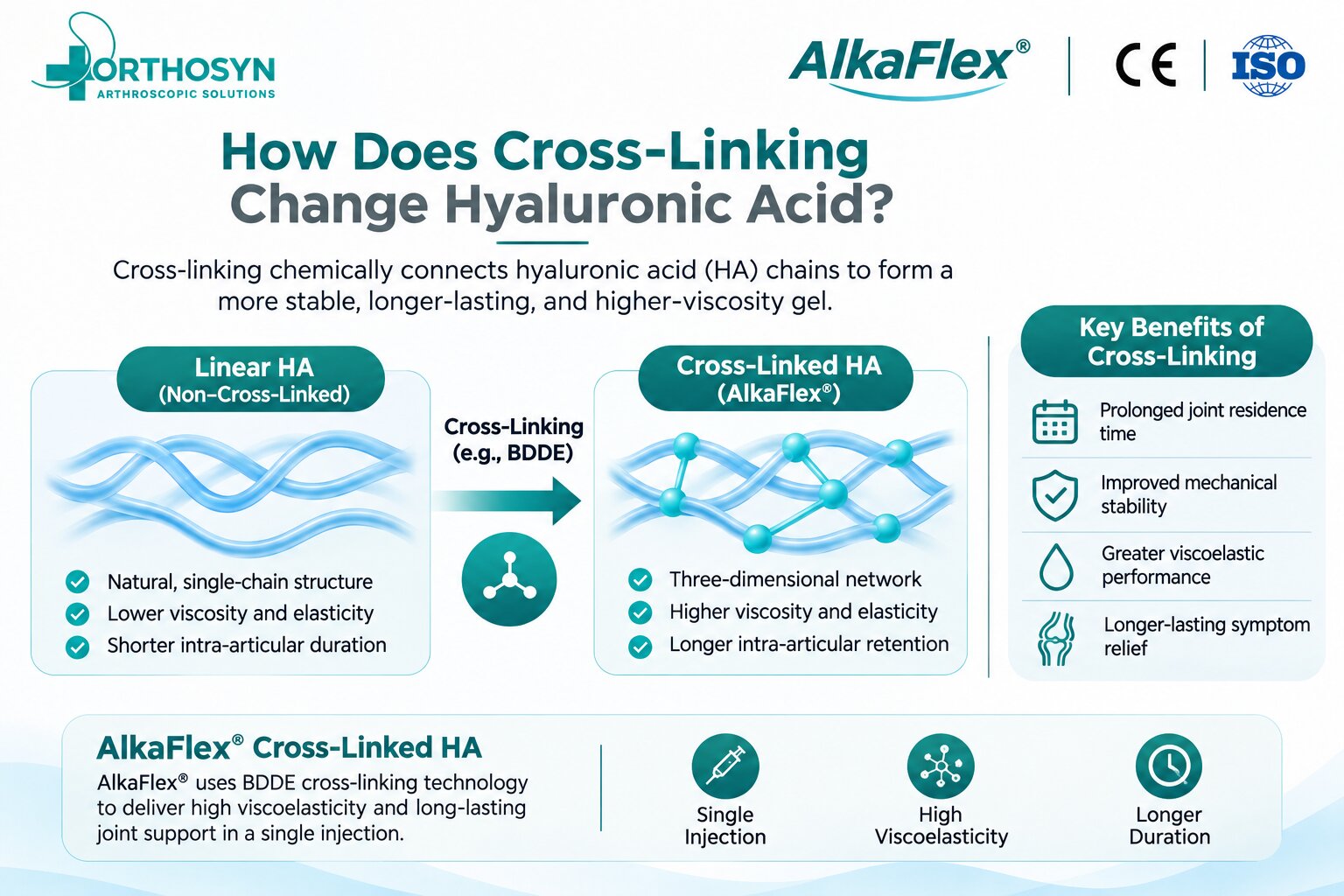
Cross-linking changes hyaluronic acid (HA) by creating chemical connections between individual polymer chains, forming a three-dimensional network. This structural modification can influence the viscosity, elasticity, mechanical properties, and resistance to degradation of hyaluronic acid formulations.
In intra-articular injections, cross-linking is used to modify the viscoelastic characteristics and persistence of hyaluronic acid within the joint.
AlkaFlex offers both linear and cross-linked hyaluronic acid formulations with different structural and rheological characteristics for viscosupplementation.
Natural hyaluronic acid consists of long, linear polysaccharide chains composed of repeating disaccharide units.
In cross-linked hyaluronic acid, chemical bonds connect these individual chains, creating an interconnected polymer network.
The fundamental structural difference is:
Linear Hyaluronic Acid: Individual polymer chains without permanent chemical cross-links.
Cross-Linked Hyaluronic Acid: Interconnected polymer chains forming a three-dimensional network.
This modification changes how hyaluronic acid responds to mechanical forces, absorbs water, and undergoes degradation.
Cross-linking can increase resistance to flow by restricting the independent movement of polymer chains.
However, viscosity also depends on HA concentration, molecular weight, cross-linking density, and measurement conditions.
The interconnected polymer network can improve the ability of a formulation to recover its shape after deformation.
Elasticity is an important rheological characteristic when evaluating hyaluronic acid formulations intended for mechanically active joints.
Cross-linking can increase resistance to enzymatic degradation by limiting the accessibility of hyaluronic acid chains to degrading enzymes.
This may contribute to longer intra-articular residence time compared with certain linear formulations.
Hyaluronic acid naturally attracts and retains water. Cross-linking modifies the swelling behavior and water retention characteristics of the polymer network.
The extent of these changes depends on the formulation and cross-linking technology.
Cross-linking modifies the balance between viscous and elastic behavior.
This balance is particularly relevant in viscosupplementation, where hyaluronic acid formulations are intended to supplement the viscoelastic properties of synovial fluid.
BDDE (1,4-butanediol diglycidyl ether) is a cross-linking agent used in certain hyaluronic acid formulations.
It creates chemical connections between HA polymer chains, forming a more interconnected structure.
Important manufacturing considerations include cross-linking density, purification, residual cross-linking agent levels, biocompatibility, and rheological characterization.
AlkaFlex Cross-Linked Hyaluronic Acid formulations utilize BDDE cross-linking technology.
Characteristic | Linear HA | Cross-Linked HA |
|---|---|---|
Molecular structure | Individual polymer chains | Interconnected polymer network |
Chemical cross-links | Absent | Present |
Viscosity | Formulation-dependent | Can be increased through cross-linking |
Elasticity | Formulation-dependent | Can exhibit greater elastic behavior |
Degradation resistance | Generally lower under comparable conditions | Potentially higher |
Intra-articular persistence | Formulation-dependent | Potentially longer |
Injection protocol | Single or multiple injections | Frequently single-injection protocols |
Cross-linking alone does not determine clinical effectiveness. The complete formulation, manufacturing process, dosage, and clinical evidence must also be considered.
Cross-linking connects individual hyaluronic acid chains into larger molecular networks.
However, the molecular weight of a linear HA chain and the reported molecular weight of a cross-linked polymer network are not necessarily directly comparable.
Cross-linking density, network structure, and rheological measurements provide additional information about the characteristics of cross-linked formulations.
Not necessarily.
A higher degree of cross-linking may increase network stiffness and degradation resistance, but it can also influence injectability, swelling behavior, and other physical properties.
An appropriate balance between viscosity, elasticity, degradation resistance, and injectability is important when developing intra-articular hyaluronic acid formulations.
Greater cross-linking does not automatically guarantee better clinical outcomes or longer-lasting symptom relief.
AlkaFlex provides different hyaluronic acid formulations manufactured using sodium hyaluronate obtained through bacterial fermentation.
Non-cross-linked molecular structure
Molecular weight of approximately 2.4 MDa
Available in different concentrations and dosages
BDDE cross-linking technology
Three-dimensional polymer network
Manufacturer-reported molecular weight of approximately 5.65 MDa
Available in single-injection formulations:
60 mg / 2 mL – 3%
72 mg / 3 mL – 2.4%
90 mg / 3 mL – 3%
These formulations provide different structural and physicochemical characteristics for intra-articular viscosupplementation.
Explore the AlkaFlex Hyaluronic Acid portfolio at ORTHOSYN.
Cross-linking changes hyaluronic acid by connecting individual polymer chains into a three-dimensional molecular network.
This structural modification can influence viscosity, elasticity, water retention, degradation resistance, and intra-articular persistence.
AlkaFlex Linear and AlkaFlex Cross-Linked Hyaluronic Acid formulations represent different approaches to hyaluronic acid viscosupplementation.
The performance of a hyaluronic acid injection depends not only on cross-linking but also on molecular structure, concentration, dosage, rheological properties, and formulation-specific clinical evidence.