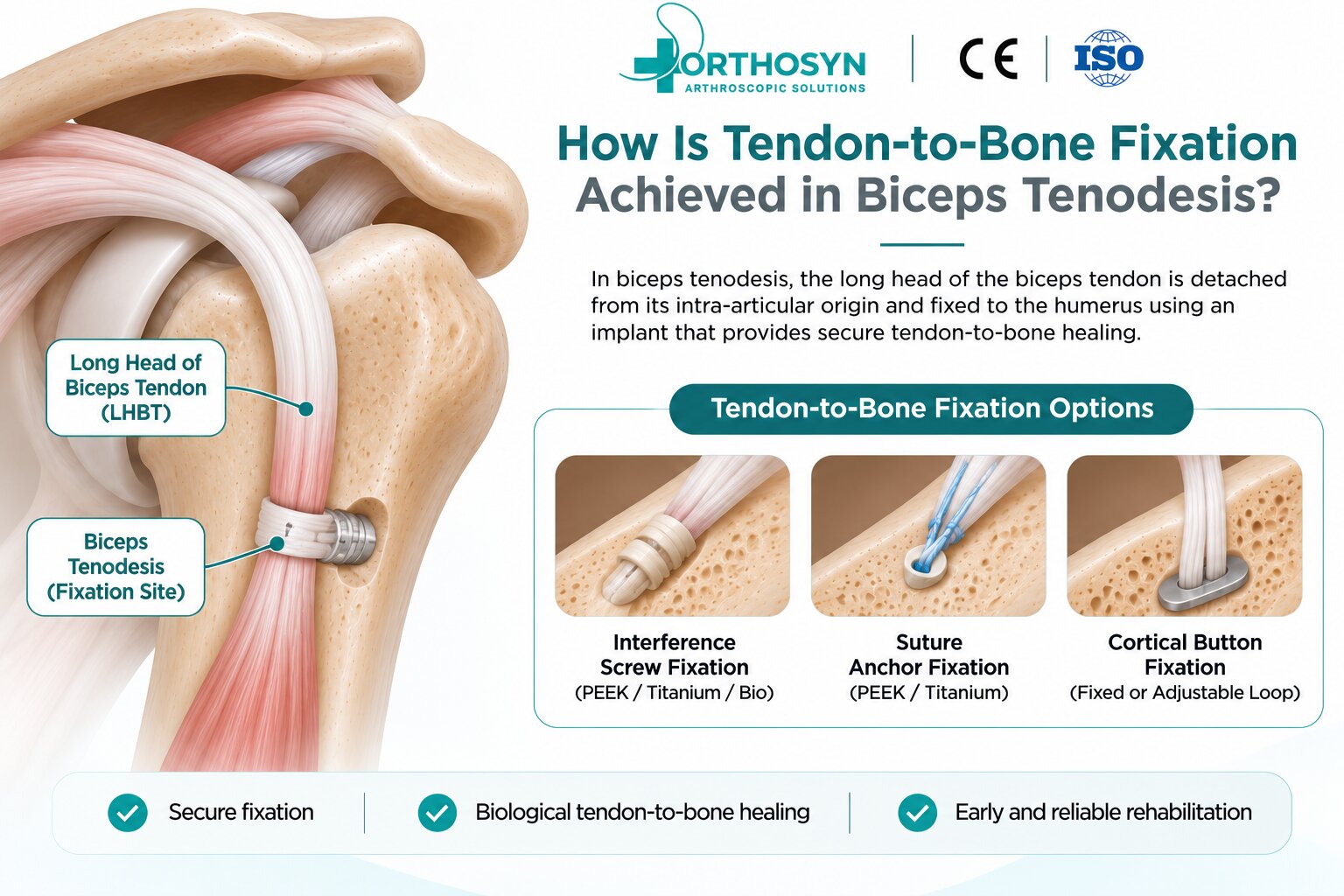
Tendon-to-bone fixation in biceps tenodesis is a surgical technique used to secure the long head of the biceps tendon to the humerus after releasing it from its original attachment at the superior glenoid region.
Biceps tenodesis is commonly performed to address selected conditions involving biceps tendon degeneration, partial tears, tendon instability, and associated shoulder injuries.
The procedure aims to establish stable mechanical fixation while supporting biological healing between the tendon and bone.
The fundamental fixation concept is:
Biceps Tendon Release → Tendon Preparation → Humeral Fixation Site Preparation → Tendon-to-Bone Fixation → Biological Healing
Biceps tenodesis is a surgical procedure in which the long head of the biceps tendon is detached from its original proximal attachment and secured to a new location on the humerus.
The procedure may be considered in patients with:
Long head of the biceps tendon injuries
Biceps tendinopathy
Partial tendon tears
Biceps tendon instability
Selected SLAP lesions
Associated rotator cuff injuries
Biceps tenodesis can be performed using arthroscopic, open, or mini-open surgical approaches.
Characteristic | Biceps Tenodesis | Biceps Tenotomy |
|---|---|---|
Surgical principle | Tendon release and refixation | Tendon release without refixation |
Bone fixation | Required | Not required |
Implant use | Depends on fixation technique | Generally not required |
Popeye deformity risk | Generally lower | Generally higher |
Rehabilitation | Requires protection of the fixation site | Often less restrictive when performed alone |
Both procedures can provide satisfactory clinical outcomes in appropriately selected patients.
Several fixation techniques are available for biceps tenodesis.
Interference screw fixation involves securing the biceps tendon within a prepared bone socket in the humerus.
The screw compresses the tendon against the surrounding bone, providing initial mechanical fixation.
Common interference screw materials include titanium, PEEK, and bioabsorbable polymers.
The mechanical principle is:
Bone Socket → Biceps Tendon → Interference Screw Compression → Tendon-to-Bone Fixation
Suture anchors provide an alternative method of securing the biceps tendon to the humerus.
High-strength sutures capture the tendon and approximate it to the prepared bone surface or fixation site.
Depending on the surgical technique, fixation may be achieved using conventional or knotless suture anchors.
Cortical button fixation uses a button supported by the cortical bone of the humerus.
Sutures connect the tendon to the fixation device and maintain its position during the initial healing period.
The specific fixation configuration depends on the implant design and surgical approach.
Characteristic | Inlay Tenodesis | Onlay Tenodesis |
|---|---|---|
Tendon position | Within a prepared bone socket | Against the bone surface |
Common fixation | Interference screws or selected button systems | Suture anchors or selected cortical buttons |
Bone preparation | Tendon-sized socket generally required | Depends on the fixation system |
Healing interface | Tendon within the bone socket | Tendon against the bone surface |
Both techniques aim to establish stable tendon-to-bone fixation.
Neither approach is universally superior for every patient or clinical indication.
Biceps tenodesis can be performed at different anatomical locations along the proximal humerus.
Suprapectoral Tenodesis: The tendon is secured above the pectoralis major tendon insertion, frequently using an arthroscopic approach.
Subpectoral Tenodesis: The tendon is secured below the pectoralis major tendon insertion, commonly through a mini-open approach.
The choice of fixation location depends on tendon pathology, bone quality, associated injuries, and surgical preference.
ORTHOSYN offers several orthopedic fixation technologies relevant to tendon-to-bone repair.
Available material options include:
Titanium Interference Screws
PEEK Interference Screws
Bioabsorbable Interference Screws
ORTHOSYN provides conventional PEEK and titanium suture anchors, as well as UHMWPE-based Soft Anchors.
Available configurations include PEEK + PEEK and PEEK + Titanium Knotless Anchors in 3.5 mm and 5.0 mmdiameters.
High-strength UHMWPE sutures provide options for compatible orthopedic soft tissue fixation procedures.
The suitability of these products for specific biceps tenodesis techniques must be confirmed through their product-specific indications, dimensions, compatibility requirements, and instructions for use.
Explore the ORTHOSYN Arthroscopy Portfolio.
Successful tendon-to-bone healing depends on several factors:
Tendon tissue quality
Humeral bone quality
Initial fixation stability
Appropriate tendon length and tension
Tendon-to-bone contact
Implant and suture characteristics
Patient-specific biological factors
Postoperative rehabilitation
Mechanical fixation provides initial stability, while biological incorporation develops gradually over time.
Potential complications following biceps tenodesis include fixation failure, persistent pain, tendon migration, muscle cramping, Popeye deformity, and shoulder stiffness.
Humeral fracture is also a rare potential complication, particularly with techniques involving bone socket preparation.
Appropriate fixation selection and surgical planning are important for managing these risks.
Rehabilitation following biceps tenodesis generally involves initial protection of the repaired tendon, controlled shoulder mobility, and progressive strengthening.
Resisted elbow flexion and forearm supination are typically restricted during the early healing period.
Return to demanding physical activities may require approximately three to six months or longer, depending on biological healing, associated procedures, and functional recovery.
Tendon-to-bone fixation in biceps tenodesis can be achieved using interference screws, suture anchors, or cortical button systems.
Each technique provides a different mechanical fixation principle while aiming to maintain tendon stability during biological healing.
ORTHOSYN offers interference screw, suture anchor, knotless anchor, and high-strength suture technologies for compatible orthopedic fixation applications.
Successful biceps tenodesis depends on appropriate anatomical positioning, stable fixation, balanced tendon tension, biological healing, and structured rehabilitation.