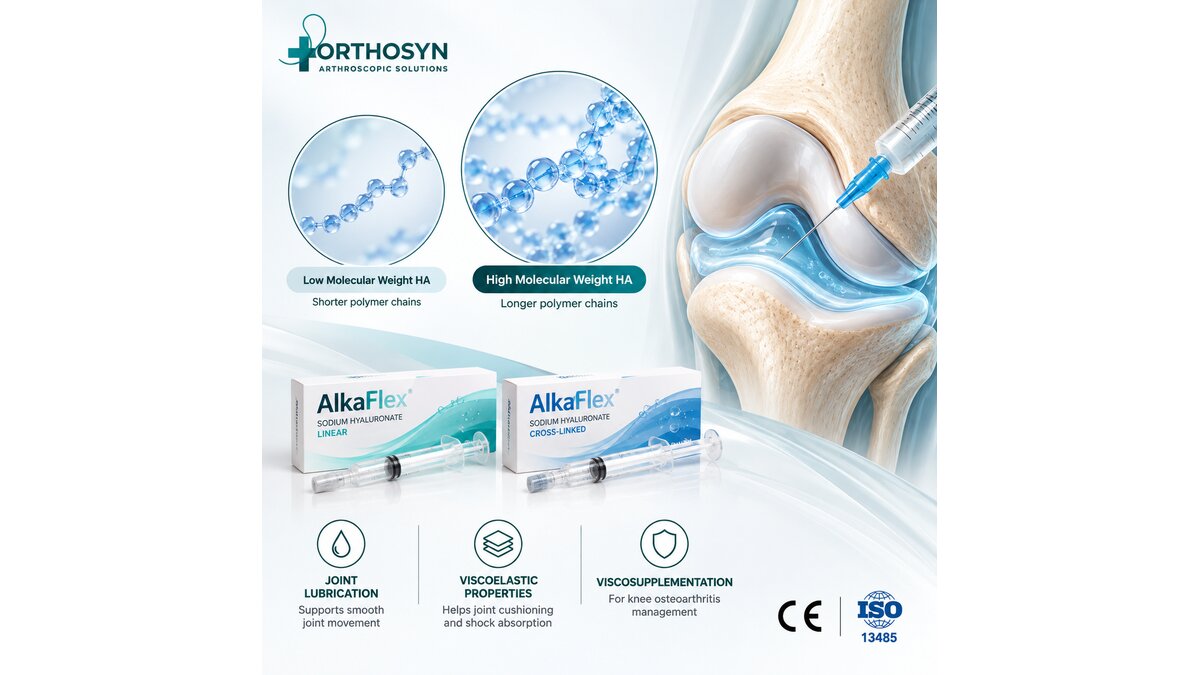
Linear and cross-linked hyaluronic acid (HA) differ primarily in their molecular structure.
In linear HA, the polymer chains remain mainly separate and non-cross-linked. In cross-linked HA, selected HA chains are chemically connected to form a molecular network.
This structural difference can influence:
viscosity,
elasticity,
viscoelasticity,
resistance to degradation,
flow behavior,
and residence characteristics.
Both approaches are used in intra-articular hyaluronic acid injections and viscosupplementation.
The AlkaFlex portfolio includes both linear and cross-linked HA formulations, allowing these two molecular strategies to be evaluated separately.
Linear HA consists of long, non-cross-linked hyaluronic acid polymer chains.
The chains remain primarily independent but can interact and physically entangle with one another.
Its behavior is strongly influenced by:
molecular weight,
concentration,
molecular-weight distribution,
polymer-chain interaction,
temperature,
and formulation conditions.
Linear does not mean low molecular weight or low viscosity.
A linear HA formulation can contain very long polymer chains and show substantial viscosity and viscoelasticity.
AlkaFlex Linear uses high molecular weight linear HA with an approximate molecular weight of 2.4 MDa.
Cross-linked HA contains polymer chains that are chemically connected.
These connections create a three-dimensional molecular network.
The network modifies the way HA behaves under mechanical stress and can influence:
elasticity,
viscosity,
structural stability,
resistance to deformation,
and degradation characteristics.
Cross-linked formulations therefore depend not only on the original HA chains but also on the characteristics of the molecular network.
The easiest way to understand the difference is through molecular architecture.
Long individual polymer chains
The chains can move relative to one another and become physically entangled.
Interconnected polymer network
Selected chains are chemically linked, creating a more structured molecular system.
This difference affects how the two formulation types respond to movement, shear and mechanical loading.
| Characteristic | Linear HA | Cross-Linked HA |
|---|---|---|
| Molecular structure | Individual polymer chains | Interconnected molecular network |
| Chemical cross-linking | No | Yes |
| Main structural influence | Chain length and entanglement | Network architecture and cross-link density |
| Molecular weight | Particularly important | Important but must be considered with network structure |
| Viscosity | Can be high | Can also be high |
| Elastic behavior | Possible through polymer interactions | Often strongly influenced by molecular network |
| Rheology | Depends strongly on MW and concentration | Depends on MW, concentration and cross-linking |
| Degradation | Influenced by chain characteristics | Network may modify degradation resistance |
| Injection protocol | Can vary | Can vary |
| Single-injection use | Possible depending on formulation | Commonly associated, but not automatic |
The exact performance of either type depends on the complete formulation.
No.
This is one of the most common misconceptions.
The viscosity of linear HA can be strongly influenced by:
molecular weight,
concentration,
polymer entanglement,
molecular-weight distribution,
and temperature.
High molecular weight linear HA can therefore have substantial viscosity.
For this reason:
Linear HA ≠ Low-viscosity HA
The molecular structure alone is not enough to predict viscosity.
Not necessarily.
Cross-linking can increase resistance to flow and change the rheological behavior of HA.
However, the final viscosity also depends on:
concentration,
original polymer characteristics,
cross-link density,
network architecture,
temperature,
and measurement conditions.
Two cross-linked formulations can therefore have very different viscosity profiles.
Molecular weight is especially straightforward in linear HA.
It generally refers to the size of the individual HA polymer chains.
For example, AlkaFlex Linear uses approximately 2.4 MDa HA, meaning polymer chains with an approximate molecular weight of 2.4 million daltons.
In cross-linked HA, interpretation becomes more complex.
Once the individual chains are chemically connected into a network, the rheological behavior of the final product cannot be explained simply by quoting the original molecular weight.
The molecular network becomes an additional and important variable.
Yes.
Concentration remains important whether HA is linear or cross-linked.
For example:
1% = 10 mg/mL
2% = 20 mg/mL
3% = 30 mg/mL
Increasing concentration means more HA is present in the same volume.
This can influence:
molecular interaction,
viscosity,
elasticity,
and overall rheological behavior.
However, two products with the same concentration can still behave very differently if one is linear and the other is cross-linked.
Cross-linking creates chemical bridges between HA polymer chains.
Instead of behaving entirely as separate chains, parts of the HA structure become connected.
This creates a molecular network that can modify:
flow behavior,
deformation,
elastic recovery,
viscosity,
and degradation characteristics.
The degree and distribution of these connections are important in determining the final behavior of the formulation.
Cross-link density describes how extensively HA chains are connected within the network.
A relatively loose network may behave differently from a more densely cross-linked structure.
Cross-link density can influence:
elasticity,
deformation resistance,
viscosity,
and structural stability.
However:
More cross-linking does not automatically mean better HA.
The complete formulation should always be evaluated.
Both linear and cross-linked HA can demonstrate viscoelastic behavior.
Viscoelasticity combines:
Viscosity — resistance to flow
and
Elasticity — deformation and recovery behavior.
In linear HA, viscoelasticity is strongly influenced by polymer-chain length, concentration and physical entanglement.
In cross-linked HA, the molecular network adds another structural factor that can strongly influence elastic behavior.
Rheological testing may use two important parameters:
G′ — Storage Modulus
Represents the elastic component.
G″ — Loss Modulus
Represents the viscous component.
Linear and cross-linked formulations may produce different G′ and G″ profiles.
However, these values should only be compared under similar testing conditions.
Important variables include:
frequency,
temperature,
shear conditions,
and measurement method.
HA formulations can demonstrate shear-dependent behavior.
For example, apparent viscosity may decrease as shear rate increases, a phenomenon commonly called shear thinning.
Linear and cross-linked formulations can respond differently because their molecular structures are different.
Linear HA relies primarily on chain movement and entanglement.
Cross-linked HA additionally contains a connected molecular network.
Therefore, rheological measurements are useful when comparing the two.
Cross-linking can increase resistance to degradation compared with an equivalent non-cross-linked molecular structure.
The connected network may make it more difficult for the HA structure to break down.
However, degradation depends on several factors:
molecular weight,
concentration,
cross-link chemistry,
degree of cross-linking,
network architecture,
and environmental conditions.
Therefore, it is not accurate to predict degradation behavior from the words “linear” or “cross-linked” alone.
No.
Cross-linked HA is commonly associated with single-injection viscosupplementation formulations, but the terms are not interchangeable.
A cross-linked product may use a particular injection protocol based on its complete formulation.
Likewise, a single-injection product should not automatically be assumed to be cross-linked.
Therefore:
Cross-Linked HA ≠ Automatically Single Injection
Injection protocol must be evaluated separately.
Not necessarily.
The number of injections depends on the individual formulation and its intended protocol.
Linear structure alone does not determine the number of injections.
Products should therefore be evaluated according to:
total HA dose,
concentration,
volume,
molecular weight,
rheological properties,
and intended protocol.
Naturally occurring hyaluronic acid exists as linear polymer chains.
Cross-linked HA undergoes an additional chemical modification to connect selected chains into a network.
For this reason, linear HA is structurally closer to the basic polymer architecture of naturally occurring HA.
However, this does not mean one structure is automatically superior.
They are different technical approaches to HA formulation.
There is no universal answer.
Linear HA and cross-linked HA should not be ranked simply according to molecular structure.
A high-quality technical comparison should evaluate the complete formulation.
For linear HA:
Molecular Weight + Concentration + Dose + Volume + Rheology
For cross-linked HA:
Original Polymer Characteristics + Concentration + Cross-Linking + Network Architecture + Dose + Rheology
The most appropriate comparison therefore depends on the specific products being evaluated.
When comparing linear and cross-linked HA injections, useful parameters include:
molecular structure,
molecular weight,
HA concentration,
total HA dose,
injection volume,
cross-linking method,
degree of cross-linking,
viscosity,
G′ and G″,
injection protocol,
manufacturing method,
and supporting technical documentation.
Looking at only one parameter can lead to an incomplete comparison.
AlkaFlex Linear uses high molecular weight, non-cross-linked hyaluronic acid.
Its approximate molecular weight is 2.4 MDa.
Its technical profile is therefore associated with:
linear HA,
non-cross-linked HA,
high molecular weight HA,
intra-articular HA,
viscosity,
viscoelasticity,
and viscosupplementation.
Explore AlkaFlex Linear Intra-Articular Hyaluronic Acid:
https://orthosynmed.com/product/39/alkaflex-intra-articular-injections-with-hyaluronic-acid---linear-linked
AlkaFlex Cross-Linked uses a molecular-network approach created through cross-linking.
Its technical profile is associated with:
cross-linked HA,
molecular-network structure,
intra-articular HA,
viscosity,
elasticity,
viscoelasticity,
and viscosupplementation.
Depending on the formulation, the AlkaFlex Cross-Linked portfolio includes different concentrations and total HA doses.
Explore AlkaFlex Cross-Linked Intra-Articular Hyaluronic Acid:
https://orthosynmed.com/product/44/alkaflex-intra-articular-injections-with-cross-linked-hyaluronic-acid
The main difference between linear and cross-linked hyaluronic acid is molecular structure.
Linear HA consists primarily of long individual HA chains.
Cross-linked HA connects selected chains into a molecular network.
This structural difference can influence:
viscosity,
elasticity,
viscoelasticity,
flow behavior,
resistance to deformation,
and degradation characteristics.
However, molecular structure should never be evaluated alone.
A meaningful comparison requires consideration of:
Molecular Weight + Concentration + Total Dose + Molecular Structure + Rheology + Injection Protocol
Importantly:
Linear HA does not automatically mean low viscosity.
Cross-linked HA does not automatically mean better HA.
Cross-linked HA does not automatically mean single injection.
The AlkaFlex portfolio includes both linear and cross-linked intra-articular HA formulations, representing two distinct approaches to hyaluronic acid formulation technology.
AlkaFlex Linear Intra-Articular Hyaluronic Acid
https://orthosynmed.com/product/39/alkaflex-intra-articular-injections-with-hyaluronic-acid---linear-linked
AlkaFlex Cross-Linked Intra-Articular Hyaluronic Acid
https://orthosynmed.com/product/44/alkaflex-intra-articular-injections-with-cross-linked-hyaluronic-acid