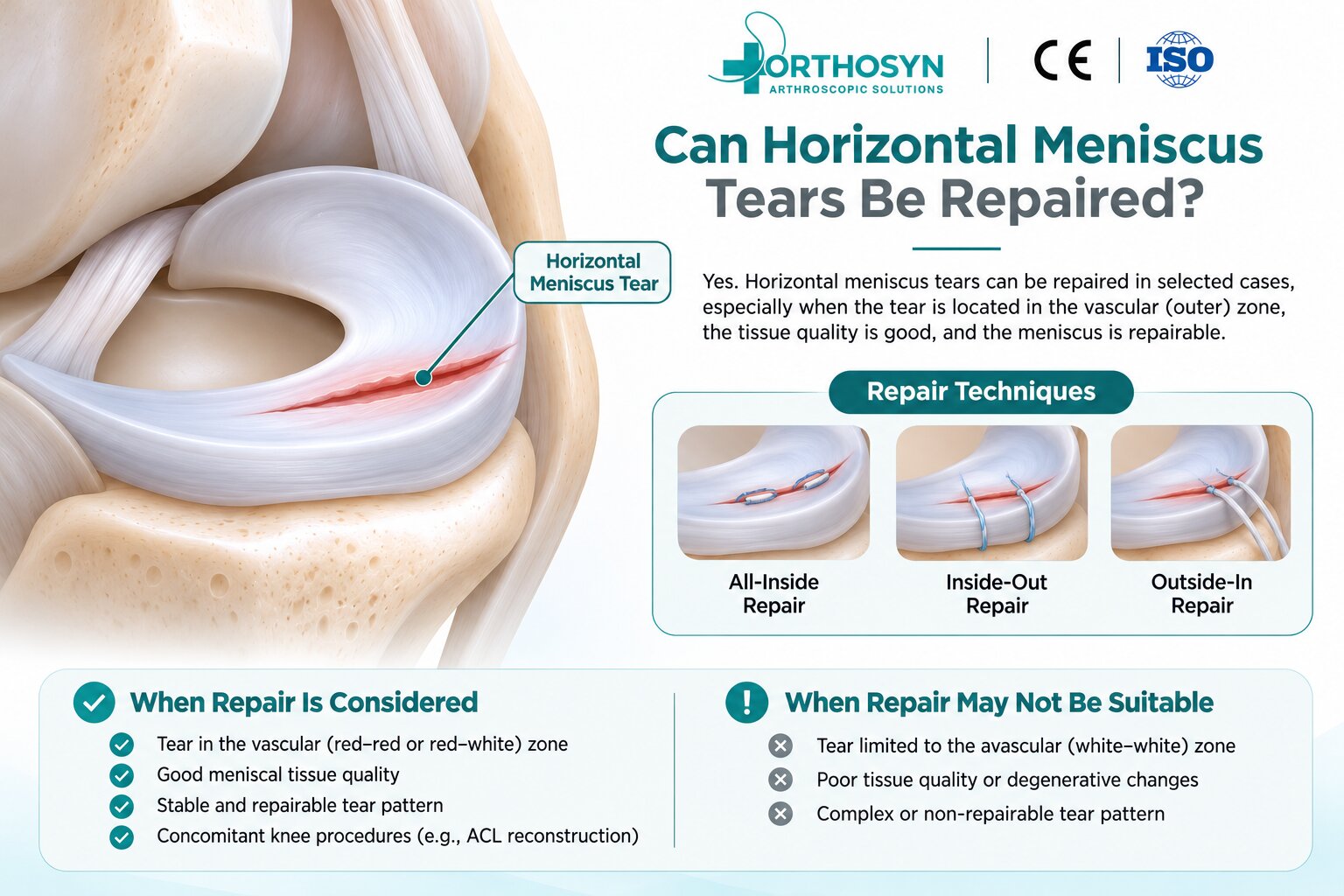
Horizontal meniscus tears can be repaired in selected patients, depending on the location of the tear, tissue quality, vascular supply, and associated knee conditions.
A horizontal meniscus tear, also known as a horizontal cleavage tear (HCT), divides the meniscus into superior and inferior tissue layers. Although these tears were traditionally treated with partial meniscectomy when surgery was required, modern meniscal repair techniques have expanded the possibilities for meniscus preservation.
The fundamental repair concept is:
Horizontal Meniscus Tear → Tissue Assessment → Tear Preparation → Suture Fixation → Compression of Meniscal Layers → Biological Healing
A horizontal meniscus tear extends approximately parallel to the tibial plateau, separating the meniscus into upper and lower layers.
These tears can occur in both the medial and lateral meniscus and are frequently associated with degenerative changes, although they may also develop following traumatic injuries.
Horizontal meniscus tears may be associated with:
Degenerative meniscal changes
Repetitive mechanical loading
Sports-related knee injuries
Meniscal tissue degeneration
Parameniscal cysts
Associated cartilage damage
Not every horizontal meniscus tear is suitable for surgical repair.
The decision depends on several factors, including tear location, vascular supply, tissue quality, knee stability, and the extent of cartilage degeneration.
Tears extending into the vascularized peripheral region of the meniscus may have greater healing potential than tears confined to the inner avascular region.
Asymptomatic tears and many symptomatic degenerative tears can be managed without surgery. Advanced tissue degeneration or significant osteoarthritis may also limit the suitability of meniscal repair.
The surgeon evaluates the tear pattern, stability, tissue quality, and location within the meniscus.
The surfaces of the horizontal cleavage tear may be prepared to encourage a biological healing response while preserving viable meniscal tissue.
Sutures are positioned to capture the superior and inferior meniscal layers.
Circumferential compression sutures are one commonly described technique for horizontal cleavage tear repair.
The sutures are secured to approximate the separated meniscal layers and reduce movement between them.
The surgeon evaluates tissue approximation, fixation stability, and the repaired meniscus during controlled knee movement.
Circumferential compression is a fixation principle in which sutures surround the meniscal tissue to bring the superior and inferior layers together.
Unlike fixation strategies primarily intended to approximate vertical longitudinal tears, circumferential sutures are designed to compress the separated layers of a horizontal cleavage tear.
The mechanical objective is:
Superior Meniscal Layer → Circumferential Suture Compression → Inferior Meniscal Layer
Appropriate compression may support tissue approximation during healing. However, excessive suture tension may damage compromised meniscal tissue.
Repair technique | Fixation principle |
|---|---|
All-Inside Repair | Meniscal fixation performed from within the joint using compatible repair devices or suturing instruments |
Inside-Out Repair | Sutures passed through the meniscus and secured externally |
Outside-In Repair | Sutures introduced from outside the joint into the meniscal tissue |
Circumferential Compression | Sutures surround and approximate the superior and inferior meniscal layers |
Circumferential compression describes a suture configuration rather than a separate surgical access technique.
The appropriate method depends on tear location, anatomical accessibility, and device compatibility.
Characteristic | Meniscus Repair | Partial Meniscectomy |
|---|---|---|
Primary objective | Preserve meniscal tissue | Remove unstable damaged tissue |
Tissue preservation | Greater preservation | Partial tissue removal |
Biological healing | Required | Healing of the original tear is not required |
Rehabilitation | Generally longer | Generally shorter |
Main limitation | Risk of incomplete healing or retear | Reduced functional meniscal tissue |
Meniscal preservation is generally preferred when a tear is suitable for repair because the meniscus contributes to load distribution, shock absorption, and knee joint protection.
However, repair is not appropriate for every horizontal tear.
The ORTHOSYN VERSAFIX Meniscal Repair System is an all-inside meniscal fixation device designed for compatible meniscal repair procedures.
The system incorporates:
Two PEEK fixation implants
High-strength UHMWPE suture
Adjustable penetration depth control
All-inside delivery configuration
The system provides a fixation mechanism for approximating meniscal tissue during compatible repair procedures.
Its suitability for horizontal cleavage tears and specific compression suture configurations must be evaluated according to the product's indications, compatibility requirements, and instructions for use.
Explore the ORTHOSYN Meniscal Repair Systems.
Successful meniscal healing depends on vascular supply, tissue quality, tear chronicity, fixation stability, patient characteristics, and rehabilitation.
Associated ligament injuries and cartilage degeneration may also influence clinical outcomes.
Mechanical fixation supports tissue approximation but does not guarantee biological healing.
Rehabilitation following horizontal meniscus repair generally involves protected weight-bearing, controlled knee mobility, progressive muscle strengthening, and functional exercises.
Return to demanding sports may require four to six months or longer, depending on the repair configuration, associated injuries, and functional recovery.
Horizontal meniscus tears can be repaired in appropriately selected patients. Modern meniscal suturing techniques, including circumferential compression configurations, provide options for preserving meniscal tissue and approximating separated tissue layers.
ORTHOSYN VERSAFIX represents an all-inside meniscal fixation technology for compatible repair applications.
Successful horizontal meniscus repair depends on appropriate patient selection, tissue quality, stable fixation, biological healing, and structured rehabilitation.