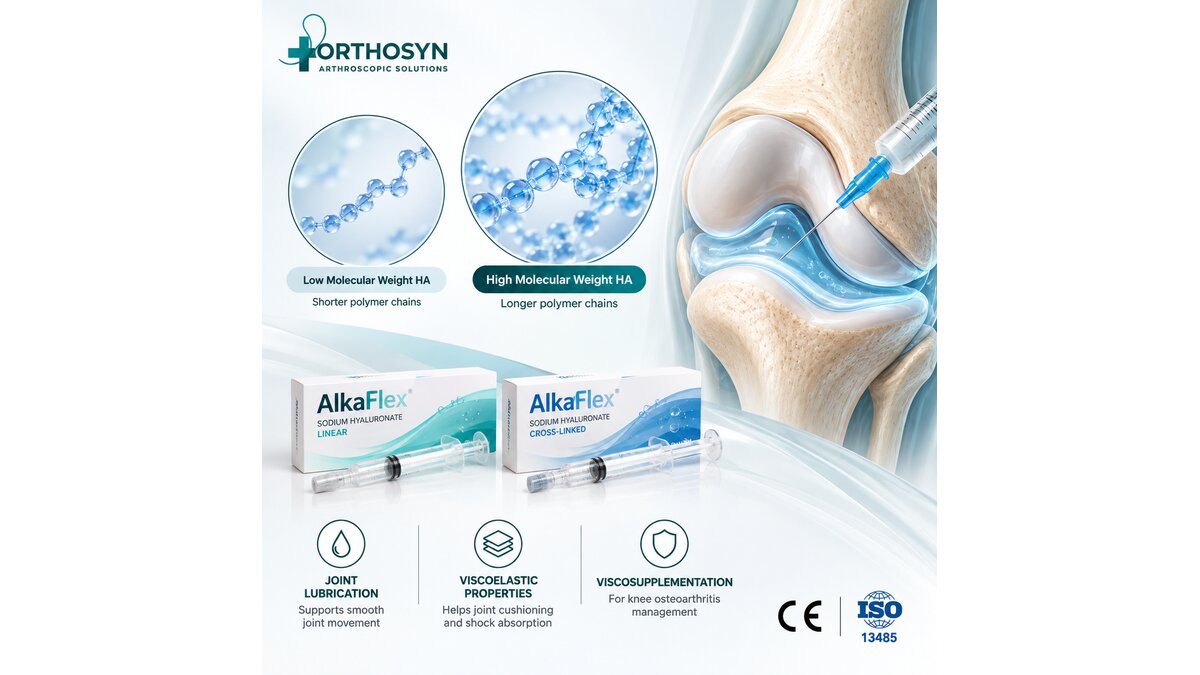
Cross-linked hyaluronic acid (HA) is hyaluronic acid whose polymer chains are chemically connected to each other to form a three-dimensional molecular network.
This is different from linear hyaluronic acid, where the HA chains remain primarily separate.
The cross-linking process changes the physical behavior of the HA formulation and can influence properties such as:
viscosity,
elasticity,
viscoelasticity,
resistance to deformation,
degradation behavior,
and residence characteristics.
Because of these structural differences, cross-linked HA is widely used in intra-articular hyaluronic acid injectionsdesigned for viscosupplementation.
The AlkaFlex Cross-Linked portfolio represents this formulation approach within Orthosyn Medikal’s international HA range.
Hyaluronic acid naturally consists of long polymer chains.
In a linear formulation, these chains remain largely independent.
In a cross-linked formulation, selected points along different HA chains are chemically connected.
This creates a network rather than a collection of completely separate chains.
A simple comparison is:
Linear HA = long individual polymer chains
Cross-Linked HA = interconnected polymer network
This structural modification can significantly affect the way the material flows and responds to mechanical force.
The purpose of cross-linking is to modify the physical and rheological properties of the HA.
Cross-linking may influence:
viscosity,
elasticity,
structural stability,
resistance to enzymatic degradation,
and how the formulation responds under mechanical loading.
Instead of behaving only as individual polymer chains moving through a solution, the material begins to behave more like a connected network.
This is why cross-linked HA can show a different rheological profile from linear HA.
The primary difference is molecular architecture.
Linear HA consists mainly of individual polymer chains.
Its behavior depends strongly on:
molecular weight,
concentration,
chain length,
polymer entanglement,
and molecular-weight distribution.
Cross-linked HA contains chemically connected polymer chains.
Its behavior also depends on:
degree of cross-linking,
network density,
network architecture,
concentration,
and the characteristics of the original HA polymer.
Therefore, cross-linked HA cannot be understood simply by looking at molecular weight alone.
Cross-linking can significantly influence viscosity.
When HA chains are connected into a network, their movement becomes more restricted.
This may increase resistance to flow and alter the apparent viscosity of the formulation.
However, viscosity is not determined by cross-linking alone.
It is also affected by:
HA concentration,
molecular weight,
molecular-weight distribution,
temperature,
and test conditions.
For this reason, two cross-linked HA products may still have very different viscosity profiles.
Cross-linking can also increase the elastic contribution of a formulation.
A connected molecular network can deform under mechanical force and then partially recover.
This behavior contributes to the viscoelasticity of the material.
In rheological testing, this elastic component may be evaluated using parameters such as storage modulus (G′).
However, the exact elastic behavior depends on the structure and density of the cross-linked network.
Viscoelasticity describes the combination of viscous and elastic behavior.
Cross-linked HA can display both:
Viscous behavior
Resistance to flow.
Elastic behavior
Ability to deform and recover.
The balance between these properties depends on:
molecular structure,
cross-link density,
HA concentration,
temperature,
and mechanical test conditions.
This is why rheological analysis is often important when evaluating cross-linked HA formulations.
Molecular weight is still important, but its role must be interpreted differently in cross-linked HA.
In linear HA, molecular weight directly describes the size of the individual polymer chains.
In cross-linked HA, those chains are connected into a larger network.
As a result, the final rheological behavior cannot be described only by the original molecular-weight value.
The network itself becomes a major factor.
Concentration describes how much HA is present per milliliter.
For example:
1% HA = 10 mg/mL
2% HA = 20 mg/mL
3% HA = 30 mg/mL
Higher concentration means more HA material is present in the same volume.
This can influence:
viscosity,
molecular interaction,
network density,
and overall rheological behavior.
However, two products with the same concentration may behave very differently if their cross-linking structures are different.
The degree of cross-linking refers to how extensively the HA chains are connected.
A formulation with fewer cross-links may form a looser molecular network.
A formulation with more cross-links may form a denser network.
This can influence:
elasticity,
viscosity,
deformation behavior,
structural stability,
and degradation characteristics.
However, more cross-linking does not automatically mean a better product.
The complete formulation and intended performance should be considered.
Cross-linked HA is not simply “more connected” or “less connected.”
The way those connections are distributed also matters.
This is known as network architecture.
Two products can use similar HA concentrations and similar levels of cross-linking but still behave differently because the molecular networks are organized differently.
This can affect:
flow behavior,
elasticity,
recovery after deformation,
and overall rheological response.
Cross-linking can influence how easily HA chains are broken down.
A connected molecular network may show greater resistance to degradation than an equivalent non-cross-linked structure.
However, degradation behavior depends on multiple factors, including:
cross-link chemistry,
degree of cross-linking,
network density,
molecular weight,
and formulation environment.
Therefore, degradation characteristics should not be predicted from the word “cross-linked” alone.
One commonly used approach in HA technology is BDDE cross-linking.
BDDE stands for 1,4-butanediol diglycidyl ether.
It can be used to chemically connect HA chains and create a cross-linked network.
The purpose is to modify the structural and rheological properties of the formulation.
For AlkaFlex Cross-Linked HA, BDDE cross-linking is part of the formulation approach.
Cross-linked HA often develops more gel-like characteristics because of its molecular network.
However, the exact consistency can vary substantially.
The final formulation may range from relatively fluid to more elastic or gel-like depending on:
concentration,
degree of cross-linking,
network structure,
and formulation conditions.
Therefore, not all cross-linked HA products should be assumed to have identical physical behavior.
Cross-linked HA is used in intra-articular injections because its molecular network can provide a different rheological profile from linear HA.
This can be relevant to formulations designed around:
viscosity,
elasticity,
viscoelasticity,
structural persistence,
and single-injection protocols.
However, the exact intended use depends on the specific product formulation.
Cross-linked HA should therefore be evaluated according to its complete technical profile.
Cross-linked HA is commonly associated with single-injection viscosupplementation products.
Its network structure may allow formulators to design products with different viscosity and residence characteristics compared with some linear formulations.
However:
cross-linked does not automatically mean single injection
and:
single injection does not automatically mean cross-linked
The actual protocol depends on the specific product.
Cross-linked HA is particularly relevant when discussing rheology.
Its behavior may be evaluated through:
viscosity,
storage modulus (G′),
loss modulus (G″),
shear response,
frequency response,
and deformation recovery.
These measurements help describe how the molecular network behaves under mechanical stress.
In rheological testing:
G′ — Storage Modulus
Represents the elastic component.
G″ — Loss Modulus
Represents the viscous component.
A cross-linked HA formulation may show a stronger elastic contribution than a linear formulation under certain conditions.
However, these values should only be compared when test conditions such as frequency and temperature are similar.
No.
A higher viscosity value does not automatically mean a better product.
The complete profile matters.
A useful technical comparison includes:
Viscosity + Elasticity + Concentration + Cross-Linking + Network Structure + Injection Protocol
Different cross-linked HA formulations may be designed for different rheological characteristics.
These terms should not be confused.
High molecular weight HA describes long polymer chains.
Cross-linked HA describes polymer chains connected into a network.
A product can be:
high molecular weight and linear,
high molecular weight and cross-linked,
or use another molecular configuration.
For example, AlkaFlex Linear uses high molecular weight linear HA, while AlkaFlex Cross-Linked uses a cross-linked molecular-network approach.
When evaluating a cross-linked HA injection, useful questions include:
What is the HA concentration?
What is the total HA dose?
What cross-linking method is used?
What is the degree of cross-linking?
What rheological data are available?
What are the G′ and G″ values?
What is the injection volume?
Is the protocol single or multiple injection?
What documentation supports the formulation specifications?
These questions provide a more complete technical understanding of the product.
AlkaFlex is Orthosyn Medikal’s international brand for intra-articular hyaluronic acid formulations.
The AlkaFlex Cross-Linked portfolio uses cross-linked HA technology to create a molecular network with different structural and rheological characteristics from linear HA.
Depending on the formulation, the AlkaFlex Cross-Linked range includes different concentrations and total HA doses.
Its technical positioning is associated with concepts such as:
cross-linked hyaluronic acid,
intra-articular HA,
viscosupplementation,
high-viscosity HA,
viscoelasticity,
single-injection HA,
and BDDE cross-linking.
Explore AlkaFlex Cross-Linked Intra-Articular Hyaluronic Acid:
https://orthosynmed.com/product/44/alkaflex-intra-articular-injections-with-cross-linked-hyaluronic-acid
AlkaFlex also includes a separate Linear Hyaluronic Acid portfolio.
AlkaFlex Linear uses high molecular weight non-cross-linked HA with an approximate molecular weight of 2.4 MDa.
This represents a different molecular strategy based primarily on long individual HA chains rather than a cross-linked network.
Explore AlkaFlex Linear Intra-Articular Hyaluronic Acid:
https://orthosynmed.com/product/39/alkaflex-intra-articular-injections-with-hyaluronic-acid---linear-linked
Cross-linked hyaluronic acid is HA whose polymer chains are chemically connected to form a molecular network.
This structural modification can influence:
viscosity,
elasticity,
viscoelasticity,
deformation behavior,
degradation characteristics,
and residence properties.
However, cross-linking should never be considered in isolation.
The complete formulation depends on:
Concentration + Molecular Weight + Cross-Linking Method + Degree of Cross-Linking + Network Architecture + Rheological Profile
Importantly:
Cross-Linked HA ≠ Automatically Better HA
and:
Cross-Linked HA ≠ Automatically Single-Injection HA
Cross-linking is a formulation strategy that changes molecular structure and physical behavior.
The AlkaFlex Cross-Linked portfolio represents this approach within Orthosyn Medikal’s international intra-articular hyaluronic acid range.
AlkaFlex Cross-Linked Intra-Articular Hyaluronic Acid
https://orthosynmed.com/product/44/alkaflex-intra-articular-injections-with-cross-linked-hyaluronic-acid
AlkaFlex Linear Intra-Articular Hyaluronic Acid
https://orthosynmed.com/product/39/alkaflex-intra-articular-injections-with-hyaluronic-acid---linear-linked