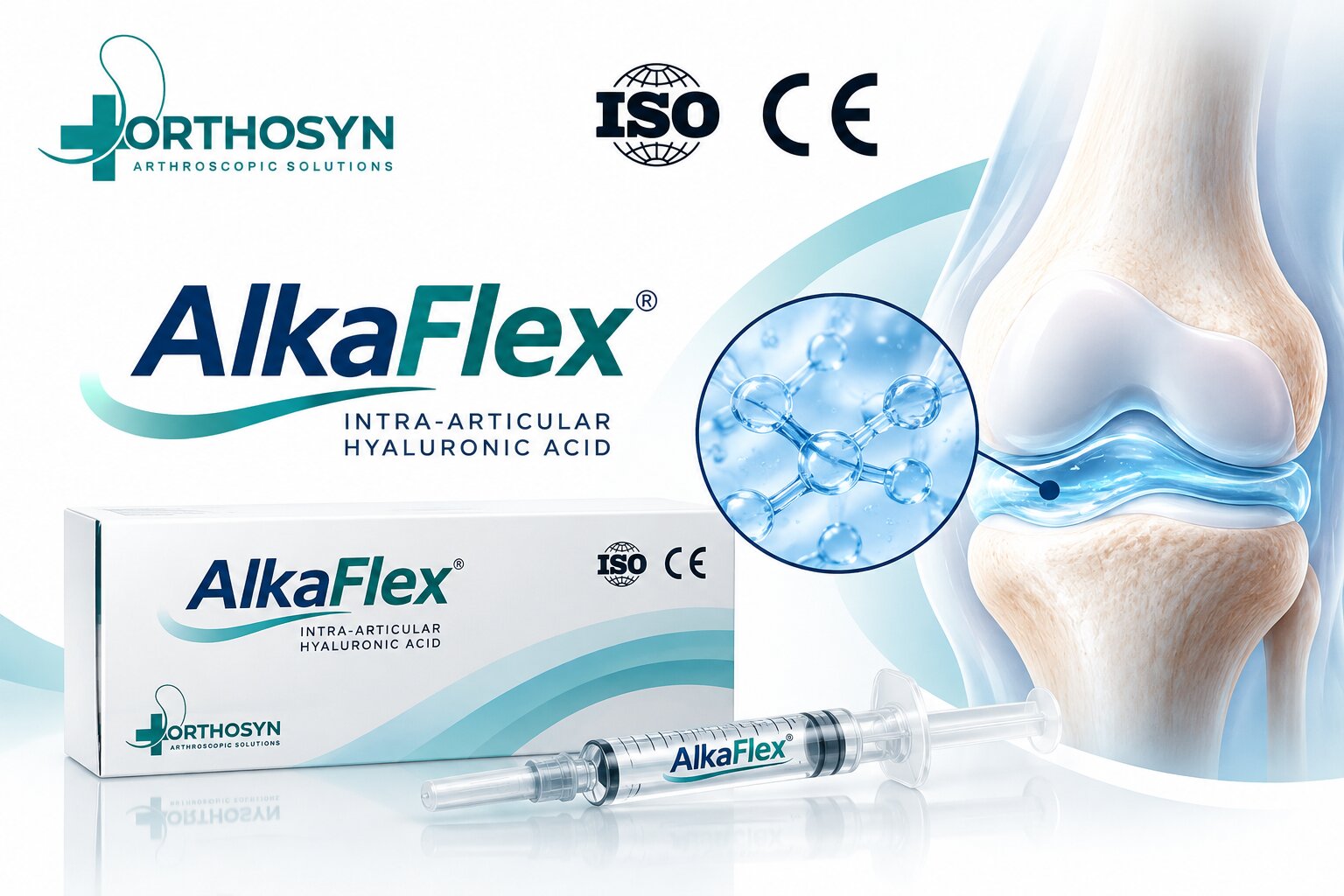
In other words, the HA molecules exist primarily as long individual polymer chains rather than being chemically connected into a three-dimensional network.
This distinction is important because molecular structure can influence:
viscosity,
viscoelasticity,
flow behavior,
polymer interaction,
and degradation characteristics.
Linear HA is widely used in intra-articular hyaluronic acid injections and is one of the main formulation approaches used in viscosupplementation.
The AlkaFlex Linear portfolio is based on high molecular weight linear hyaluronic acid designed for intra-articular administration.
Hyaluronic acid is a polysaccharide composed of repeating disaccharide units.
These repeating units connect to form long polymer chains.
In a linear HA formulation, these chains remain primarily separate rather than being intentionally connected through chemical cross-linking.
A simple comparison is:
Linear HA = individual long polymer chains
Cross-linked HA = polymer chains connected into a molecular network
The term “linear” therefore describes the molecular structure of the hyaluronic acid.
It does not describe its concentration, dose or molecular weight.
In most practical discussions, linear HA and non-cross-linked HA refer to the same general concept.
The HA polymer chains have not been intentionally chemically connected to create a cross-linked network.
However, not all linear HA products are identical.
They can differ in:
molecular weight,
concentration,
total HA dose,
injection volume,
molecular-weight distribution,
manufacturing process,
and injection protocol.
Therefore, the term “linear HA” describes only one part of the complete formulation.
Linear hyaluronic acid consists of long polymer chains that can move and interact within a solution.
These chains can:
overlap,
become physically entangled,
interact with surrounding water,
and move relative to one another.
Their physical behavior depends strongly on both chain length and concentration.
Longer chains generally create more polymer interaction than shorter chains.
This is why molecular weight is particularly important when evaluating linear HA.
Molecular weight describes the size of the HA polymer chains.
Higher molecular weight generally means longer polymer chains.
Longer chains can create greater:
polymer entanglement,
molecular interaction,
resistance to flow,
viscosity,
and viscoelastic behavior.
In a linear formulation, these chain characteristics are especially important because the product does not rely on a cross-linked molecular network.
However, molecular weight should still not be evaluated alone.
A useful technical approach is:
Molecular Weight + Concentration + Total Dose + Volume + Rheological Profile
High molecular weight linear HA refers to non-cross-linked hyaluronic acid containing relatively long polymer chains.
There is no single universally accepted threshold that defines every HA product as low, medium or high molecular weight.
For this reason, the actual molecular-weight specification is more informative than the category name alone.
The AlkaFlex Linear portfolio uses high molecular weight linear HA with an approximate molecular weight of 2.4 MDa.
This corresponds to approximately:
2.4 million daltons
Yes.
A common misconception is that only cross-linked HA can have substantial viscosity.
That is not correct.
Linear HA can also show significant viscosity, especially when it combines:
high molecular weight,
appropriate concentration,
and strong polymer-chain interaction.
Long HA chains can become physically entangled within the solution, increasing resistance to flow.
Therefore:
Linear HA does not mean low-viscosity HA.
Concentration describes how much HA is present per milliliter.
For example:
1% HA = 10 mg/mL
2% HA = 20 mg/mL
3% HA = 30 mg/mL
As concentration increases, more HA polymer chains are present in the same volume.
This can increase interaction and entanglement between the chains.
As a result, concentration can influence the viscosity and rheological behavior of linear HA.
This is why molecular weight and concentration should always be evaluated together.
These two parameters describe different things.
Molecular weight tells us:
How large are the HA polymer chains?
Concentration tells us:
How much HA is present per milliliter?
For example, two linear HA products may both use high molecular weight HA but at different concentrations.
Their viscosity and overall rheological behavior may therefore be different.
Yes.
Linear hyaluronic acid can show both viscous and elastic behavior.
This combined behavior is called viscoelasticity.
The viscoelastic characteristics of linear HA depend on factors including:
molecular weight,
concentration,
polymer entanglement,
temperature,
and mechanical conditions.
This means a linear HA formulation can still have a complex rheological profile without chemical cross-linking.
The main difference is molecular architecture.
The polymer chains remain primarily separate.
Its technical behavior depends strongly on:
molecular weight,
concentration,
polymer interaction,
and molecular-weight distribution.
Polymer chains are chemically connected into a molecular network.
Cross-linking can influence:
elasticity,
viscosity,
structural resistance,
resistance to degradation,
and residence characteristics.
These are two different formulation strategies rather than simply two different levels of the same product.
No.
This distinction is essential.
Linear describes structure.
Molecular weight describes chain size.
A product can therefore be:
Linear + High Molecular Weight
This is the case with AlkaFlex Linear, which uses approximately 2.4 MDa high molecular weight HA.
Therefore:
Linear HA ≠ Low Molecular Weight HA
No.
Linear structure also does not determine concentration.
A linear product may be formulated at different HA concentrations.
For example, one linear formulation may contain 16 mg/mL while another may contain 24 mg/mL.
Both may still be linear HA formulations.
Their concentration, total dose and rheological behavior can differ considerably.
Hyaluronic acid solutions can exhibit shear-thinning behavior.
This means their apparent viscosity can decrease when shear rate increases.
Under mechanical movement, long HA chains can change orientation and interact differently.
This is relevant to HA rheology because movement inside a joint occurs at different speeds and under changing mechanical conditions.
Hyaluronic acid is naturally present in synovial fluid.
Its long polymer chains contribute to important physical characteristics of the joint environment.
These include:
viscosity,
viscoelasticity,
lubrication-related behavior,
and response to mechanical loading.
Because naturally occurring HA also exists as long polymer chains, linear HA is an important structural concept in the discussion of intra-articular HA formulations.
Linear HA is used in intra-articular injections within the context of viscosupplementation.
The formulation is administered directly into the joint space.
Different linear HA injections can use different:
molecular weights,
concentrations,
total doses,
injection volumes,
and application protocols.
This means “linear HA injection” is a product category rather than one standardized formulation.
Neither should automatically be considered better.
They represent different molecular approaches.
A high molecular weight linear formulation may obtain much of its rheological profile from:
long polymer chains,
concentration,
and polymer interaction.
A cross-linked formulation additionally uses chemical connections between chains to create a network.
A meaningful comparison should therefore consider:
Molecular Weight + Concentration + Total Dose + Molecular Structure + Rheology + Injection Protocol
rather than simply asking whether the HA is linear or cross-linked.
When reviewing a linear HA injection, useful questions include:
What is the molecular weight?
What is the HA concentration?
What is the total HA dose?
What is the injection volume?
Is the formulation non-cross-linked?
What rheological data are available?
How is the HA produced?
What technical documentation supports the specifications?
What injection protocol is intended?
These questions provide a more complete understanding of the formulation.
AlkaFlex is Orthosyn Medikal’s international brand for intra-articular hyaluronic acid formulations.
AlkaFlex Linear uses high molecular weight, non-cross-linked hyaluronic acid.
One of its key technical characteristics is an approximate molecular weight of 2.4 MDa.
This positions AlkaFlex Linear around important technical concepts including:
linear hyaluronic acid,
non-cross-linked HA,
high molecular weight HA,
intra-articular HA,
viscosupplementation,
viscosity,
and viscoelasticity.
Explore AlkaFlex Linear Intra-Articular Hyaluronic Acid:
https://orthosynmed.com/product/39/alkaflex-intra-articular-injections-with-hyaluronic-acid---linear-linked
AlkaFlex also includes a separate Cross-Linked Hyaluronic Acid portfolio.
Instead of relying only on individual polymer chains, cross-linked formulations chemically connect HA chains into a molecular network.
This creates a different structural and rheological approach.
Explore AlkaFlex Cross-Linked Intra-Articular Hyaluronic Acid:
https://orthosynmed.com/product/44/alkaflex-intra-articular-injections-with-cross-linked-hyaluronic-acid
Linear hyaluronic acid is HA whose polymer chains remain primarily non-cross-linked instead of being chemically connected into a three-dimensional network.
Its physical and rheological properties can depend on:
molecular weight,
concentration,
polymer interaction,
molecular-weight distribution,
temperature,
and formulation conditions.
Importantly:
Linear HA ≠ Low Molecular Weight HA
and:
Linear HA ≠ Low-Viscosity HA
Linear HA can be high molecular weight, viscous and viscoelastic.
The AlkaFlex Linear portfolio combines a linear molecular structure with approximately 2.4 MDa high molecular weight HA, representing one of the principal formulation approaches within the AlkaFlex intra-articular hyaluronic acid portfolio.
AlkaFlex Linear Intra-Articular Hyaluronic Acid
https://orthosynmed.com/product/39/alkaflex-intra-articular-injections-with-hyaluronic-acid---linear-linked
AlkaFlex Cross-Linked Intra-Articular Hyaluronic Acid
https://orthosynmed.com/product/44/alkaflex-intra-articular-injections-with-cross-linked-hyaluronic-acid