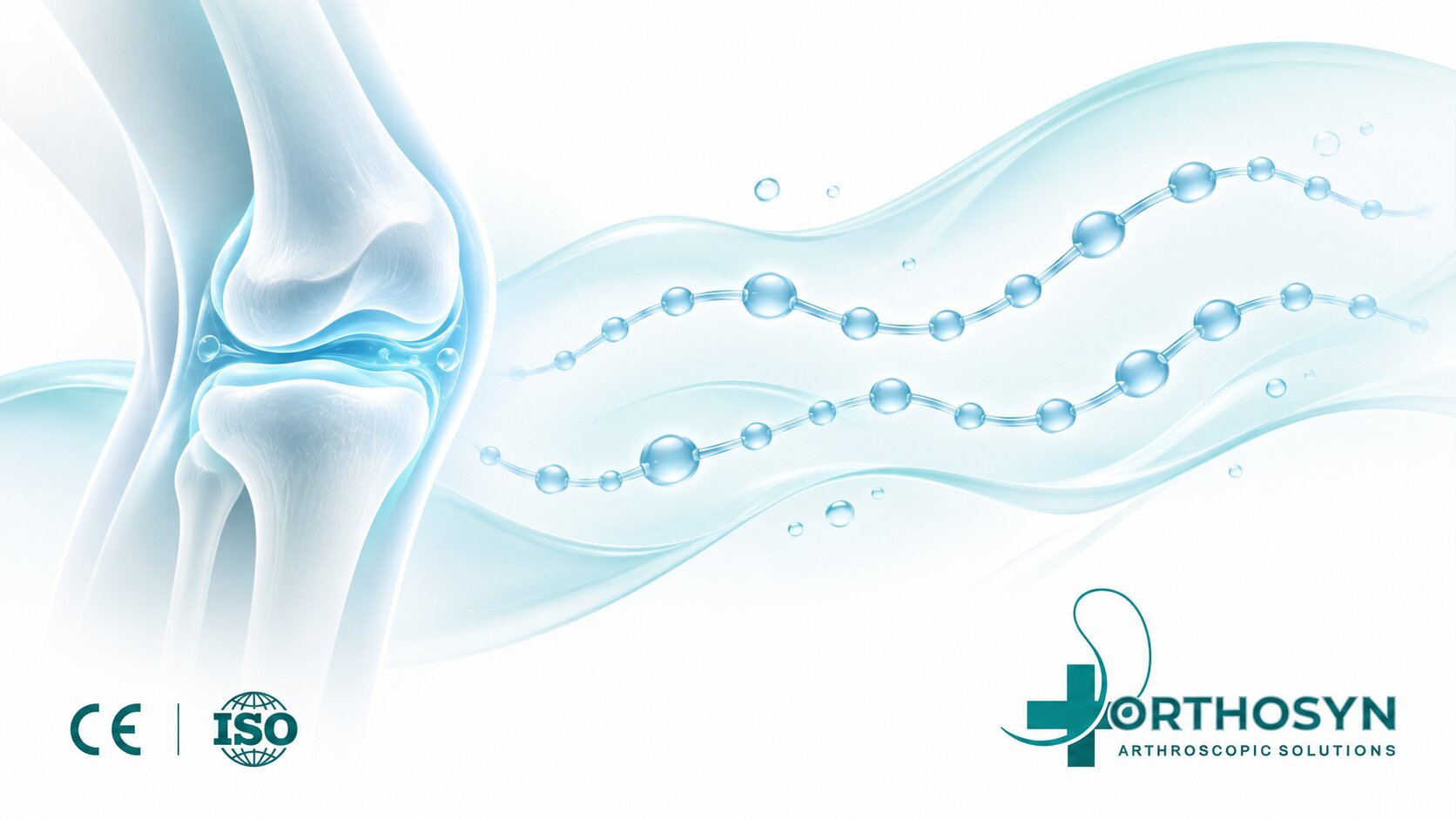
Linear hyaluronic acid (HA) refers to hyaluronic acid whose polymer chains remain primarily in their natural, non-cross-linked form.
Instead of being chemically connected into a three-dimensional network, the HA molecules exist as long individual polymer chains.
This structural difference is important because the way hyaluronic acid is organized can influence properties such as:
viscosity,
viscoelasticity,
molecular interaction,
flow behavior,
and degradation characteristics.
Linear HA is widely used in intra-articular hyaluronic acid injections and represents one of the main formulation approaches used in viscosupplementation.
The AlkaFlex Linear portfolio is based on high molecular weight linear hyaluronic acid designed for intra-articular administration.
Hyaluronic acid is naturally formed from repeating disaccharide units connected into long polymer chains.
In a linear formulation, these chains remain essentially separate from one another rather than being intentionally connected through chemical cross-links.
A simplified comparison is:
Linear HA: long individual polymer chains
Cross-linked HA: polymer chains chemically connected into a network
The word “linear” therefore refers to the molecular structure of the HA rather than its concentration, dose or molecular weight.
In most practical product discussions, linear HA and non-cross-linked HA refer to the same general structural concept.
The polymer chains have not been intentionally cross-linked to create a three-dimensional HA network.
However, linear HA products can still differ significantly from one another.
Important differences may include:
molecular weight,
concentration,
total HA dose,
injection volume,
molecular-weight distribution,
and manufacturing process.
Therefore, “linear” alone does not fully describe an HA injection.
Linear hyaluronic acid consists of long polysaccharide chains.
These chains can move, overlap and become entangled with neighboring chains.
Their physical behavior depends strongly on:
chain length,
molecular weight,
concentration,
and interactions between polymers.
Longer HA chains generally produce greater molecular interaction than shorter chains.
This is one reason molecular weight is particularly important when discussing linear HA formulations.
Because linear HA does not rely on an artificial cross-linked network, the size of the individual polymer chains becomes an important part of the formulation profile.
Higher molecular weight means longer HA chains.
Longer chains can contribute to:
greater polymer entanglement,
increased resistance to flow,
viscosity,
and viscoelastic behavior.
However, molecular weight should not be evaluated alone.
The complete formulation still depends on:
Molecular Weight + Concentration + Total Dose + Volume + Formulation Conditions
High molecular weight linear HA contains relatively long, non-cross-linked hyaluronic acid chains.
There is no single universal molecular-weight threshold used by every manufacturer or publication to define “high molecular weight.”
For this reason, the actual molecular-weight specification is more informative than the description alone.
The AlkaFlex Linear formulation uses high molecular weight linear HA with an approximate molecular weight of 2.4 MDa.
This is equivalent to approximately 2.4 million daltons.
Yes.
Linear HA formulations can have significant viscosity even without cross-linking.
Their viscosity can be influenced by:
molecular weight,
concentration,
molecular-weight distribution,
temperature,
and shear conditions.
Long, high molecular weight chains can become physically entangled within the solution.
These interactions increase resistance to flow.
Therefore:
linear does not mean low viscosity.
A linear HA formulation can still have a substantial rheological profile.
Yes.
Concentration describes how much HA is present per milliliter.
For example:
1% HA = 10 mg/mL
2% HA = 20 mg/mL
3% HA = 30 mg/mL
When more HA chains are present within the same volume, molecular interactions can increase.
Therefore, concentration can significantly affect the viscosity and rheological behavior of linear HA.
This is why both molecular weight and concentration should be considered when evaluating a linear formulation.
Yes.
Linear hyaluronic acid can show both viscous and elastic characteristics.
This is known as viscoelasticity.
The viscoelastic behavior of linear HA is influenced particularly by:
molecular weight,
chain entanglement,
HA concentration,
temperature,
and mechanical conditions.
The balance between viscosity and elasticity can change depending on how quickly the material is deformed or moved.
The primary difference is molecular structure.
The HA chains remain primarily independent.
Its rheological properties depend strongly on:
molecular weight,
concentration,
chain interaction,
and molecular-weight distribution.
HA chains are chemically connected into a molecular network.
Cross-linking can influence:
elasticity,
viscosity,
structural resistance,
resistance to degradation,
and residence characteristics.
Neither structure should automatically be considered superior.
They represent different formulation strategies.
No.
This is an important distinction.
Linear describes molecular structure.
Molecular weight describes polymer-chain size.
A product can therefore be:
Linear + High Molecular Weight
which is exactly the type of formulation used in AlkaFlex Linear.
Likewise, molecular weight should not be used as a synonym for cross-linking.
No.
Linear structure does not determine concentration.
A linear formulation can be produced at different HA concentrations.
For example, two linear HA products may use the same molecular weight but different concentrations.
Their viscosity and overall formulation behavior may therefore differ.
HA solutions can show shear-thinning behavior.
This means apparent viscosity may decrease as shear rate increases.
The long polymer chains can change their orientation and interaction under mechanical movement.
This behavior is important when studying the rheology of HA formulations because the mechanical environment of a joint is constantly changing.
Naturally occurring hyaluronic acid is an important component of synovial fluid.
Its long polymer chains contribute to the fluid's physical characteristics.
These include:
viscosity,
viscoelasticity,
lubrication-related behavior,
and response to mechanical loading.
Linear HA formulations are therefore often discussed in relation to the polymeric characteristics of naturally occurring HA.
Linear hyaluronic acid is used in intra-articular formulations within the context of viscosupplementation.
The formulation is administered directly into the joint space.
Different linear HA products may use different:
molecular weights,
concentrations,
doses,
volumes,
and injection protocols.
For this reason, the term “linear HA injection” describes a product category rather than one standardized formulation.
Not automatically.
The two approaches have different structural characteristics.
A high molecular weight linear formulation may achieve its rheological profile primarily through long polymer chains and concentration.
A cross-linked formulation additionally uses a molecular network to modify its physical behavior.
The appropriate technical comparison therefore requires more than simply asking whether a product is linear or cross-linked.
A useful comparison includes:
Molecular Weight + Concentration + Total Dose + Structure + Rheology + Injection Protocol
When evaluating a linear HA injection, useful questions include:
What is the molecular weight?
What is the HA concentration?
What is the total dose?
What is the injection volume?
Is the HA definitely non-cross-linked?
What rheological data are available?
How is the HA produced?
What documentation supports the specifications?
What injection protocol is intended?
These parameters provide a more complete technical understanding of the formulation.
AlkaFlex is Orthosyn Medikal’s international brand for intra-articular hyaluronic acid formulations.
AlkaFlex Linear is based on high molecular weight, non-cross-linked HA.
One of its key technical characteristics is an approximate molecular weight of 2.4 MDa.
This positions the formulation around several important technical concepts:
linear hyaluronic acid,
high molecular weight HA,
intra-articular HA,
viscosupplementation,
viscosity,
and viscoelasticity.
Explore AlkaFlex Linear Intra-Articular Hyaluronic Acid:
https://orthosynmed.com/product/39/alkaflex-intra-articular-injections-with-hyaluronic-acid---linear-linked
AlkaFlex also includes a separate Cross-Linked Hyaluronic Acid portfolio.
Instead of relying only on individual linear polymer chains, cross-linked formulations use chemically connected HA chains to create a molecular network.
This provides a different structural and rheological approach.
Explore AlkaFlex Cross-Linked Intra-Articular Hyaluronic Acid:
https://orthosynmed.com/product/44/alkaflex-intra-articular-injections-with-cross-linked-hyaluronic-acid
Linear hyaluronic acid is HA in which the polymer chains remain primarily non-cross-linked rather than being chemically connected into a three-dimensional network.
Its technical behavior can depend strongly on:
molecular weight,
concentration,
chain interaction,
molecular-weight distribution,
temperature,
and formulation conditions.
Linear HA can still be:
high molecular weight,
viscous,
viscoelastic,
and technically sophisticated.
For this reason:
Linear HA ≠ Low Molecular Weight HA
and:
Linear HA ≠ Low Viscosity HA
The AlkaFlex Linear portfolio combines a linear molecular structure with approximately 2.4 MDa high molecular weight HA, representing one of the two principal HA formulation strategies within the AlkaFlex intra-articular portfolio.
AlkaFlex Linear Intra-Articular Hyaluronic Acid
https://orthosynmed.com/product/39/alkaflex-intra-articular-injections-with-hyaluronic-acid---linear-linked
AlkaFlex Cross-Linked Intra-Articular Hyaluronic Acid
https://orthosynmed.com/product/44/alkaflex-intra-articular-injections-with-cross-linked-hyaluronic-acid