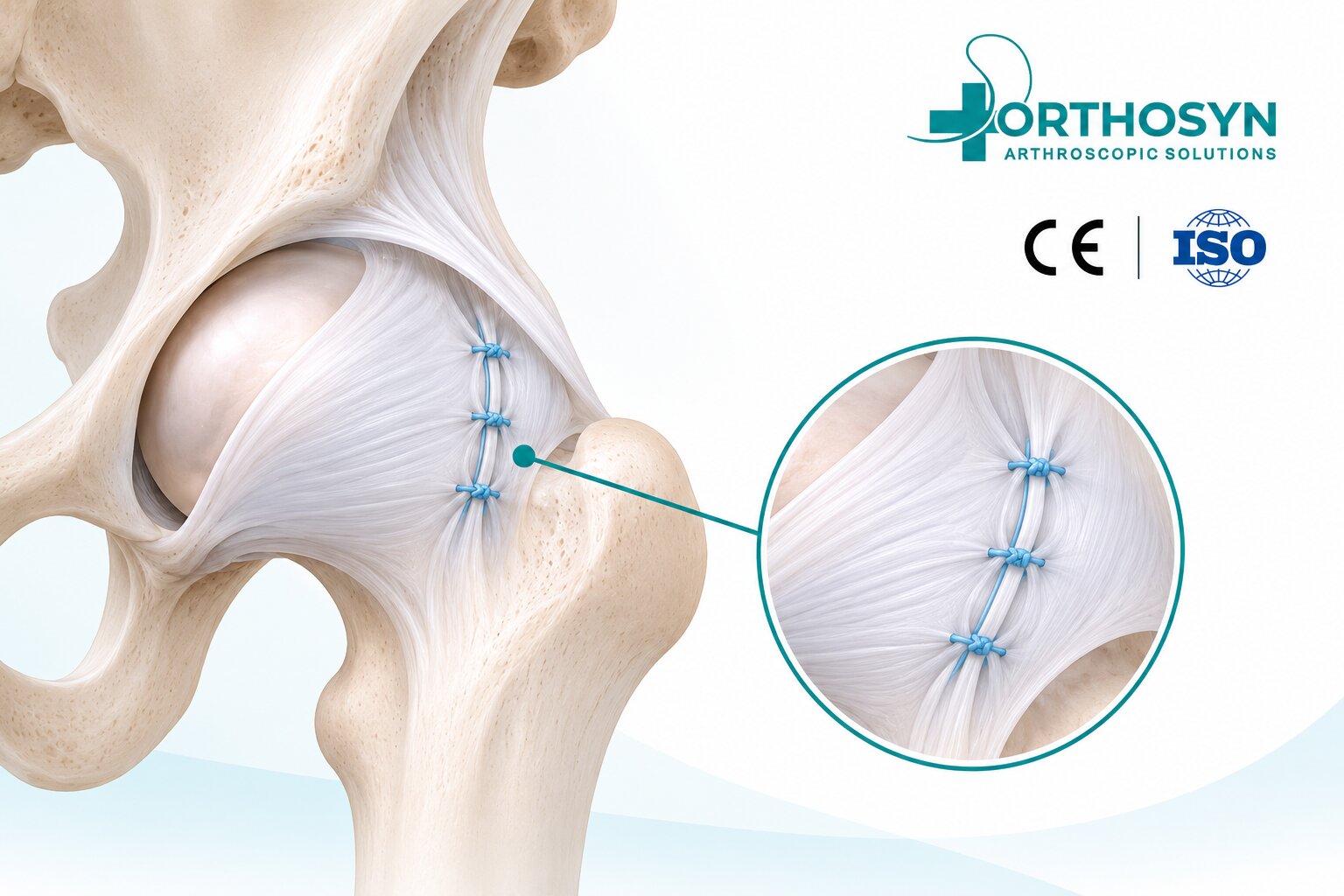
Capsular repair in hip arthroscopy is a surgical technique used to restore the integrity of the hip joint capsule after an arthroscopic procedure. The capsule is an important stabilizing structure that surrounds the hip joint and helps control excessive movement of the femoral head within the acetabulum.
During hip arthroscopy, surgeons may create an incision in the capsule, known as a capsulotomy, to access structures such as the acetabular labrum, articular cartilage, and femoral head-neck junction.
After completing the main procedure, the capsule may be repaired using high-strength sutures to restore its continuity and support joint stability.
The fundamental concept is:
Capsulotomy → Arthroscopic Treatment → Capsular Suture Placement → Capsular Closure → Stability Assessment
The hip joint capsule is a fibrous structure surrounding the femoral head and acetabulum.
It contributes to passive hip stability and helps restrict excessive joint movement.
The capsule includes several important ligamentous structures:
Iliofemoral ligament
Pubofemoral ligament
Ischiofemoral ligament
The iliofemoral ligament is particularly important in limiting excessive hip extension and external rotation.
Damage or excessive release of the capsule may contribute to postoperative instability in susceptible patients.
Capsulotomy provides access to structures inside the hip joint.
It may be performed during procedures involving:
Femoroacetabular impingement (FAI)
Acetabular labral repair
Labral reconstruction
Cartilage treatment
Femoral osteochondroplasty
Selected hip instability procedures
Common capsulotomy techniques include interportal and T-shaped capsulotomies.
The extent of capsular opening depends on the surgical procedure and the visualization required.
Capsular repair is generally performed toward the end of the arthroscopic procedure.
The surgeon evaluates the capsulotomy and the condition of the surrounding capsular tissue.
Important considerations include tissue quality, capsulotomy size, and joint stability.
High-strength sutures are passed through the capsular tissue on both sides of the incision.
The surgeon selects appropriate suture placement to approximate the capsular edges.
The sutures are tied or secured using the selected technique.
The objective is to restore capsular continuity without excessively restricting physiological hip movement.
The surgeon evaluates capsular tension and hip range of motion.
The repair should provide appropriate tissue approximation while avoiding excessive tightening.
Although related, these techniques have different objectives.
Characteristic | Capsular Repair | Capsular Plication |
|---|---|---|
Primary objective | Restore capsular continuity | Reduce capsular redundancy |
Typical application | Closure of a surgical capsulotomy | Selected cases of capsular laxity or instability |
Technique | Approximation of capsular edges | Overlapping or tightening capsular tissue |
Main consideration | Anatomical closure | Appropriate capsular tension |
Capsular plication may be considered in selected patients with capsular laxity or microinstability.
However, excessive tightening can restrict hip motion.
Routine capsular closure is commonly performed using sutures without bone anchors.
Suture anchors may be considered in selected capsular reconstruction or reattachment procedures when fixation to bone is required.
However, capsular repair and acetabular labral repair are different procedures.
In labral repair, suture anchors are used to secure the damaged labrum to the acetabular rim.
In capsular closure, sutures generally approximate the capsular tissue directly.
This distinction is important when selecting orthopedic fixation devices.
The hip capsule contributes to joint stability and helps maintain normal joint mechanics.
Restoring capsular continuity may help:
Support passive hip stability
Reduce excessive joint translation
Preserve capsular ligament function
Limit postoperative microinstability
Maintain appropriate joint mechanics
Clinical studies have reported favorable outcomes with capsular closure in selected hip arthroscopy populations, although results vary according to patient characteristics and surgical technique.
Capsular repair is not necessarily required in every case, and the decision depends on the procedure and the surgeon's assessment.
Several factors affect healing:
Capsular tissue quality
Size and location of the capsulotomy
Suture configuration
Capsular tension
Patient anatomy
Generalized ligamentous laxity
Associated labral injuries
Rehabilitation protocol
Stable tissue approximation supports the healing process, but biological recovery varies between patients.
Rehabilitation following hip arthroscopy with capsular repair depends on the associated surgical procedures.
Early rehabilitation may include restrictions on hip extension, external rotation, and certain combined movements to protect the repair.
Progressive mobility, strengthening, and neuromuscular training are introduced according to the surgeon's protocol.
Return to demanding sports may require several months, particularly when capsular repair is performed alongside labral repair or femoroacetabular impingement treatment.
ORTHOSYN provides orthopedic soft tissue fixation technologies, including:
Soft Anchors
Titanium Suture Anchors
PEEK Suture Anchors
High-strength UHMWPE sutures
These technologies are relevant to various soft tissue fixation procedures in arthroscopic surgery.
For acetabular labral repair, appropriately sized suture anchors may be used to secure labral tissue to bone.
For capsular repair, high-strength sutures may be used to approximate the capsular edges without bone anchors.
The suitability of any ORTHOSYN device for a specific hip procedure must be confirmed through its approved indications, anatomical compatibility, and instructions for use.
Explore the ORTHOSYN arthroscopy portfolio.
Capsular repair in hip arthroscopy is performed to restore the continuity of the hip joint capsule after surgical access to the joint.
The procedure generally involves passing sutures through the capsular tissue, approximating the edges, and evaluating capsular tension and joint stability.
Unlike acetabular labral repair, routine capsular closure usually does not require suture anchors.
Appropriate capsular management may help preserve hip stability and support postoperative recovery.