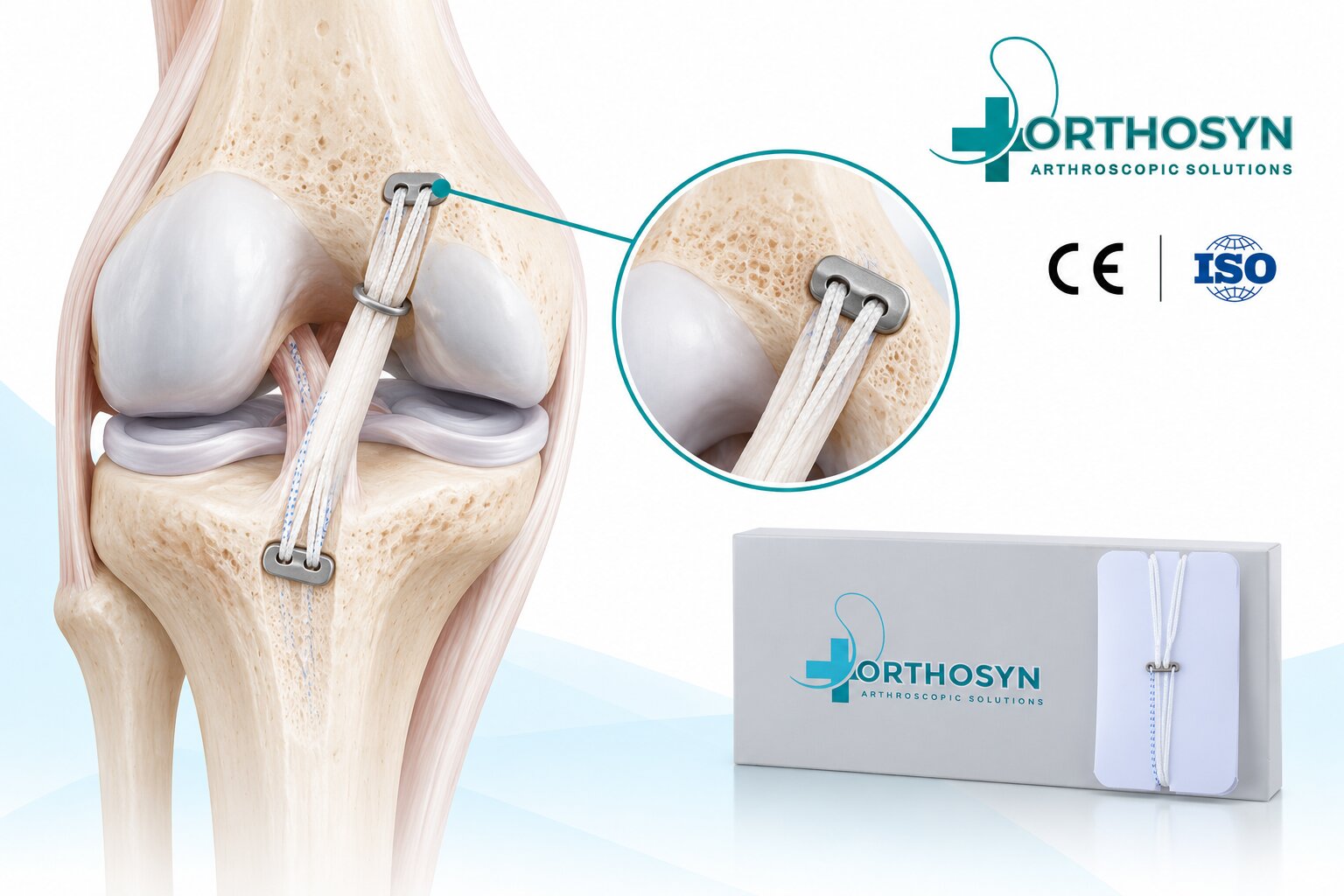
All-inside ACL reconstruction is an arthroscopic surgical technique used to reconstruct a ruptured anterior cruciate ligament (ACL) using a tendon graft, specialized bone sockets, and compatible fixation devices.
Unlike conventional full-tunnel ACL reconstruction, the all-inside technique typically uses shorter femoral and tibial bone sockets rather than complete tunnels of graft diameter. This approach can preserve bone and may allow the use of shorter tendon grafts.
One of the defining features of all-inside ACL reconstruction is the frequent use of cortical suspensory fixation systems on both the femoral and tibial sides.
The fundamental reconstruction concept is:
ACL Rupture → Graft Preparation → Femoral and Tibial Socket Creation → Graft Passage → Cortical Button Fixation → Graft Tensioning
The ORTHOSYN arthroscopy portfolio includes adjustable-loop femoral fixation technologies and cortical button systems relevant to ligament reconstruction.
All-inside ACL reconstruction is a minimally invasive arthroscopic technique in which the surgeon prepares bone sockets for the tendon graft while preserving portions of the surrounding bone.
In conventional ACL reconstruction, full-length tunnels are commonly created through the femur and tibia.
In the all-inside approach, the surgeon generally creates shorter sockets using specialized drilling instruments, including retrograde drilling systems.
These sockets accommodate the graft ends while cortical fixation devices provide mechanical support.
The technique is commonly associated with:
Arthroscopic ACL reconstruction
Femoral and tibial bone sockets
Shorter graft configurations
Cortical suspensory fixation
Adjustable-loop fixation systems
Retrograde drilling techniques
All-inside reconstruction is one of several established ACL reconstruction approaches. It is not necessarily the preferred technique for every patient.
The main difference involves bone preparation and graft fixation.
Characteristic | All-Inside ACL Reconstruction | Conventional ACL Reconstruction |
|---|---|---|
Bone preparation | Short femoral and tibial sockets | Commonly full-length tunnels |
Graft configuration | Often shorter, multi-strand graft | Various graft configurations |
Femoral fixation | Frequently cortical suspensory fixation | Cortical button or interference fixation |
Tibial fixation | Frequently cortical suspensory fixation | Often interference screw or other fixation |
Drilling technique | Commonly retrograde socket drilling | Conventional tunnel drilling |
Bone preservation | May preserve more bone | Depends on tunnel dimensions and technique |
Both approaches aim to restore knee stability through anatomical graft placement and secure fixation.
Clinical outcomes depend on graft selection, surgical technique, fixation stability, rehabilitation, and patient-specific factors.
All-inside ACL reconstruction commonly uses autologous tendon grafts.
The semitendinosus tendon is frequently selected because it can be folded into a multi-strand configuration.
Other graft options may include:
Semitendinosus tendon
Semitendinosus and gracilis tendons
Quadriceps tendon grafts
Selected allograft configurations
A four-strand semitendinosus graft is one commonly used configuration.
The graft is prepared according to the required diameter, length, and fixation system.
The appropriate graft configuration depends on patient anatomy, available tendon tissue, socket dimensions, and surgical planning.
Socket preparation is an important characteristic of all-inside ACL reconstruction.
The surgeon identifies the anatomical femoral ACL attachment region.
A guide pin or compatible drilling system is used to establish the planned socket position.
The femoral socket is then prepared to accommodate the graft.
The surgeon must consider:
Anatomical tunnel position
Socket diameter
Socket depth
Cortical bone integrity
Graft length
Fixation device compatibility
The tibial socket is created near the anatomical tibial ACL attachment region.
Retrograde drilling instruments may be used to prepare the socket from within the joint.
Unlike conventional full-tunnel techniques, the tibial socket generally does not extend through the entire tibial bone at graft diameter.
A smaller passage may still be required for the fixation sutures or button system.
Accurate socket positioning is essential for appropriate graft orientation and knee biomechanics.
All-inside ACL reconstruction commonly uses cortical suspensory fixation on both sides of the graft.
The fixation construct may include:
Femoral cortical button
Femoral adjustable loop
Tendon graft
Tibial adjustable loop
Tibial cortical button
The mechanical fixation pathway is:
Femoral Cortex → Femoral Button → Adjustable Loop → ACL Graft → Adjustable Loop → Tibial Button → Tibial Cortex
The cortical buttons provide external bone support, while the adjustable loops connect the graft to the fixation devices.
This configuration allows the surgeon to advance the graft into the prepared sockets and adjust its position during implantation.
Femoral cortical suspensory fixation uses a button positioned against the outer cortex of the femur.
The button is connected to the graft through a high-strength loop.
During implantation, the button passes through the femoral tunnel and is deployed against the lateral femoral cortex.
The surgeon verifies that the button is correctly positioned.
The graft is then advanced into the femoral socket.
An adjustable-loop system allows the surgeon to shorten the loop after the button has been deployed.
This provides intraoperative control over graft advancement and positioning.
The basic sequence is:
Connect the graft to the adjustable-loop system.
Pass the cortical button through the femoral tunnel.
Deploy the button against the lateral femoral cortex.
Verify correct button positioning.
Shorten the adjustable loop.
Advance the graft into the femoral socket.
Complete the device-specific locking or tensioning steps.
The exact sequence depends on the fixation device and its instructions for use.
ORTHOSYN provides adjustable-loop cortical fixation technologies within its arthroscopy portfolio.
Reference: ORT-LS-1001
The Femoral Lift From Bottom system uses an adjustable suspensory fixation configuration.
It is designed around cortical button fixation and intraoperative loop adjustment.
Reference: ORT-LS-3001
The Femoral Lift From Top system also uses an adjustable-loop cortical fixation concept.
Its configuration provides an alternative approach to loop adjustment and graft positioning.
Both technologies represent cortical suspensory fixation principles relevant to ligament reconstruction.
Their suitability for a particular all-inside ACL technique must be confirmed through the product-specific indications, compatibility requirements, and instructions for use.
In all-inside ACL reconstruction, the tibial side is frequently secured using a cortical suspensory fixation system.
A tibial cortical button is positioned against the outer tibial cortex.
The button connects to the graft through an adjustable-loop construct.
The mechanical pathway is:
Tibial Cortex → Tibial Button → Adjustable Loop → ACL Graft
The surgeon adjusts the loop to position the graft within the tibial socket and establish the required tension.
Correct tibial button positioning is important because soft tissue interposition or incomplete deployment may compromise fixation.
Although both sides may use cortical suspensory fixation, their anatomical locations and mechanical requirements differ.
Characteristic | Femoral Fixation | Tibial Fixation |
|---|---|---|
Fixation location | Lateral femoral cortex | External tibial cortex |
Common device | Cortical button with adjustable loop | Cortical button with adjustable loop |
Main function | Secure the femoral graft end | Secure the tibial graft end |
Graft positioning | Advancement into femoral socket | Advancement into tibial socket |
Important consideration | Button deployment and socket seating | Button seating and graft tension |
The surgeon must ensure that both fixation systems work together to maintain graft stability.
Not every femoral button is suitable for tibial fixation, and the devices are not automatically interchangeable.
Adjustable-loop fixation systems allow the surgeon to modify the effective loop length during implantation.
Potential technical advantages include:
Intraoperative graft positioning
Controlled advancement into bone sockets
Compatibility with selected shorter graft constructs
Flexibility during tensioning
Use with cortical suspensory fixation techniques
However, adjustable-loop systems differ in their locking mechanisms, mechanical properties, and recommended implantation procedures.
Some biomechanical studies have reported loop elongation under cyclic loading in particular devices or test conditions.
Therefore, proper device selection, deployment, tensioning, and locking are important.
Adjustable-loop fixation should not be considered universally superior to fixed-loop or interference screw fixation.
Graft tensioning is an important stage of all-inside ACL reconstruction.
After the graft is positioned in the femoral and tibial sockets, the surgeon adjusts the fixation constructs according to the selected surgical technique.
The process may include:
Initial graft positioning
Femoral loop adjustment
Tibial loop adjustment
Controlled knee cycling
Graft retensioning when supported by the device
Final stability assessment
The surgeon evaluates knee motion and graft stability before completing the procedure.
Excessive tension may restrict normal knee movement, while insufficient tension may contribute to residual instability.
There is no single universally appropriate tensioning protocol for all patients and fixation systems.
Graft-tunnel motion describes movement of the graft within a prepared bone tunnel or socket.
Two commonly discussed biomechanical concepts are:
Bungee Effect: Longitudinal movement of the graft along the tunnel axis.
Windshield-Wiper Effect: Transverse movement of the graft within the tunnel.
These phenomena may be influenced by fixation distance, graft characteristics, bone quality, and device mechanics.
However, the presence of suspensory fixation does not automatically mean that clinically significant tunnel enlargement or graft failure will occur.
Depending on the surgical technique and patient anatomy, potential advantages may include:
Reduced volume of bone removal
Use of shorter tendon grafts
Preservation of portions of the tibial cortex
Compatibility with selected adjustable-loop fixation systems
Potential reduction in early postoperative pain in some patients
These are potential technical or clinical advantages, not guaranteed outcomes.
Current evidence does not establish that all-inside ACL reconstruction is universally superior to conventional techniques.
All-inside ACL reconstruction also presents technical considerations.
These include:
Requirement for specialized socket preparation instruments
Accurate socket depth measurement
Correct cortical button deployment
Appropriate graft length calculation
Compatibility between graft and fixation systems
Careful adjustment of suspensory loops
Risk of graft bottoming out within the sockets
The technique requires appropriate surgical planning and familiarity with the selected fixation devices.
Immediately after ACL reconstruction, the graft relies on mechanical fixation for stability.
Over time, biological incorporation develops at the tendon-bone interface.
The simplified process is:
Initial Mechanical Fixation → Tendon-to-Bone Incorporation → Graft Remodeling → Functional Adaptation
Biological healing occurs over months and is influenced by graft quality, patient factors, surgical technique, and rehabilitation.
Cortical buttons and adjustable loops provide mechanical support during the early healing period but do not directly guarantee biological incorporation.
Recovery after all-inside ACL reconstruction depends on the graft type, associated injuries, fixation construct, and rehabilitation protocol.
Rehabilitation generally includes:
Early swelling management and mobility
Restoration of knee extension
Progressive muscle strengthening
Neuromuscular control exercises
Functional movement training
Sport-specific rehabilitation
Return to pivoting sports commonly requires at least nine months, and some patients need longer.
Return-to-sport decisions should consider objective strength testing, movement quality, functional performance, and psychological readiness rather than time alone.
Potential complications include:
Graft rupture
Residual knee instability
Cortical button malposition
Fixation failure
Adjustable-loop elongation or slippage
Incomplete graft incorporation
Knee stiffness
Infection
Persistent pain
Socket or tunnel enlargement
Complication risks depend on patient characteristics, implant design, surgical technique, and rehabilitation.
The ORTHOSYN arthroscopy portfolio includes different technologies for ligament reconstruction.
ORTHOSYN Femoral Lift From Bottom – ORT-LS-1001
Adjustable-loop cortical suspensory fixation.
ORTHOSYN Femoral Lift From Top – ORT-LS-3001
Adjustable-loop cortical fixation technology.
ORTHOSYN Fixed-Loop Systems
Cortical button fixation with predetermined loop lengths.
ORTHOSYN Interference Screws
Titanium, PEEK, and bioabsorbable fixation technologies for compatible ligament reconstruction procedures.
These systems represent different mechanical fixation principles.
For an all-inside ACL reconstruction involving both femoral and tibial cortical fixation, the surgeon must select compatible devices specifically intended for the respective anatomical applications.
Explore the ORTHOSYN arthroscopy portfolio for more information about ligament reconstruction fixation technologies.
All-inside ACL reconstruction is an arthroscopic technique that uses femoral and tibial bone sockets to accommodate a tendon graft.
The graft is commonly secured using cortical suspensory fixation systems on both sides.
Adjustable-loop buttons allow controlled graft advancement and intraoperative adjustment, while the cortical buttons provide mechanical support against the outer bone surfaces.
The fundamental fixation principle is:
Femoral Cortical Button → Adjustable Loop → ACL Graft → Adjustable Loop → Tibial Cortical Button
Within the ORTHOSYN arthroscopy portfolio, Femoral Lift systems and other ligament fixation technologies represent solutions for compatible orthopedic reconstruction procedures.
Successful all-inside ACL reconstruction depends on accurate anatomical positioning, appropriate graft dimensions, stable fixation, biological healing, and structured rehabilitation.