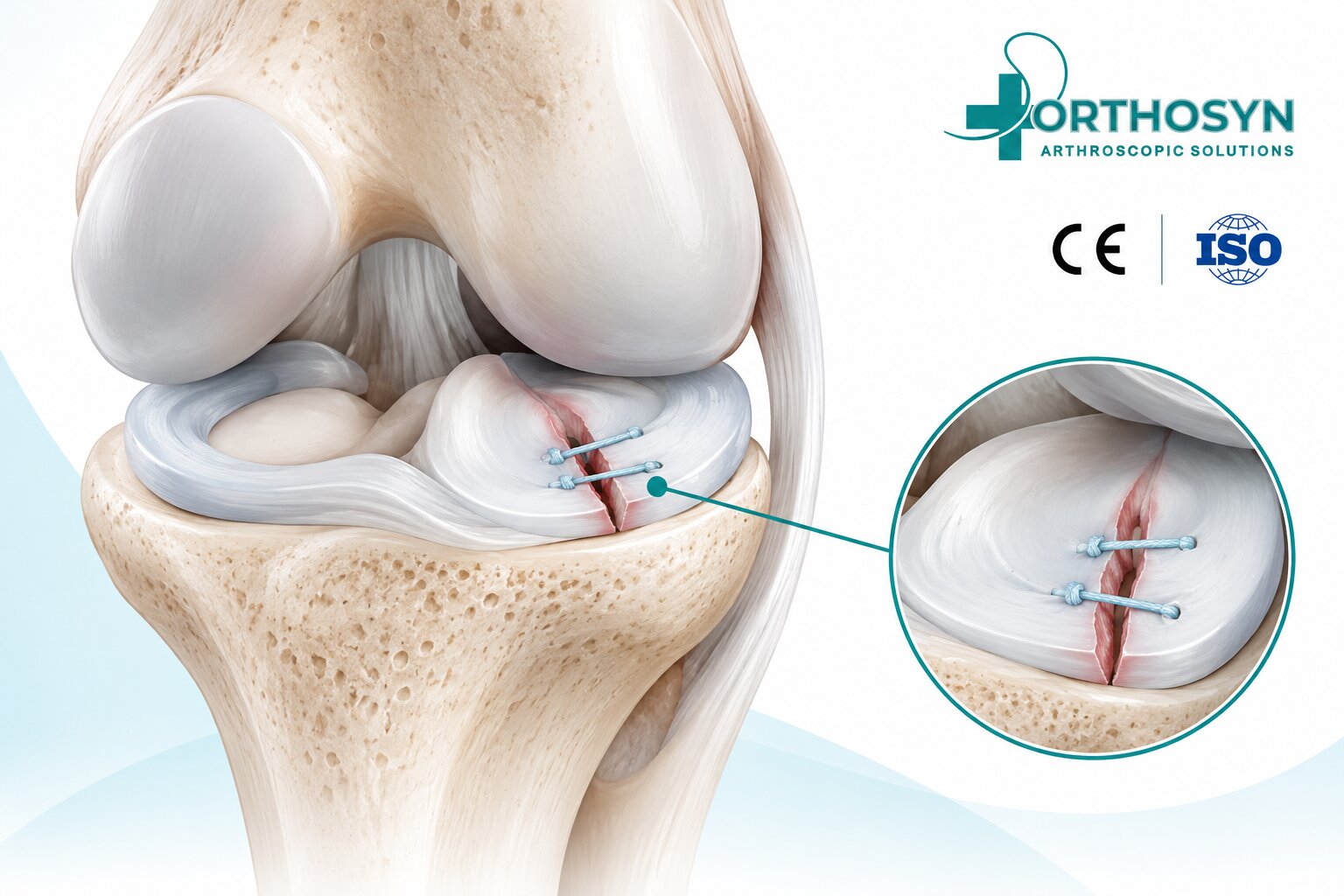
Radial meniscus tear repair is an arthroscopic procedure used to restore the continuity and mechanical function of a damaged knee meniscus. Radial tears extend from the inner free edge of the meniscus toward its outer circumference, disrupting the collagen fibers responsible for distributing loads across the knee joint.
Unlike some longitudinal tears, radial tears can significantly impair the meniscus's ability to convert compressive forces into circumferential tension, commonly known as hoop stress.
When the tear is suitable for repair, arthroscopic suturing techniques may be used to reconnect the damaged meniscal tissue and preserve its function.
The fundamental repair concept is:
Radial Meniscus Tear → Arthroscopic Evaluation → Tissue Preparation → Suture Placement → Tear Approximation → Healing
A radial meniscus tear is a tear that runs perpendicular to the circumferential collagen fibers of the meniscus.
It may occur in either the medial or lateral meniscus and can involve different anatomical regions.
Radial tears are commonly classified according to their location, length, and depth.
A complete radial tear can disrupt the circumferential fiber network, potentially compromising meniscal load transmission and increasing contact stresses on the articular cartilage.
Radial meniscus tears may result from traumatic injuries or degenerative changes.
Common contributing factors include:
Sudden twisting movements
Sports-related knee injuries
Deep knee flexion under load
Rotational forces during pivoting
Age-related meniscal degeneration
Associated ACL injuries
Traumatic radial tears may occur in younger, physically active patients, while degenerative tears are more frequently associated with progressive tissue deterioration.
Patients with radial meniscus tears may experience:
Knee pain along the joint line
Swelling after activity
Clicking or catching sensations
Difficulty squatting
Pain during rotational movements
Reduced knee mobility
Mechanical symptoms in selected cases
Clinical examination and MRI can help identify the tear pattern. Arthroscopy may provide direct visualization when surgical treatment is indicated.
The meniscus distributes forces between the femur and tibia while contributing to joint stability and cartilage protection.
Its circumferential collagen fibers help convert compressive loading into hoop stress.
A radial tear interrupts these fibers, potentially reducing the meniscus's ability to distribute loads effectively.
Repair aims to restore tissue continuity and preserve as much functional meniscal tissue as possible.
However, not every radial tear is repairable. Treatment depends on tear location, tissue quality, vascularity, associated injuries, and patient-specific factors.
The surgeon examines the knee joint and identifies the radial tear.
Important considerations include the tear's location, completeness, tissue quality, stability, and relationship to the meniscal root.
Associated cartilage damage or ligament injuries are also assessed.
The torn edges are evaluated and prepared to encourage biological healing.
Depending on the surgical technique, preparation may include limited debridement of damaged tissue and stimulation of the repair site.
The objective is to preserve viable meniscal tissue while creating suitable conditions for healing.
High-strength sutures are passed through the meniscal tissue on both sides of the radial tear.
Several configurations may be used, including:
Horizontal mattress sutures
Vertical mattress sutures
Cross-suture configurations
Hashtag repair techniques
Rip-stop or reinforced suture constructs
The selected configuration depends on tear geometry, tissue quality, and surgical preference.
The sutures are tensioned to bring the separated meniscal edges together.
The surgeon aims to restore continuity of the circumferential collagen fiber network without excessive tissue compression or suture cut-through.
After fixation, the surgeon evaluates the repair using arthroscopic instruments.
The repaired tissue is assessed for approximation, stability, and resistance to displacement.
Additional sutures may be placed when necessary.
Different arthroscopic techniques can be selected according to the tear pattern and anatomical location.
Technique | Main characteristic |
|---|---|
All-Inside Repair | Suture fixation using devices deployed primarily within the joint |
Inside-Out Repair | Sutures passed from inside the joint to the outside and secured through an accessory incision |
Outside-In Repair | Sutures introduced from outside the joint toward the meniscus |
Reinforced Radial Repair | Additional suture configurations designed to improve construct stability |
All-inside techniques may reduce the need for accessory incisions in selected cases, while inside-out techniques provide flexibility for certain complex tear configurations.
No single technique is universally superior for every radial meniscus tear.
The hashtag repair technique is a reinforced suture configuration developed for radial meniscus tears.
It combines sutures placed across the tear with additional sutures oriented to reinforce the repair.
The objective is to improve resistance to tissue displacement and reduce the risk of sutures cutting through the meniscus.
Other reinforced configurations may use rip-stop sutures or different combinations of vertical and horizontal stitches.
The biomechanical performance of each construct depends on the tear pattern, suture material, tissue quality, and surgical technique.
All-inside meniscal repair devices are used for various meniscal tear patterns.
Their suitability for radial tears depends on the specific device design, tear location, tissue quality, and required suture configuration.
Some radial tears require reinforced or hybrid repair techniques that cannot be achieved using every all-inside device.
The ORTHOSYN VersaFix Meniscal Repair System is an all-inside meniscal fixation technology featuring:
Two PEEK fixation implants
High-strength UHMWPE suture
Adjustable insertion depth control
An all-inside fixation approach
VersaFix represents one of the meniscal repair technologies within the ORTHOSYN arthroscopy portfolio.
Its suitability for a particular radial meniscus tear must be confirmed according to the device's approved indications, instructions for use, and the required repair configuration.
Explore the ORTHOSYN Meniscal Repair Systems.
Radial tears and meniscal root tears can produce similar biomechanical consequences, but they are not identical.
A radial tear occurs across the meniscal tissue, while a meniscal root tear involves the attachment region that anchors the meniscus to the tibia.
A radial tear located close to the meniscal root may functionally compromise root attachment and hoop stress transmission.
Depending on the injury, root-adjacent radial tears may require specialized repair techniques, including transtibial fixation.
Successful meniscal healing depends on several factors:
Tear location and vascular supply
Tissue quality
Tear size and completeness
Suture configuration
Mechanical stability
Associated ACL injury
Patient age and activity level
Rehabilitation compliance
Tears extending into the peripheral vascular region may have greater healing potential than tears confined to the relatively avascular inner meniscus.
However, healing cannot be predicted from tear location alone.
Rehabilitation after radial meniscus repair is often more protective than rehabilitation after a simple partial meniscectomy.
Depending on the repair configuration, the surgeon may initially restrict weight-bearing, knee flexion, or loaded squatting to protect the healing tissue.
Progressive rehabilitation generally includes controlled mobility, strengthening, balance training, and functional exercises.
Return to demanding sports may require approximately six months or longer, depending on healing, associated procedures, and functional recovery.
The rehabilitation protocol must be individualized by the treating surgeon.
Potential complications include:
Incomplete meniscal healing
Recurrent meniscal tearing
Suture or fixation failure
Persistent knee pain
Joint stiffness
Infection
Neurovascular injury
Continued mechanical symptoms
The risk of complications depends on the injury, repair technique, and patient-specific factors.
Radial meniscus tear repair aims to reconnect damaged meniscal tissue and restore the continuity of circumferential collagen fibers responsible for hoop stress transmission.
Arthroscopic repair may involve all-inside, inside-out, outside-in, or reinforced suture techniques.
The selected approach depends on tear geometry, tissue quality, anatomical location, and the stability required.
Within the ORTHOSYN portfolio, the VersaFix Meniscal Repair System provides an all-inside meniscal fixation option for compatible applications.
Successful repair requires appropriate patient selection, stable tissue approximation, biological healing, and structured rehabilitation.