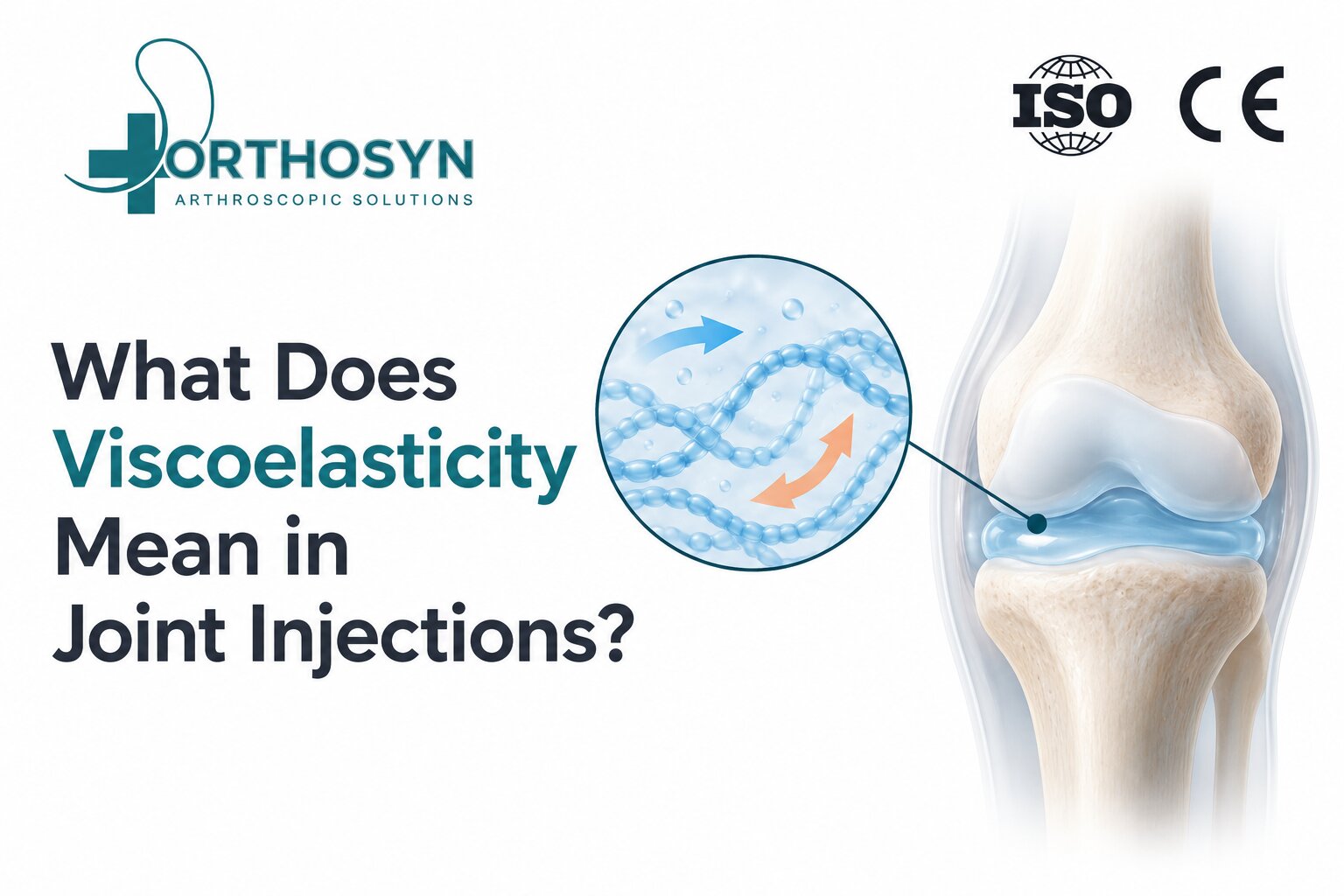
Viscoelasticity describes the ability of a material to show both viscous and elastic behavior.
This is especially important in intra-articular hyaluronic acid (HA) injections because the joint environment is exposed to different types of movement, loading and mechanical stress.
In simple terms:
Viscosity = resistance to flow.
Elasticity = ability to deform and recover.
Viscoelasticity = a combination of both behaviors.
Hyaluronic acid formulations can display viscoelastic properties because their polymer chains interact with each other and with water.
For this reason, viscoelasticity is one of the key concepts used to describe the rheological behavior of intra-articular HA products.
Synovial joints such as the knee are exposed to constantly changing mechanical conditions.
The joint may experience:
The fluid inside the joint must therefore behave differently depending on the mechanical situation.
This is where viscoelasticity becomes relevant.
A viscoelastic material can behave more like a fluid under some conditions and more like an elastic material under others.
Although they are related, viscosity and elasticity describe different properties.
Viscosity describes resistance to flow.
A more viscous fluid resists movement more strongly.
Elasticity describes the ability of a material to deform under stress and then recover when that stress is reduced or removed.
In a viscoelastic material, both properties are present at the same time.
This combination is particularly relevant to hyaluronic acid.
Hyaluronic acid is a long-chain polymer.
Its chains can:
These interactions create both viscous and elastic characteristics.
The exact viscoelastic profile depends on factors such as:
For this reason, different HA formulations can have different viscoelastic behavior.
Molecular weight describes the size of HA polymer chains.
Higher molecular weight generally means longer chains.
Longer chains can create more interaction and entanglement within a solution.
This may influence:
However, molecular weight alone does not determine viscoelasticity.
A complete evaluation must also consider concentration and molecular structure.
Concentration describes how much HA is present per milliliter.
As concentration increases, more HA chains are present within the same volume.
This can increase:
As a result, concentration can influence both viscous and elastic components of a formulation.
But again, concentration should not be evaluated alone.
Cross-linking can substantially change viscoelastic behavior.
In linear HA, polymer chains remain separate.
In cross-linked HA, some chains are chemically connected into a three-dimensional network.
This molecular network can influence:
For this reason, cross-linked formulations may show a different viscoelastic profile from linear HA.
Linear and cross-linked HA formulations should not be compared using molecular weight or viscosity alone.
A linear formulation may rely more heavily on:
A cross-linked formulation introduces another variable:
network structure
This can change how the material responds to mechanical forces.
Therefore, the viscoelastic behavior of a cross-linked product cannot be fully described simply by looking at the molecular weight of the original HA chains.
Rheology is the study of how materials flow and deform.
Viscoelasticity is part of rheology.
When evaluating an HA formulation, rheological analysis may include:
This provides a more complete picture than viscosity alone.
In viscoelastic testing, two parameters are often used:
Storage modulus (G′)
Represents the elastic component of the material.
Loss modulus (G″)
Represents the viscous component.
A formulation with a stronger elastic response may show a higher relative G′.
A formulation with a stronger viscous response may show a higher relative G″.
These parameters can change depending on test conditions and frequency.
Therefore, they should always be interpreted within the measurement method used.
Viscoelastic materials can behave differently depending on how quickly mechanical force is applied.
At slower movements, the material may behave in a more viscous way.
At faster movements, the elastic component may become more significant.
This frequency-dependent behavior is particularly relevant in joints because movement can vary from slow daily activity to rapid mechanical loading.
In rheological testing, the crossover point is the frequency at which the viscous and elastic components are equal.
In other words:
G′ = G″
Below or above this point, either the viscous or elastic component may dominate.
The crossover point can provide useful information about the mechanical behavior of an HA formulation.
However, it should not be interpreted as a standalone measure of product quality.
Synovial fluid naturally contains hyaluronic acid.
Its mechanical behavior changes according to movement conditions.
At lower movement speeds, viscous behavior can contribute to lubrication.
At higher movement speeds or under changing mechanical loads, elastic behavior becomes increasingly relevant.
This combination helps explain why viscoelasticity is such an important concept in joint biomechanics.
The viscous component of an HA-containing fluid contributes to resistance to flow and fluid behavior between joint surfaces.
However, lubrication is not determined by viscosity alone.
Viscoelasticity provides a broader understanding because it includes both viscous and elastic responses.
This makes it a more complete concept when discussing HA behavior inside the joint environment.
Joints are exposed to repeated loading during activities such as:
A viscoelastic material responds differently depending on the speed and intensity of these forces.
This is why viscoelasticity is often discussed together with:
Not automatically.
There is no single viscoelastic value that defines a better product.
Different formulations may be designed with different rheological profiles.
A product should instead be evaluated according to:
The overall formulation profile is more informative than one rheological parameter.
Yes.
Two products can differ in viscoelastic behavior even if they have similar:
Differences may result from:
This is why technical comparison should go beyond the amount of HA in the syringe.
In a linear HA formulation, viscoelastic behavior is strongly influenced by:
The AlkaFlex Linear Intra-Articular Hyaluronic Acid portfolio uses high molecular weight linear HA with an approximate molecular weight of 2.4 MDa.
This high molecular weight contributes to the technical characteristics of the formulation.
Explore AlkaFlex Linear Hyaluronic Acid:
https://orthosynmed.com/product/39/alkaflex-intra-articular-injections-with-hyaluronic-acid---linear-linked
Cross-linked HA introduces a molecular network that can influence elastic and viscous behavior differently.
The AlkaFlex Cross-Linked Intra-Articular Hyaluronic Acid portfolio uses a cross-linked structure rather than relying only on linear chain length.
This can affect:
Explore AlkaFlex Cross-Linked Hyaluronic Acid:
https://orthosynmed.com/product/44/alkaflex-intra-articular-injections-with-cross-linked-hyaluronic-acid
A useful summary is:
Molecular Weight + Concentration + Molecular Structure + Cross-Linking + Temperature + Test Frequency = Viscoelastic Profile
Each parameter can influence the final behavior of the formulation.
This is why viscoelasticity cannot be understood by looking at a single specification.
When reviewing the viscoelastic properties of an HA product, useful questions include:
These questions provide a more complete basis for technical comparison.
AlkaFlex is Orthosyn Medikal’s international brand for intra-articular hyaluronic acid formulations.
The portfolio includes two main formulation approaches:
AlkaFlex Linear
High molecular weight linear HA, approximately 2.4 MDa.
AlkaFlex Cross-Linked
A cross-linked HA network with a different structural and rheological profile.
These two approaches demonstrate why viscoelasticity depends not only on the amount of HA present, but also on how the HA molecules are structured and interact.
Viscoelasticity means that a material shows both viscous and elastic behavior.
For hyaluronic acid injections:
Viscosity describes resistance to flow.
Elasticity describes the ability to deform and recover.
Viscoelasticity describes the combined behavior of both.
The viscoelastic profile of an HA formulation can be influenced by:
Therefore, the most useful technical approach is to evaluate:
molecular weight + concentration + structure + cross-linking + rheological profile
together.
For AlkaFlex Linear, high molecular weight linear HA contributes to the formulation’s viscoelastic characteristics, while AlkaFlex Cross-Linked uses a molecular-network approach that influences viscosity and elasticity differently.
AlkaFlex Linear Intra-Articular Hyaluronic Acid
https://orthosynmed.com/product/39/alkaflex-intra-articular-injections-with-hyaluronic-acid---linear-linked
AlkaFlex Cross-Linked Intra-Articular Hyaluronic Acid
https://orthosynmed.com/product/44/alkaflex-intra-articular-injections-with-cross-linked-hyaluronic-acid