Viscosity describes how strongly a fluid resists flowing.
In hyaluronic acid (HA) injections, viscosity is an important physical property because it helps describe how the formulation behaves as a fluid inside the syringe and within the joint environment.
A lower-viscosity formulation flows more easily.
A higher-viscosity formulation offers greater resistance to flow.
However, viscosity is not determined by a single parameter. In hyaluronic acid injections, it can be influenced by:
For this reason, viscosity should be evaluated as part of the complete technical profile of an intra-articular HA product.
Viscosity is a measure of resistance to flow.
A simple everyday comparison is:
In medical formulations, viscosity is more complex than this simple example because polymers such as hyaluronic acid can behave differently under different conditions.
HA solutions are not just “thick liquids.” Their behavior can change depending on:
This is why HA is often discussed together with rheology and viscoelasticity.
Hyaluronic acid is a long-chain polymer naturally present in synovial fluid.
Its polymer chains interact with water and with each other.
These interactions contribute to the physical properties of the fluid.
Viscosity is relevant because HA-containing fluids must respond to changing mechanical conditions inside synovial joints.
Intra-articular HA formulations are therefore often evaluated according to their:
Molecular weight describes the size of the HA polymer chains.
Higher molecular weight usually means longer polymer chains.
Longer chains can interact and become entangled more extensively.
This can increase resistance to flow and therefore contribute to higher viscosity.
However, molecular weight does not determine viscosity by itself.
For example, a high-molecular-weight HA used at a low concentration may behave differently from a lower-molecular-weight HA used at a high concentration.
Concentration describes how much hyaluronic acid is present per milliliter.
For example:
As concentration increases, more HA chains are present within the same volume.
This can increase polymer interaction and entanglement, which can influence viscosity.
Therefore, concentration is another major factor when evaluating how thick or resistant to flow an HA formulation may be.
Molecular weight and concentration should be considered together.
A useful way to think about it is:
Molecular weight = chain size
Concentration = amount of HA per volume
Both can influence viscosity.
For example:
may produce very different rheological behaviors.
This is why one value alone cannot fully describe an HA injection.
Cross-linking can strongly influence viscosity.
In linear HA, polymer chains remain separate from one another.
In cross-linked HA, some polymer chains are chemically connected into a three-dimensional network.
This network can significantly modify:
Because of this, a cross-linked HA formulation may behave very differently from a linear formulation even if the original HA chains have similar molecular weights.
Linear and cross-linked HA should not be compared using viscosity alone.
A linear HA formulation may have:
A cross-linked HA formulation may have:
These structural differences can create very different product characteristics.
These terms are related but not identical.
Viscosity describes resistance to flow.
Elasticity describes the ability of a material to deform and recover.
Viscoelasticity describes behavior that includes both viscous and elastic characteristics.
Hyaluronic acid formulations can show both.
This is particularly relevant in synovial joints, where mechanical loading changes constantly during movement.
Rheology is the study of how materials flow and deform.
In HA formulations, rheology includes properties such as:
Viscosity is therefore only one part of the rheological profile.
A complete evaluation of an intra-articular HA formulation may require more than a single viscosity value.
No.
Higher viscosity does not automatically mean better quality or better performance.
Viscosity should be interpreted together with:
Different products may be designed to achieve different rheological characteristics.
Therefore, “more viscous” should not automatically be interpreted as “better.”
Yes.
Two formulations may show similar viscosity values but still differ in:
This means viscosity alone cannot fully describe the formulation.
Two apparently similar products may behave differently under changing mechanical conditions.
Yes.
Temperature can influence the viscosity of polymer solutions.
Because of this, viscosity measurements should ideally be interpreted together with the conditions under which they were measured.
When comparing technical data, it can be useful to check:
This helps make comparisons more meaningful.
Viscosity may change depending on how quickly a material is being deformed or moved.
This is called shear-dependent behavior.
HA solutions can show non-Newtonian behavior, meaning their viscosity may not remain constant under all flow conditions.
As shear rate changes, the apparent viscosity may also change.
This is one reason a single viscosity value does not always describe the complete behavior of a hyaluronic acid formulation.
Synovial fluid must function under different mechanical conditions.
For example, the knee experiences different forces during:
Hyaluronic acid contributes to the physical behavior of synovial fluid.
Its viscosity and viscoelasticity help characterize how the fluid responds to movement and loading.
This is one reason viscosity is an important technical concept in the field of viscosupplementation.
Viscosity contributes to how a fluid moves between articular surfaces.
However, joint lubrication is not determined by viscosity alone.
It also depends on:
Therefore, a higher viscosity value should not be interpreted as a direct measure of better lubrication.
The AlkaFlex Linear Intra-Articular Hyaluronic Acid portfolio uses high molecular weight linear HA.
For AlkaFlex Linear, molecular weight and concentration are important factors contributing to the formulation's physical profile.
The approximate 2.4 MDa molecular weight is one of the key technical characteristics of the linear HA.
Explore AlkaFlex Linear Hyaluronic Acid:
https://orthosynmed.com/product/39/alkaflex-intra-articular-injections-with-hyaluronic-acid---linear-linked
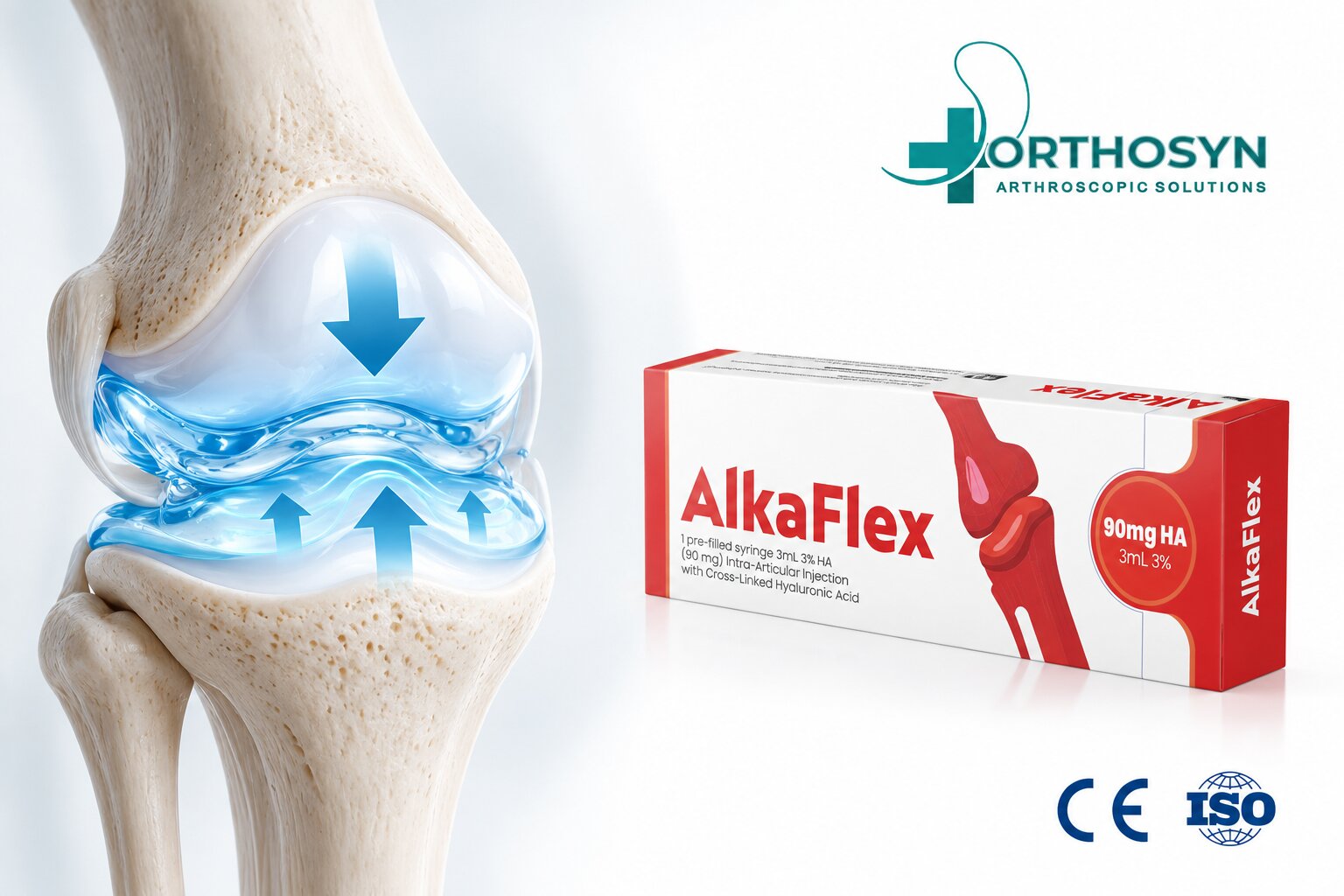
The AlkaFlex Cross-Linked Intra-Articular Hyaluronic Acid portfolio uses a different structural approach.
Cross-linking connects HA chains into a molecular network.
This can influence viscosity and elasticity differently from a purely linear formulation.
As a result, cross-linked HA should be evaluated according to the complete rheological profile rather than only the molecular weight of the original polymer chains.
Explore AlkaFlex Cross-Linked Hyaluronic Acid:
https://orthosynmed.com/product/44/alkaflex-intra-articular-injections-with-cross-linked-hyaluronic-acid
A useful summary is:
Molecular Weight + Concentration + Molecular Structure + Cross-Linking + Temperature + Test Conditions = Viscosity Profile
Each factor can influence the final result.
This is why two HA products with similar concentrations or molecular weights may still show different viscosity characteristics.
When reviewing viscosity data for an intra-articular HA product, useful questions include:
These questions provide a more complete basis for technical comparison.
AlkaFlex is Orthosyn Medikal’s international brand for intra-articular hyaluronic acid formulations.
The portfolio includes both:
AlkaFlex Linear
High molecular weight linear HA, approximately 2.4 MDa.
AlkaFlex Cross-Linked
Cross-linked HA with a different molecular-network structure.
These two approaches illustrate why viscosity should always be understood in relation to molecular weight, concentration and molecular structure.
Viscosity describes the resistance of a hyaluronic acid formulation to flow.
It is an important technical property, but it is not determined by a single number.
HA viscosity can be influenced by:
For this reason, the most useful technical evaluation is not simply:
“How viscous is the product?”
but rather:
molecular weight + concentration + structure + cross-linking + rheological profile
For AlkaFlex Linear, high molecular weight linear HA contributes to the formulation profile, while AlkaFlex Cross-Linked uses a different molecular-network approach that influences viscosity and elasticity differently.
AlkaFlex Linear Intra-Articular Hyaluronic Acid
https://orthosynmed.com/product/39/alkaflex-intra-articular-injections-with-hyaluronic-acid---linear-linked
AlkaFlex Cross-Linked Intra-Articular Hyaluronic Acid
https://orthosynmed.com/product/44/alkaflex-intra-articular-injections-with-cross-linked-hyaluronic-acid