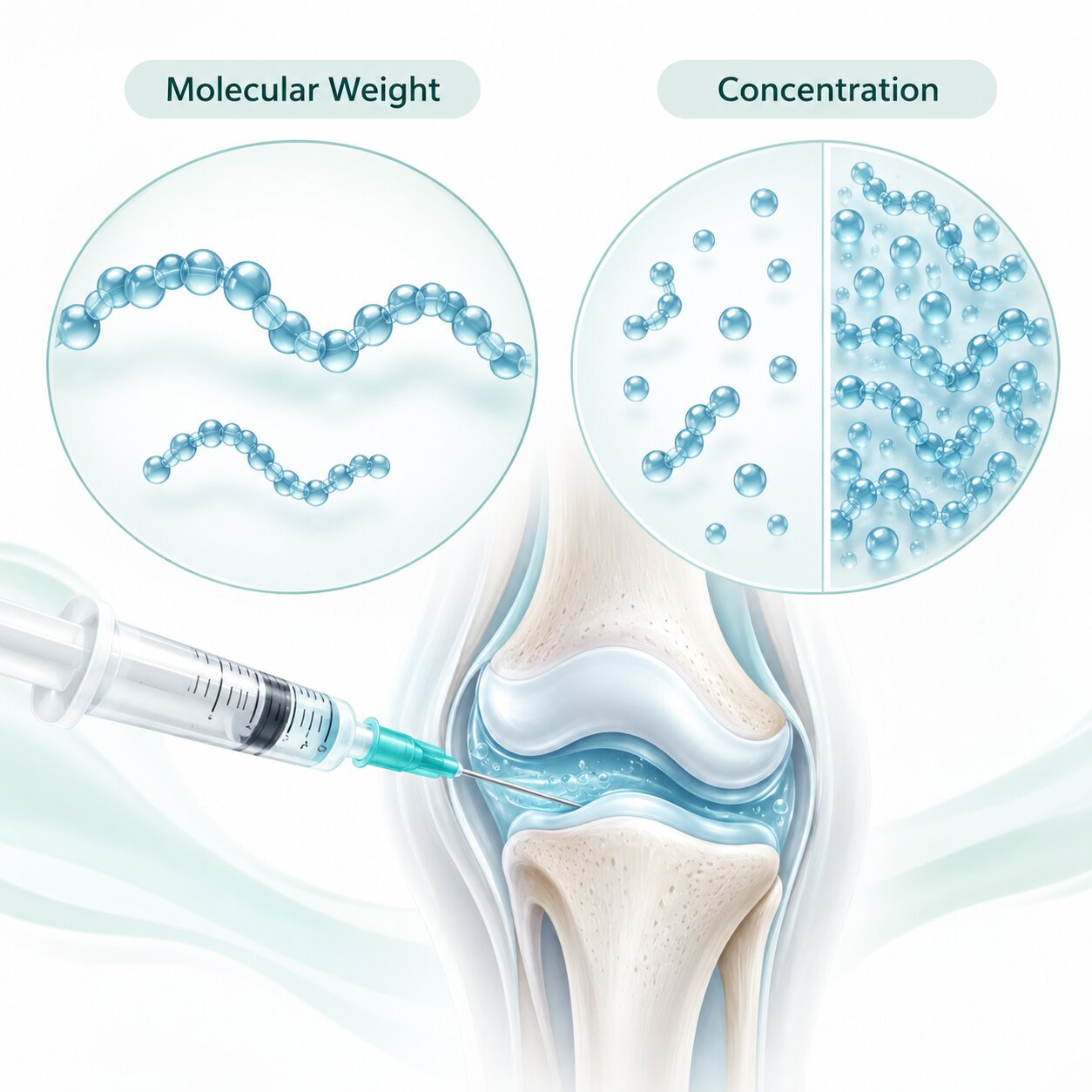
When comparing hyaluronic acid injections, molecular weight and concentration are two of the most important technical parameters.
They are often discussed together, but they describe completely different characteristics of a hyaluronic acid (HA) formulation.
In simple terms:
Molecular weight describes the size of the HA polymer chains.
Concentration describes how much HA is present in a certain volume.
Both can influence viscosity and rheological behavior, but neither should be interpreted alone.
For intra-articular products such as AlkaFlex, understanding the difference between these two parameters is essential when comparing formulations.
Hyaluronic acid is a long-chain polysaccharide made of repeating molecular units.
The length of these chains determines their molecular weight.
Molecular weight is usually expressed in:
For example:
2.4 MDa = approximately 2.4 million daltons
A higher molecular weight generally means longer HA polymer chains.
Longer chains can interact and entangle more strongly, which may influence:
Concentration describes how much hyaluronic acid is present in each milliliter of solution.
It is usually expressed in:
For example:
So concentration tells us how densely HA is present within a formulation.
It does not tell us how large the individual polymer chains are.
Because both can influence the physical behavior of an HA formulation.
A product with higher molecular weight may have increased viscosity.
A product with higher concentration may also have increased viscosity.
This sometimes creates the impression that molecular weight and concentration describe the same thing.
They do not.
One describes polymer chain size.
The other describes amount of polymer per volume.
Imagine two HA formulations.
Formulation A
Formulation B
Formulation A has larger HA chains.
Formulation B contains more HA per milliliter.
You cannot determine which formulation is more viscous or technically preferable just by looking at one of these values.
The complete formulation must be considered.
No.
A high molecular weight product can have a low concentration.
A lower molecular weight product can have a high concentration.
These parameters are independent.
For example:
A product can use high molecular weight HA at 16 mg/mL.
Another can use lower molecular weight HA at 30 mg/mL.
The second product has a higher concentration, but not necessarily a higher molecular weight.
No.
Concentration only describes how much HA is present in a specific volume.
It does not describe polymer size.
For example:
30 mg/mL HA does not automatically mean the product contains high molecular weight HA.
Similarly:
10 mg/mL HA does not automatically mean the product contains low molecular weight HA.
The molecular-weight value must be evaluated separately.
Higher molecular weight means longer HA polymer chains.
Longer chains can:
This can contribute to higher viscosity.
However, molecular weight does not determine viscosity by itself.
Viscosity is also affected by:
At higher concentrations, more HA chains are present in the same volume.
This increases the likelihood of polymer interaction and entanglement.
As a result, increasing HA concentration can increase viscosity.
But again, the final result depends on the molecular weight and structure of the HA.
This is why a highly concentrated lower-molecular-weight product may sometimes behave differently from a lower-concentration high-molecular-weight product.
There is no universal answer.
Both parameters are important.
Their significance depends on the formulation.
A more useful approach is to consider:
molecular weight + concentration + total dose + molecular structure + cross-linking
together.
This provides a more complete technical understanding of an intra-articular HA product.
Total dose is another parameter that should not be confused with molecular weight or concentration.
Total dose tells us how much HA is contained in the full syringe.
It can be calculated as:
Concentration × Volume = Total HA Dose
For example:
30 mg/mL × 3 mL = 90 mg HA
This tells us the total amount of HA delivered in the syringe.
It still does not tell us the molecular weight.
These three parameters describe different things:
Molecular weight
Size of the HA polymer chains.
Concentration
Amount of HA per milliliter.
Total dose
Total amount of HA in the syringe.
For example:
A syringe can contain:
This would provide:
40 mg total HA
Each number describes a different characteristic.
Cross-linking adds another level of complexity.
In linear HA, the original polymer chain size is especially relevant.
In cross-linked HA, chains are chemically connected into a molecular network.
This network can significantly change:
Therefore, molecular weight and concentration alone may not fully describe a cross-linked HA formulation.
In a linear HA product, the original polymer chain size is especially important because the chains are not intentionally connected into a cross-linked network.
The AlkaFlex Linear Intra-Articular Hyaluronic Acid portfolio uses high molecular weight linear HA with an approximate molecular weight of 2.4 MDa.
This molecular-weight value forms an important part of the technical profile.
Explore AlkaFlex Linear Hyaluronic Acid:
https://orthosynmed.com/product/39/alkaflex-intra-articular-injections-with-hyaluronic-acid---linear-linked
In cross-linked formulations, molecular structure becomes especially important.
The polymer chains are connected into a network, which changes the way the material behaves.
As a result, viscosity and elasticity are influenced not only by molecular weight and concentration, but also by the degree and architecture of cross-linking.
The AlkaFlex Cross-Linked Intra-Articular Hyaluronic Acid portfolio represents this different formulation strategy.
Explore AlkaFlex Cross-Linked Hyaluronic Acid:
https://orthosynmed.com/product/44/alkaflex-intra-articular-injections-with-cross-linked-hyaluronic-acid
Yes.
Two products can both use HA with the same molecular weight but contain different amounts of HA per milliliter.
For example:
The molecular weight is the same, but the concentration is different.
This can influence viscosity and formulation behavior.
Yes.
For example:
The concentration is identical.
But the polymer chain sizes are different.
This can create different rheological profiles.
Intra-articular HA formulations are designed to interact with the synovial environment.
Their physical behavior can be affected by:
For this reason, comparing only one number can be misleading.
A more complete technical evaluation gives a better understanding of how a formulation is designed.
No.
A higher concentration does not automatically mean a better product.
Likewise, a higher molecular weight does not automatically mean a better product.
Both parameters should be interpreted in the context of the complete formulation.
For example, a higher concentration may increase viscosity, but other formulation characteristics may also change how the product behaves.
Again, not automatically.
High molecular weight is an important technical characteristic, especially in linear HA.
But the complete product profile still matters.
A meaningful comparison should consider:
When evaluating an HA injection, useful questions include:
This provides a more reliable basis for product comparison.
AlkaFlex is Orthosyn Medikal's international brand for intra-articular hyaluronic acid formulations.
Within the AlkaFlex portfolio:
AlkaFlex Linear is based on high molecular weight linear HA, approximately 2.4 MDa.
AlkaFlex Cross-Linked uses a different molecular structure based on cross-linking technology.
Different AlkaFlex formulations can also use different concentrations and total HA doses.
This is why AlkaFlex products should be evaluated using the complete technical profile rather than one isolated number.
Molecular weight and concentration are not the same thing.
Molecular weight tells us:
How large are the HA polymer chains?
Concentration tells us:
How much HA is present per milliliter?
Both can influence viscosity and rheological behavior, but they do so in different ways.
For a complete comparison of hyaluronic acid injections, it is better to evaluate:
molecular weight + concentration + total dose + molecular structure + cross-linking + injection volume
together.
For AlkaFlex Linear, approximately 2.4 MDa high molecular weight HA is an important technical characteristic, while concentration and total dose provide additional information about how much HA is present in each formulation.
AlkaFlex Linear Intra-Articular Hyaluronic Acid
https://orthosynmed.com/product/39/alkaflex-intra-articular-injections-with-hyaluronic-acid---linear-linked
AlkaFlex Cross-Linked Intra-Articular Hyaluronic Acid
https://orthosynmed.com/product/44/alkaflex-intra-articular-injections-with-cross-linked-hyaluronic-acid