


Yes. Molecular weight can significantly influence the viscosity of hyaluronic acid (HA), but it is not the only factor that determines how viscous an intra-articular HA formulation will be.
Hyaluronic acid is a long-chain polymer. As its polymer chains become longer, their molecular weight increases. Longer chains can interact and become entangled with each other more extensively, which can increase resistance to flow.
This is one reason why high molecular weight hyaluronic acid is frequently associated with higher viscosity.
However, the complete relationship is more complex.
The viscosity of an HA injection can also depend on:
Therefore, molecular weight should always be evaluated together with the complete formulation profile.
Viscosity describes how strongly a fluid resists flowing.
A low-viscosity liquid flows relatively easily.
A higher-viscosity material offers greater resistance to flow.
In hyaluronic acid formulations, viscosity is particularly important because HA is used in environments where mechanical and rheological behavior matters, including synovial joints.
Synovial fluid itself has complex viscous and elastic properties.
For this reason, viscosity is frequently discussed when evaluating intra-articular hyaluronic acid injections.
Molecular weight describes the approximate size of the hyaluronic acid polymer chains.
HA is made from repeating disaccharide units connected together into long chains.
As the number of repeating units increases, the chain becomes longer and its molecular weight increases.
HA molecular weight may be expressed in:
For example:
2.4 MDa = approximately 2.4 million daltons
The AlkaFlex Linear formulation uses high molecular weight linear HA with an approximate molecular weight of 2.4 MDa.
Imagine polymer chains as long flexible strands suspended in a liquid.
Shorter chains have relatively fewer opportunities to interact with surrounding chains.
Longer chains can:
This increases resistance to flow.
Therefore, under otherwise similar formulation conditions, increasing HA molecular weight can result in greater viscosity.
This relationship is particularly important in linear hyaluronic acid formulations.
Not necessarily.
This is one of the most important points when comparing HA products.
Consider two formulations:
Formulation A
Formulation B
It is not possible to determine the final viscosity simply by looking at molecular weight.
Concentration can strongly influence polymer interactions.
The molecular structure of the product can also change the result.
Therefore:
higher molecular weight ≠ automatically higher final viscosity
HA concentration indicates how much hyaluronic acid is present in a specific volume.
For example:
At higher concentrations, more HA chains are present within the same volume.
This can increase interactions and entanglement between polymer chains.
As a result, concentration can have a major effect on viscosity.
This is why molecular weight and concentration should always be considered together.
Although molecular weight and concentration both influence viscosity, they describe different properties.
Molecular weight:
How large are the HA polymer chains?
Concentration:
How much HA is present in each milliliter?
A high molecular weight does not automatically mean a high concentration.
Likewise, a highly concentrated product does not automatically contain higher molecular weight HA.
This distinction is essential when comparing viscosupplementation products.
Cross-linking changes the relationship even further.
In linear HA, individual polymer chains remain separate.
In cross-linked HA, some of these chains are chemically connected to form a larger molecular network.
Cross-linking can significantly alter:
This means a cross-linked HA formulation may display a very different viscosity profile from a linear HA formulation even if their original polymer chains have comparable molecular weights.
Molecular weight and cross-linking are not the same thing.
Molecular weight describes the size of polymer chains.
Cross-linking describes connections between those chains.
A linear HA product can therefore have very high molecular weight without being cross-linked.
Similarly, a cross-linked formulation cannot be fully characterized by simply quoting the molecular weight of the starting HA.
The final network structure must also be considered.
Synovial fluid helps create the mechanical environment inside synovial joints such as the knee.
Hyaluronic acid contributes to its rheological characteristics.
These include:
The viscosity of HA-containing fluid can influence how it behaves under different movement conditions.
However, synovial fluid is not simply a “thick liquid.”
It has viscoelastic properties, meaning it can behave differently depending on the type and speed of mechanical stress.
These terms are related but should not be confused.
Viscosity describes resistance to flow.
Elasticity describes the ability of a material to deform and recover.
Viscoelasticity combines both behaviors.
An HA formulation can therefore have a certain viscosity while also showing elastic characteristics under mechanical stress.
This is why rheological evaluation of intra-articular HA often goes beyond a simple viscosity measurement.
High molecular weight HA can contribute to properties associated with lubrication because longer polymer chains can influence viscosity and viscoelastic behavior.
However, joint lubrication depends on the complete formulation and biological environment.
It cannot be predicted from molecular weight alone.
Factors such as:
also matter.
Therefore, molecular weight should be considered an important technical parameter rather than a single measure of product performance.
The AlkaFlex Linear Intra-Articular Hyaluronic Acid portfolio uses high molecular weight linear HA with an approximate molecular weight of 2.4 MDa.
Because it is a linear formulation, the size of the original HA polymer chains is particularly relevant to the technical profile.
The 2.4 MDa molecular weight can contribute to characteristics associated with:
However, these properties should still be evaluated together with concentration, total dose and injection volume.
Explore AlkaFlex Linear Hyaluronic Acid:
https://orthosynmed.com/product/39/alkaflex-intra-articular-injections-with-hyaluronic-acid---linear-linked
The AlkaFlex Cross-Linked portfolio uses a different molecular strategy.
In cross-linked HA, polymer chains are connected into a molecular network.
As a result, viscosity and elasticity are influenced not only by the original HA chain size but also by the degree and structure of cross-linking.
This is why linear and cross-linked HA products should not be compared using molecular weight alone.
Explore AlkaFlex Cross-Linked Hyaluronic Acid:
https://orthosynmed.com/product/44/alkaflex-intra-articular-injections-with-cross-linked-hyaluronic-acid
Yes.
Two formulations could both use HA with an approximate molecular weight of 2.4 MDa and still have different viscosities.
Possible reasons include differences in:
Therefore, the molecular-weight number alone cannot predict the exact viscosity of the final syringe formulation.
Yes.
Different combinations of molecular weight and concentration can sometimes produce similar apparent viscosity values.
For example, a formulation using shorter chains at a higher concentration may exhibit viscosity characteristics that overlap with a formulation using longer chains at a lower concentration.
Cross-linking can make comparisons even more complex.
This is another reason why HA products should be evaluated using multiple technical parameters rather than a single specification.
A useful way to understand HA viscosity is:
Molecular Weight + Concentration + Molecular Structure + Cross-Linking + Formulation Conditions = Viscosity Profile
Each factor contributes to the final behavior of the product.
The importance of each parameter can vary depending on whether the formulation is linear or cross-linked.
When evaluating the viscosity of an intra-articular HA product, it is useful to review:
This provides a much stronger basis for comparison than simply asking whether the HA is “high molecular weight.”
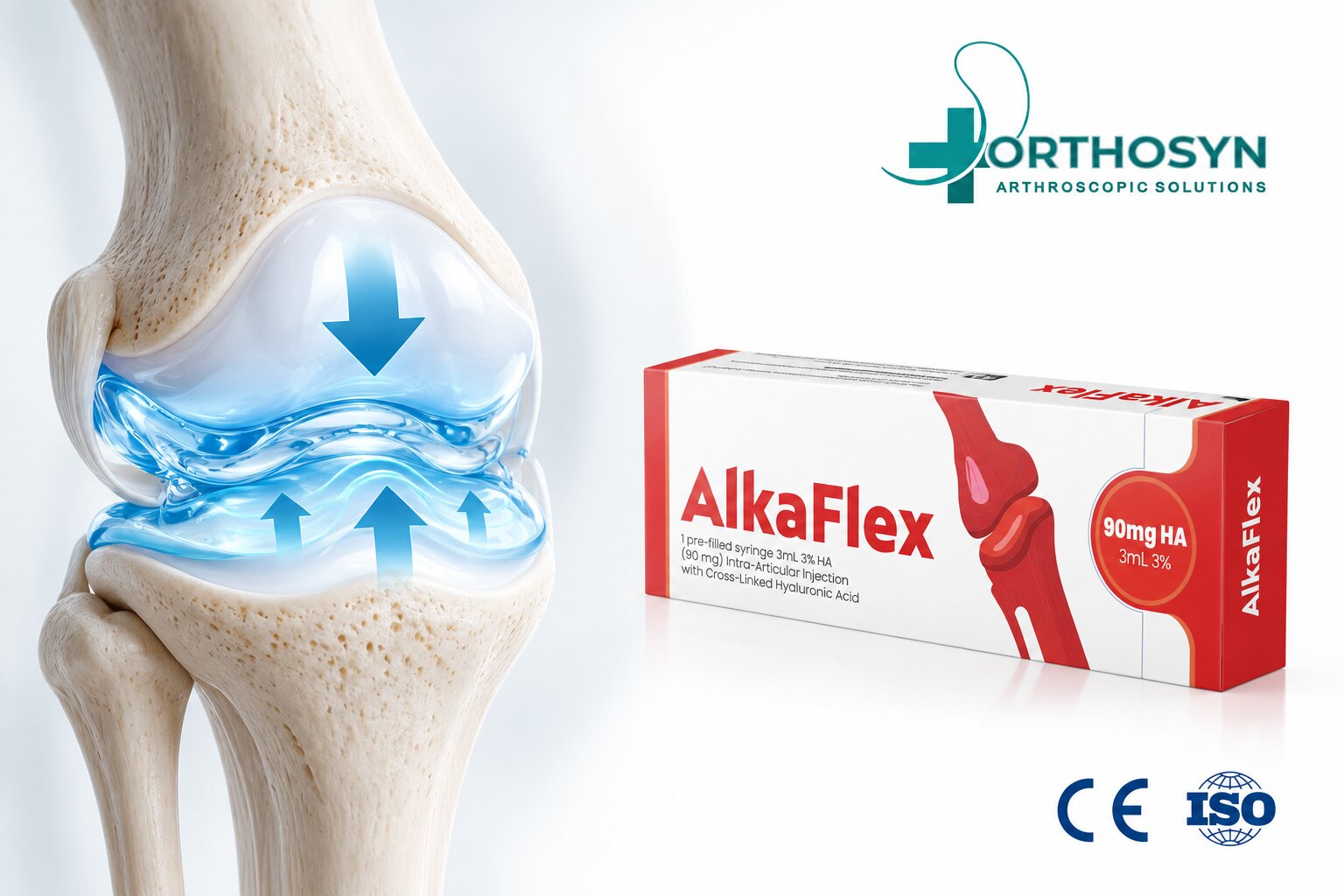
AlkaFlex is Orthosyn Medikal's international brand for intra-articular hyaluronic acid formulations.
The portfolio includes both:
AlkaFlex Linear
High molecular weight linear HA with an approximate molecular weight of 2.4 MDa.
AlkaFlex Cross-Linked
A cross-linked HA formulation in which the molecular network provides a different structural and rheological profile.
These two formulation approaches demonstrate why molecular weight, viscosity and molecular structure should be considered together when evaluating an HA injection.
So, does molecular weight affect hyaluronic acid viscosity?
Yes.
Longer HA polymer chains can create more molecular interaction and entanglement, which can contribute to increased viscosity.
But molecular weight does not determine viscosity by itself.
The final viscosity of an HA formulation also depends on:
For this reason, the most useful technical evaluation is not simply:
“What is the molecular weight?”
but rather:
molecular weight + concentration + structure + cross-linking + rheological profile
For AlkaFlex Linear, approximately 2.4 MDa high molecular weight linear HA is an important part of the formulation profile, while AlkaFlex Cross-Linked uses a different molecular-network approach to influence rheological behavior.
AlkaFlex Linear Intra-Articular Hyaluronic Acid
https://orthosynmed.com/product/39/alkaflex-intra-articular-injections-with-hyaluronic-acid---linear-linked
AlkaFlex Cross-Linked Intra-Articular Hyaluronic Acid
https://orthosynmed.com/product/44/alkaflex-intra-articular-injections-with-cross-linked-hyaluronic-acid