


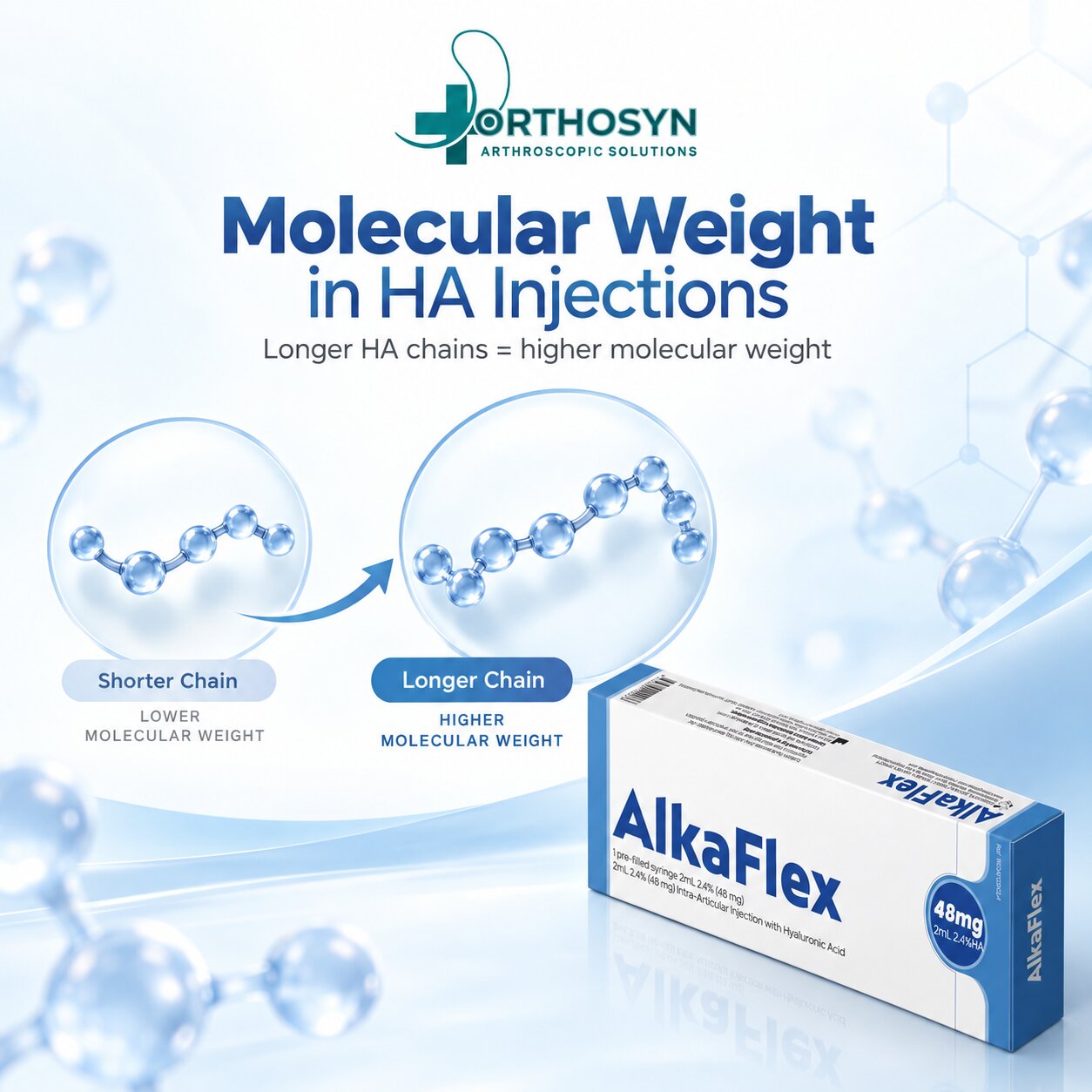
When a hyaluronic acid injection is described as 2.4 MDa, the number refers to the molecular weight of the hyaluronic acid polymer chains.
MDa stands for megadalton.
So:
2.4 MDa = approximately 2.4 million daltons
In practical terms, this means the hyaluronic acid in the formulation consists of relatively long polymer chains with an average molecular mass of around 2.4 million daltons.
For intra-articular products such as AlkaFlex Linear, molecular weight is an important technical characteristic because it can influence viscosity, viscoelasticity and overall rheological behavior.
A dalton (Da) is a unit used to describe molecular mass.
Because hyaluronic acid molecules are very large polymers, their molecular weight is often expressed in thousands or millions of daltons.
Common units include:
Therefore:
2.4 MDa = 2,400 kDa
or approximately 2.4 million daltons.
Hyaluronic acid is not a small molecule.
It is a long-chain polysaccharide made from repeating disaccharide units.
As more repeating units are connected together, the polymer chain becomes longer.
Longer polymer chains generally have a higher molecular weight.
This is why HA products can have very different molecular-weight profiles depending on the length of their polymer chains.
A value of 2.4 MDa tells us that the HA chains are in a high-molecular-weight range.
This can be relevant to physical properties such as:
However, 2.4 MDa does not describe the entire product.
It is only one part of the formulation profile.
Yes, in practical HA product terminology, 2.4 MDa is generally considered a high molecular weight value.
However, classification systems can vary.
Different studies and manufacturers may use different thresholds when describing HA as:
For this reason, the exact value 2.4 MDa is more informative than simply saying “high molecular weight.”
Higher-molecular-weight HA contains longer polymer chains.
Longer chains can create more interaction and entanglement within a solution.
This can contribute to increased viscosity.
However, viscosity also depends on:
So 2.4 MDa does not automatically determine the final viscosity of a product.
The complete formulation must be considered.
Molecular weight and concentration are different concepts.
2.4 MDa describes the size of the HA polymer chains.
Concentration describes how much HA is present per milliliter.
For example, a formulation may contain:
All three could use HA with the same molecular weight but behave differently because the concentration is different.
This is why molecular weight and concentration should always be evaluated separately.
Total HA dose is also different from molecular weight.
For example:
A syringe may contain:
while using HA with the same molecular weight.
The total dose tells you how much HA is delivered.
The molecular weight tells you about the size of the polymer chains.
They are different technical parameters.
In a linear HA formulation, the polymer chains are not intentionally connected into a cross-linked network.
This makes the original molecular weight of the HA chains especially important when describing the formulation.
The AlkaFlex Linear Intra-Articular Hyaluronic Acid portfolio uses high molecular weight linear HA with an approximate molecular weight of 2.4 MDa.
This means AlkaFlex Linear combines:
Explore AlkaFlex Linear Hyaluronic Acid:
https://orthosynmed.com/product/39/alkaflex-intra-articular-injections-with-hyaluronic-acid---linear-linked
No.
This distinction is important.
2.4 MDa describes molecular weight.
Cross-linking describes molecular structure.
A linear HA product can have a molecular weight of 2.4 MDa without being cross-linked.
Cross-linked formulations contain HA chains that are chemically connected into a modified molecular network.
Therefore:
high molecular weight ≠ cross-linked
They are separate technical concepts.
In cross-linked HA, polymer chains are connected to form a three-dimensional network.
This can influence:
Because the material behaves as a network, the original molecular weight of the linear HA chains does not fully describe the final formulation.
This is why cross-linked products should be evaluated differently from linear products.
The AlkaFlex Cross-Linked Intra-Articular Hyaluronic Acid portfolio represents this second formulation approach.
Explore AlkaFlex Cross-Linked Hyaluronic Acid:
https://orthosynmed.com/product/44/alkaflex-intra-articular-injections-with-cross-linked-hyaluronic-acid
Hyaluronic acid contributes to the rheological properties of synovial fluid.
Higher molecular weight can influence:
These characteristics are relevant to the mechanical environment of synovial joints.
However, joint lubrication is not determined by molecular weight alone.
Concentration and formulation structure also matter.
Viscosupplementation involves administering HA directly into a synovial joint.
The behavior of the formulation depends on several technical parameters.
These include:
For a linear HA formulation, a molecular weight of approximately 2.4 MDa is therefore an important part of its technical profile.
Not automatically.
It would be misleading to judge a product only by one number.
A product with a higher molecular weight is not necessarily better in every respect.
The formulation should be considered as a whole.
For example:
2.4 MDa + concentration + total dose + linear structure
may produce a different technical profile from:
another molecular weight + different concentration + cross-linked structure
The important point is how these parameters work together.
When reviewing a 2.4 MDa HA product, useful questions include:
These characteristics provide a more complete technical picture.
AlkaFlex is Orthosyn Medikal’s international brand for intra-articular hyaluronic acid formulations.
Within the AlkaFlex Linear portfolio, 2.4 MDa high molecular weight HA is a key technical characteristic.
This supports the product’s positioning around:
For this reason, the 2.4 MDa specification is not simply a number on a technical sheet. It is part of the formulation identity of AlkaFlex Linear.
When a hyaluronic acid injection is described as 2.4 MDa, it means the HA polymer chains have an average molecular mass of approximately 2.4 million daltons.
This is generally considered a high molecular weight range and can influence physical properties such as:
However, molecular weight should never be evaluated alone.
A complete comparison should also consider:
concentration + total dose + linear or cross-linked structure + injection volume + formulation technology
The AlkaFlex Linear portfolio uses approximately 2.4 MDa high molecular weight linear HA as one of its key technical characteristics.
AlkaFlex Linear Intra-Articular Hyaluronic Acid
https://orthosynmed.com/product/39/alkaflex-intra-articular-injections-with-hyaluronic-acid---linear-linked
AlkaFlex Cross-Linked Intra-Articular Hyaluronic Acid
https://orthosynmed.com/product/44/alkaflex-intra-articular-injections-with-cross-linked-hyaluronic-acid