


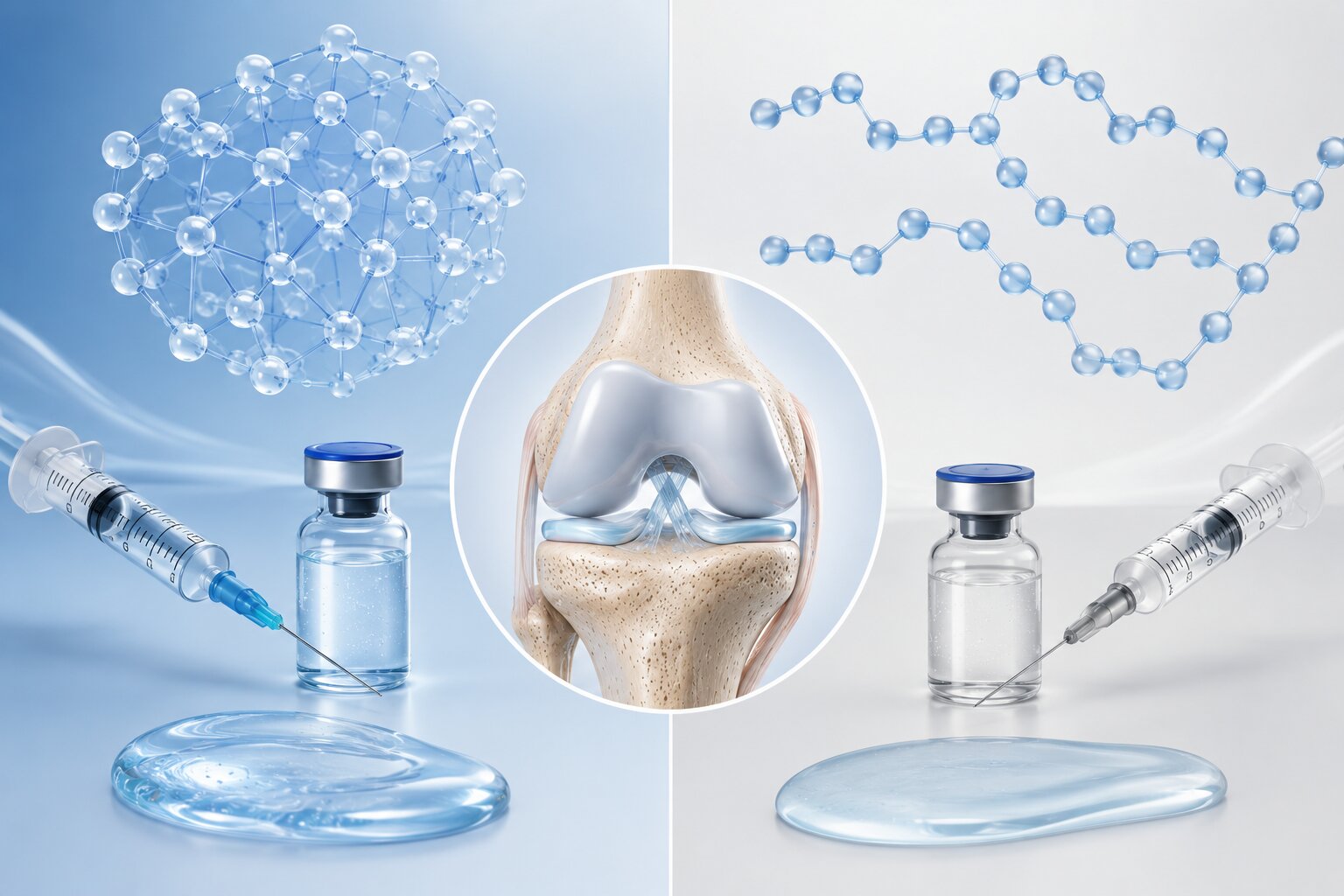
Molecular weight is one of the main technical characteristics used to describe hyaluronic acid (HA) in intra-articular injections.
When people compare low molecular weight and high molecular weight hyaluronic acid, they are mainly comparing the average size of the HA polymer chains.
In general:
Lower molecular weight HA contains shorter polymer chains.
Higher molecular weight HA contains longer polymer chains.
This difference can influence important physical characteristics such as:
However, molecular weight is only one part of a complete HA formulation. Concentration, total dose, linear or cross-linked structure and injection protocol also matter.
Hyaluronic acid is a long-chain polysaccharide made of repeating disaccharide units.
The length of these polymer chains determines their molecular weight.
Molecular weight is commonly expressed in:
For example:
1 MDa = 1 million daltons
So an HA formulation with a molecular weight of 2.4 MDa contains polymer chains with an average molecular mass of approximately 2.4 million daltons.
Low molecular weight hyaluronic acid consists of relatively shorter polymer chains.
Shorter chains generally have fewer intermolecular interactions and less polymer entanglement than longer chains.
This can affect the physical behavior of the material, including:
However, the exact behavior depends strongly on concentration and formulation conditions.
There is also no single universal threshold used by every study or manufacturer to define “low molecular weight.”
High molecular weight hyaluronic acid contains relatively longer polymer chains.
Longer chains can create greater molecular interaction and entanglement.
This may influence:
High molecular weight HA is therefore frequently discussed in connection with intra-articular formulations and synovial-fluid-like mechanical properties.
Again, “high molecular weight” is a relative term. The actual molecular-weight value is more useful than the category name alone.
Viscosity is the resistance of a fluid to flow.
Under comparable formulation conditions, longer HA chains can create more molecular interaction and entanglement than shorter chains.
This can contribute to greater viscosity.
However, viscosity does not depend on molecular weight alone.
It is also affected by:
This means a lower molecular weight HA at a high concentration may behave differently from a high molecular weight HA at a lower concentration.
Viscoelasticity describes a material that has both viscous and elastic characteristics.
This property is particularly relevant in synovial joints because synovial fluid must respond to different movement speeds and mechanical loads.
The size of HA polymer chains can influence:
Higher molecular weight can therefore contribute to different viscoelastic behavior compared with shorter-chain HA.
But concentration and molecular structure still need to be considered.
Not necessarily.
It is too simplistic to say:
high molecular weight = good
low molecular weight = bad
or the opposite.
Different HA formulations are designed with different technical characteristics.
A meaningful comparison should include:
This is especially important in intra-articular products.
Naturally occurring hyaluronic acid is an important contributor to the rheological behavior of synovial fluid.
Its polymer chains help influence:
Changes in the molecular-weight profile of endogenous HA may alter the physical characteristics of synovial fluid.
This is one reason molecular weight is frequently discussed in the context of osteoarthritis and viscosupplementation.
In osteoarthritis, the synovial environment can change.
Naturally occurring high-molecular-weight HA may be degraded into shorter fragments.
This can contribute to changes in:
This altered molecular environment forms part of the background for the use of exogenous intra-articular HA formulations.
This distinction is very important.
Molecular weight = size of the HA polymer chains.
Concentration = amount of HA present per milliliter.
For example:
A formulation can contain high molecular weight HA at 10 mg/mL.
Another formulation can contain lower molecular weight HA at 20 mg/mL.
The second product has a higher concentration, but that does not mean it has a higher molecular weight.
These parameters describe different things.
Cross-linked HA introduces another important factor.
In cross-linked formulations, HA chains are chemically connected into a three-dimensional molecular network.
This can influence:
Because of this network structure, cross-linked HA cannot always be compared directly with linear HA using molecular-weight values alone.
Cross-linking changes the way the overall material behaves.
Linear HA can still have a high molecular weight even without cross-linking.
This is an important distinction.
The AlkaFlex Linear Intra-Articular Hyaluronic Acid portfolio uses high molecular weight linear HA with an approximate molecular weight of 2.4 MDa.
This means AlkaFlex Linear combines:
Explore AlkaFlex Linear Hyaluronic Acid:
https://orthosynmed.com/product/39/alkaflex-intra-articular-injections-with-hyaluronic-acid---linear-linked
The AlkaFlex Cross-Linked Intra-Articular Hyaluronic Acid portfolio uses a different formulation strategy.
Instead of relying only on the molecular weight of linear HA chains, the formulation uses a cross-linked molecular network.
This network influences rheological properties differently from a purely linear formulation.
Explore AlkaFlex Cross-Linked Hyaluronic Acid:
https://orthosynmed.com/product/44/alkaflex-intra-articular-injections-with-cross-linked-hyaluronic-acid
For AlkaFlex Linear, high molecular weight is one of the key technical characteristics of the formulation.
The approximate 2.4 MDa molecular weight is relevant to:
However, it should still be evaluated together with:
Yes.
Two products can both be described as “high molecular weight HA” and still behave differently.
Possible reasons include differences in:
If one product is linear and another is cross-linked, the difference can be even greater.
This is why the phrase “high molecular weight” alone does not fully describe a product.
Healthcare professionals and distributors should consider questions such as:
This provides a more objective basis for product evaluation.
AlkaFlex is Orthosyn Medikal’s international brand for intra-articular hyaluronic acid formulations.
Within the AlkaFlex portfolio:
AlkaFlex Linear uses high molecular weight linear HA with an approximate molecular weight of 2.4 MDa.
AlkaFlex Cross-Linked uses a different molecular-structure approach based on cross-linked HA technology.
This allows the AlkaFlex portfolio to address both molecular-weight and molecular-structure considerations within intra-articular HA formulations.
The main difference between low and high molecular weight hyaluronic acid is the size of their polymer chains.
Longer HA chains can influence:
However, high molecular weight is not automatically synonymous with a better product.
A complete evaluation should consider:
molecular weight + concentration + total dose + molecular structure + cross-linking + injection protocol
together.
For AlkaFlex Linear, high molecular weight HA of approximately 2.4 MDa is a key technical characteristic, while AlkaFlex Cross-Linked represents a different formulation strategy based on molecular cross-linking.
AlkaFlex Linear Intra-Articular Hyaluronic Acid
https://orthosynmed.com/product/39/alkaflex-intra-articular-injections-with-hyaluronic-acid---linear-linked
AlkaFlex Cross-Linked Intra-Articular Hyaluronic Acid
https://orthosynmed.com/product/44/alkaflex-intra-articular-injections-with-cross-linked-hyaluronic-acid