


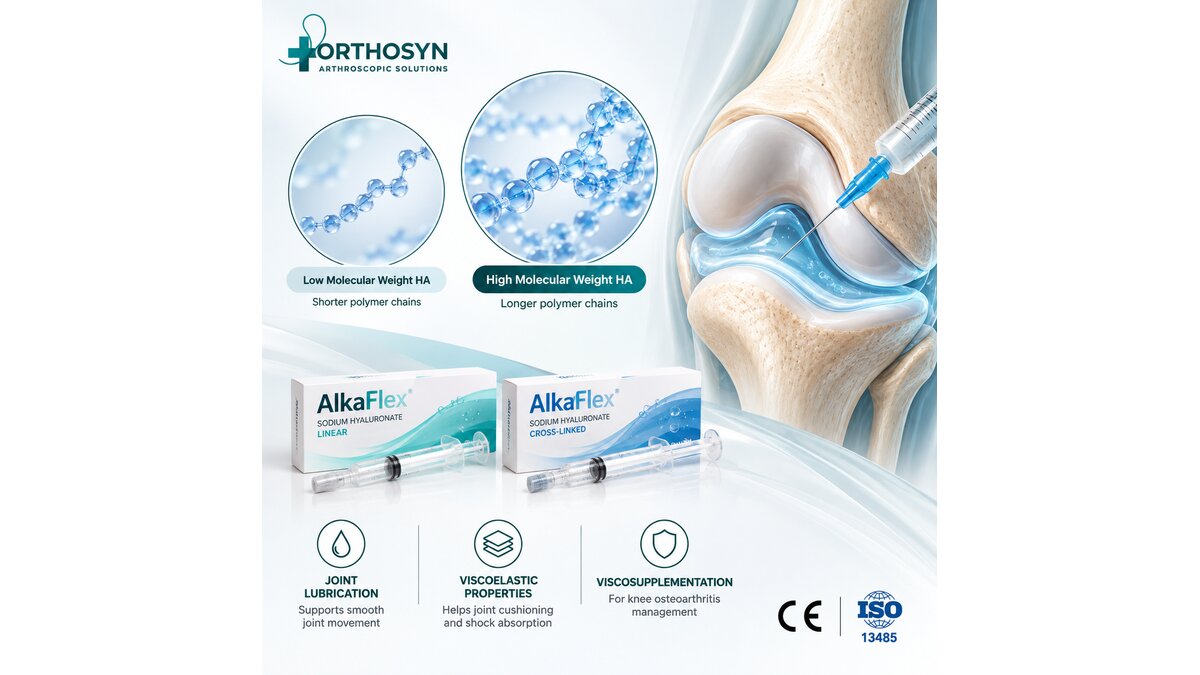
High molecular weight hyaluronic acid (HMW-HA) is a form of hyaluronic acid characterized by relatively long molecular chains and a high molecular mass. It is naturally associated with the viscoelastic properties of synovial fluid, which helps joints move smoothly while contributing to lubrication and mechanical cushioning.
In orthopedics, high molecular weight hyaluronic acid is particularly relevant to intra-articular injections, viscosupplementation and knee osteoarthritis management.
Molecular weight is one of several important characteristics used to describe hyaluronic acid formulations. However, it should not be considered the only factor determining a product's clinical performance.
Within the ORTHOSYN hyaluronic acid portfolio, AlkaFlex offers linear and cross-linked sodium hyaluronate formulations designed for intra-articular viscosupplementation applications.
Understanding molecular weight helps explain how different hyaluronic acid formulations are characterized and why their physical properties may vary.
Hyaluronic acid (HA) is a naturally occurring glycosaminoglycan found in many tissues throughout the human body.
It is particularly abundant in:
Synovial fluid
Articular cartilage
Connective tissues
Skin
Extracellular matrix
In synovial joints, hyaluronic acid contributes to the physical properties of synovial fluid.
Its functions include supporting:
Joint lubrication
Viscoelastic behavior
Mechanical cushioning
Smooth joint movement
The normal synovial environment
These characteristics explain why hyaluronic acid is widely studied in orthopedic applications.
Molecular weight describes the mass of a molecule and is commonly expressed in Daltons (Da), kilodaltons (kDa) or megadaltons (MDa).
For hyaluronic acid, molecular weight is related to the length of its polymer chains.
In general:
Longer HA Polymer Chain → Higher Molecular Weight
Shorter HA Polymer Chain → Lower Molecular Weight
For example:
500 kDa = 0.5 MDa
1,000 kDa = 1.0 MDa
2,400 kDa = 2.4 MDa
5,650 kDa = 5.65 MDa
These values describe molecular mass rather than the amount of hyaluronic acid contained in an injection.
A product containing 60 mg of hyaluronic acid does not necessarily have a higher molecular weight than one containing 32 mg.
HA concentration, total dose and molecular weight are different product characteristics.
There is no single universally accepted molecular weight threshold separating low, medium and high molecular weight hyaluronic acid across all scientific publications and commercial products.
Nevertheless, hyaluronic acid is frequently described using approximate molecular weight categories.
Molecular weight category | Illustrative molecular weight range |
|---|---|
Low molecular weight HA | Below approximately 500 kDa |
Medium molecular weight HA | Approximately 500–1,500 kDa |
High molecular weight HA | Above approximately 1,500 kDa |
These ranges are illustrative rather than standardized regulatory classifications. Different studies may use different definitions.
In orthopedic viscosupplementation, formulations with molecular weights measured in millions of Daltons are commonly discussed as high molecular weight products.
Hyaluronic acid contributes to the viscoelastic properties of synovial fluid.
Molecular weight can influence how HA polymer chains interact with one another and with their surrounding fluid environment.
In general, higher molecular weight chains may contribute to:
Greater polymer-chain interactions
Increased solution viscosity under comparable conditions
Viscoelastic behavior
Lubrication-related physical properties
Mechanical cushioning characteristics
However, the behavior of a finished injectable formulation also depends on concentration, cross-linking, polymer distribution and other formulation characteristics.
Therefore, higher molecular weight does not automatically mean better clinical outcomes.
Synovial fluid is a specialized fluid found inside synovial joints.
It helps reduce friction between articulating surfaces and supports the mechanical environment of the joint.
Hyaluronic acid is one of the important components contributing to synovial fluid's viscoelastic characteristics.
These properties allow synovial fluid to behave differently under different movement conditions.
For example, its physical behavior changes during slow joint movement compared with rapid mechanical loading.
This is one reason hyaluronic acid is frequently discussed in relation to both joint lubrication and shock absorption.
Lubrication is essential for smooth joint movement.
Hyaluronic acid contributes to the rheological behavior of synovial fluid and interacts with other components of the joint environment.
High molecular weight HA is particularly relevant because long polymer chains can influence viscosity and viscoelasticity.
A simplified relationship is:
High Molecular Weight HA → Polymer Chain Interactions → Viscoelastic Properties → Joint Lubrication Support
However, joint lubrication is a complex biological process involving additional molecules and cartilage surface structures.
Hyaluronic acid should therefore be understood as one component of the joint's lubrication system.
Viscosupplementation is an orthopedic treatment approach involving the injection of hyaluronic acid or sodium hyaluronate formulations into a joint.
The knee is one of the most frequently discussed anatomical applications.
Intra-articular HA injections are intended to supplement the physical properties of synovial fluid.
The general concept is:
Intra-Articular HA Injection → Synovial Fluid Supplementation → Joint Lubrication and Viscoelastic Support
Viscosupplementation is used in selected clinical settings, although recommendations for knee osteoarthritis differ among professional guidelines because clinical study results have been inconsistent.
The decision to use an injection should be individualized by the treating clinician.
Knee osteoarthritis is a degenerative joint condition associated with changes in articular cartilage, subchondral bone, synovial tissues and other joint structures.
Patients may experience:
Joint pain
Stiffness
Reduced mobility
Functional limitations
Difficulty during daily activities
Changes in synovial fluid composition and rheological properties may also occur.
High molecular weight hyaluronic acid formulations are investigated and used in viscosupplementation because of their physical characteristics and potential role in symptom management.
However, intra-articular HA injections do not regenerate damaged cartilage or reverse osteoarthritis, and their effectiveness varies among patients and formulations.
The primary distinction between high and low molecular weight HA is polymer-chain mass.
Characteristic | High Molecular Weight HA | Low Molecular Weight HA |
|---|---|---|
Polymer chains | Generally longer | Generally shorter |
Molecular mass | Higher | Lower |
Solution viscosity | Often higher under comparable conditions | Often lower under comparable conditions |
Viscoelastic properties | Influenced by longer-chain interactions | Different rheological characteristics |
Clinical effectiveness | Depends on formulation and evidence | Depends on formulation and evidence |
It is important not to interpret this comparison as proof that one molecular weight category is clinically superior in every situation.
Molecular weight and cross-linking are related to formulation characteristics, but they are not identical concepts.
Linear or non-cross-linked hyaluronic acid consists of polymer chains without intentional chemical cross-linking between them.
Its rheological behavior depends on factors including molecular weight, concentration and polymer interactions.
Cross-linked hyaluronic acid contains polymer chains connected through a cross-linking process.
Cross-linking can modify the material's mechanical properties and resistance to degradation.
The distinction can be represented as:
Linear HA → Non-Cross-Linked Polymer Chains
Cross-Linked HA → Interconnected Polymer Network
For cross-linked products, a manufacturer's reported molecular weight or equivalent molecular-weight value may not be directly comparable with the molecular weight of a linear HA polymer.
This distinction is important when evaluating different injectable formulations.
Within the ORTHOSYN portfolio, AlkaFlex includes linear and cross-linked sodium hyaluronate formulations for intra-articular viscosupplementation.
The AlkaFlex product family includes formulations characterized by different molecular weight and structural properties.

AlkaFlex Linear Hyaluronic Acid
Reported molecular weight: 2.4 MDa
Non-cross-linked sodium hyaluronate
Produced using microbial fermentation
Intended for intra-articular viscosupplementation according to product labeling

AlkaFlex Cross-Linked Hyaluronic Acid
Manufacturer-reported molecular weight specification: 5.65 MDa
BDDE cross-linked formulation
Sodium hyaluronate-based injectable technology
Designed for intra-articular viscosupplementation applications
The molecular weight values describe manufacturer-reported product characteristics. The cross-linked specification should not automatically be interpreted as the molecular mass of a single linear polymer chain.
The appropriate AlkaFlex formulation should be selected according to its approved indications, instructions for use and patient-specific clinical considerations.
No. Molecular weight and concentration describe different characteristics.
Molecular weight describes the mass of the HA polymer molecules.
Concentration describes how much HA is present in a given volume of formulation.
For example:
A formulation containing 30 mg/mL of HA has a concentration of 3%, regardless of whether the polymer molecular weight is 1 MDa, 2.4 MDa or another value.
Similarly, a syringe containing 90 mg of HA does not necessarily contain higher molecular weight polymer than a syringe containing 32 mg.
The distinction is:
Molecular Weight = Polymer Molecular Mass
Concentration = HA Amount per Unit Volume
Total Dose = HA Amount per Syringe
These specifications should be evaluated separately when comparing viscosupplementation products.
Not necessarily.
The duration of clinical effects after intra-articular hyaluronic acid injection depends on multiple factors, including:
Formulation characteristics
Cross-linking
Concentration
Injected dose
Joint condition
Patient characteristics
Biological clearance
Individual treatment response
A high molecular weight specification alone does not establish how long symptom relief will last.
Similarly, cross-linking may modify the physical behavior and persistence of a formulation, but it does not guarantee a specific clinical duration for every patient.
Clinical claims about treatment duration should be supported by evidence relevant to the exact formulation.
There is no universal answer.
Although molecular weight influences physical properties, the clinical performance of intra-articular HA products cannot be determined by molecular weight alone.
Important factors include:
Molecular weight distribution
HA concentration
Linear or cross-linked structure
Manufacturing process
Product purity
Injection regimen
Clinical evidence
Patient characteristics
Two formulations with similar reported molecular weights may still differ in rheological properties, manufacturing characteristics and clinical performance.
For this reason, molecular weight is best understood as one important technical specification within a broader product evaluation.
When evaluating hyaluronic acid injections, clinicians and procurement professionals may review:
Molecular weight and its measurement method
Linear or cross-linked formulation
Sodium hyaluronate concentration
Total HA dose
Injection volume
Source and manufacturing process
Sterility and quality documentation
Approved indications and instructions for use
Product-specific clinical evidence
Within this framework, the AlkaFlex portfolio offers different sodium hyaluronate formulations that can be evaluated according to their technical characteristics and intended clinical applications.
High molecular weight HA is particularly relevant to discussions involving:
Knee osteoarthritis
Intra-articular hyaluronic acid injections
Viscosupplementation
Synovial fluid properties
Joint lubrication
Viscoelasticity
Linear and cross-linked HA formulations
An educational search pathway can be represented as:
Knee Osteoarthritis → Synovial Fluid Changes → Hyaluronic Acid → High Molecular Weight HA → Viscosupplementation → AlkaFlex
This connects scientific searches about molecular weight with more specific research into intra-articular sodium hyaluronate formulations.
High molecular weight hyaluronic acid refers to HA characterized by relatively long polymer chains and high molecular mass, commonly expressed in megadaltons.
Its molecular structure influences important physical properties, including viscosity and viscoelastic behavior, making it relevant to joint lubrication and intra-articular viscosupplementation.
However, molecular weight alone does not determine the effectiveness, safety or duration of an HA injection.
Within the ORTHOSYN portfolio, AlkaFlex Linear (2.4 MDa) and AlkaFlex Cross-Linked (manufacturer-reported 5.65 MDa specification) represent different formulation technologies for intra-articular viscosupplementation.
Understanding molecular weight alongside concentration, cross-linking, product quality and clinical evidence provides a more complete basis for evaluating hyaluronic acid injections.