Femoral graft fixation is an important stage of anterior cruciate ligament (ACL) reconstruction. After the graft has been prepared and passed through the femoral tunnel or socket, it must be securely fixed to maintain its intended position during the initial healing period.
One commonly used approach is cortical suspensory fixation, in which a femoral button rests against the outer cortical surface of the femur while a loop connects the button to the ACL graft.
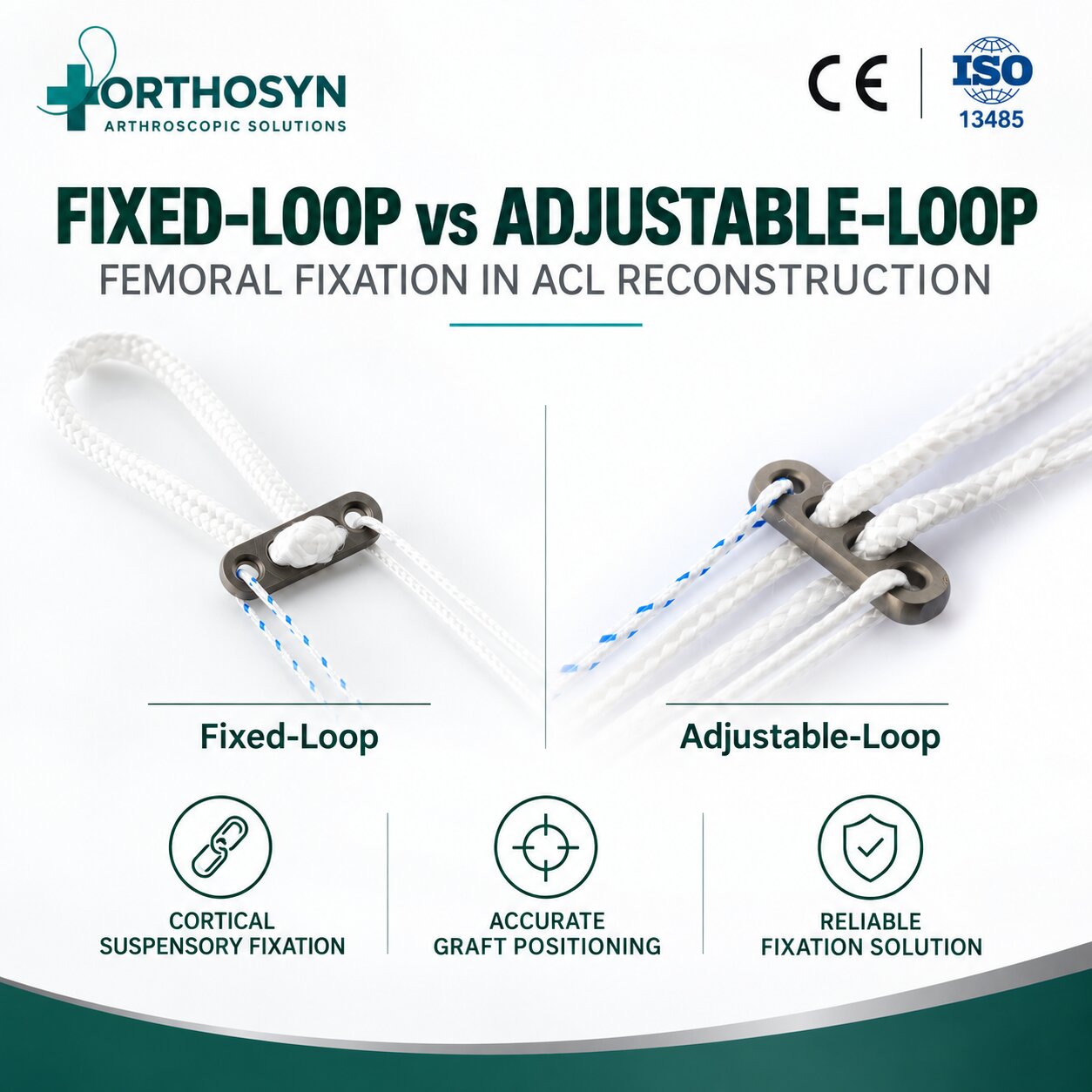
Two major configurations are used in this category: fixed-loop and adjustable-loop femoral fixation systems.
Although both technologies rely on cortical button fixation, they differ in how the loop length is established, how the graft is positioned and how tension can be adjusted during surgery.
Within the ORTHOSYN arthroscopy portfolio, Femoral Lift Systems provide cortical suspensory fixation technologies relevant to ACL reconstruction, including adjustable-loop fixation concepts.
The anterior cruciate ligament is one of the primary stabilizers of the knee. It helps resist excessive anterior translation of the tibia and contributes to rotational stability.
When ACL reconstruction is performed, a graft is used to replace the function of the damaged ligament.
The procedure generally includes:
Graft preparation
Femoral and tibial tunnel or socket preparation
Graft passage
Graft positioning
Graft tensioning
Femoral and tibial fixation
The femoral fixation system secures the graft on the femoral side while biological integration develops.
A simplified sequence is:
ACL Graft → Femoral Tunnel → Fixation Device → Femoral Cortex
Cortical suspensory fixation uses a button positioned against the outer cortical bone surface.
The graft is connected to this button through a loop or high-strength suture construct.
The fixation principle is:
ACL Graft → Suture Loop → Femoral Button → Femoral Cortex
The cortical button provides the fixation interface against bone, while the loop suspends the graft within the prepared femoral tunnel or socket.
This differs from aperture fixation, in which an interference screw secures the graft closer to the tunnel entrance.
A fixed-loop femoral fixation system uses a loop with a predetermined length.
The loop length is selected before implantation based on the surgical technique, tunnel measurements and desired graft position.
Once the cortical button is deployed, the loop length remains essentially fixed.
The principle is:
Fixed Loop Length → Button Deployment → Graft Positioning
Because the loop cannot normally be shortened after deployment, accurate measurement and selection are particularly important.
The general procedure involves:
Preparing the femoral tunnel or socket.
Measuring the relevant tunnel and graft dimensions.
Selecting the appropriate fixed-loop length.
Connecting the graft to the fixation system.
Passing the button through the femoral tunnel.
Deploying the button against the femoral cortex.
Positioning and assessing the graft.
The loop provides a predefined distance between the cortical button and the graft.
Fixed-loop fixation offers several design characteristics:
Predetermined loop length
No loop-shortening mechanism
Relatively straightforward loop construction
Dependence on accurate tunnel measurements
Cortical suspensory fixation principle
However, the absence of an adjustment mechanism means that graft positioning must be planned carefully.
An adjustable-loop femoral fixation system allows the surgeon to modify the loop length during the procedure.
Instead of relying entirely on a predetermined loop length, the surgeon can shorten the loop after the cortical button has been positioned.
The principle is:
Button Deployment → Loop Adjustment → Graft Advancement → Final Positioning
This can provide greater flexibility during graft positioning.
A typical adjustable-loop procedure involves:
Preparing the femoral tunnel or socket.
Connecting the ACL graft to the adjustable-loop system.
Passing the cortical button through the femoral tunnel.
Deploying the button against the femoral cortex.
Pulling the designated adjustment sutures.
Shortening the loop to advance the graft.
Confirming graft position and fixation.
The specific sequence varies according to the implant design and surgical technique.
Both systems use cortical suspensory fixation, but their loop-management mechanisms differ.
Feature | Fixed-Loop Fixation | Adjustable-Loop Fixation |
|---|---|---|
Loop length | Predetermined | Adjustable |
Graft positioning | Based on selected loop length | Can be adjusted during surgery |
Button fixation | Femoral cortex | Femoral cortex |
Loop-shortening mechanism | Generally absent | Present |
Tunnel measurement | Critical for loop selection | Still important |
Graft advancement | Determined by loop configuration | Controlled through adjustment |
Main concept | Fixed suspension length | Variable suspension length |
Neither technology should be considered universally superior. Selection depends on the reconstruction technique, graft configuration, tunnel geometry, implant characteristics and surgeon preference.
Loop length affects the relationship between the femoral cortical button and the graft.
In a fixed-loop system, an inappropriate loop length may affect the intended graft position within the femoral tunnel or socket.
In an adjustable-loop system, the surgeon can modify this distance during implantation.
The concept can be represented as:
Femoral Cortex → Loop Length → Graft Position
Therefore, loop selection or adjustment is an important part of femoral fixation planning.
The graft must be positioned appropriately within the prepared femoral tunnel or socket.
Several factors influence this process:
Femoral socket depth
Graft length
Tunnel geometry
Desired graft insertion depth
Button position
Fixation technique
Adjustable-loop technology can provide flexibility when advancing the graft into the socket.
However, accurate tunnel preparation and graft measurements remain essential with both fixation methods.
The presence of an adjustable mechanism does not automatically mean that an implant provides greater mechanical stability.
Mechanical performance depends on several factors, including:
Loop construction
Suture material
Locking mechanism
Implant design
Loading conditions
Fixation technique
Some biomechanical studies have examined potential loop elongation or displacement under cyclic loading, while other investigations have demonstrated favorable performance for particular adjustable-loop designs.
These findings cannot automatically be applied to every device.
Clinical outcomes also depend on graft selection, tunnel positioning, rehabilitation and patient-related factors.
Therefore, fixed-loop and adjustable-loop systems should be evaluated according to their specific designs and supporting evidence rather than loop type alone.
Loop elongation refers to an increase in the effective length of the suspensory construct under loading.
In adjustable-loop systems, researchers may evaluate whether the locking mechanism maintains loop length during repeated loading cycles.
However, loop elongation is not determined solely by whether the device is fixed or adjustable.
The performance of the complete construct is influenced by:
Suture Material + Loop Configuration + Locking Mechanism + Loading Conditions
For this reason, biomechanical performance should be assessed using device-specific testing.
The femoral button provides the cortical fixation point.
After passing through the femoral tunnel, the button is positioned against the external femoral cortex.
The button and loop function together:
Femoral Cortex → Cortical Button → Loop → ACL Graft
The loop transfers forces between the graft and the cortical button.
Appropriate button deployment is essential because the button must rest against the intended cortical surface.
Femoral graft fixation can be achieved using different mechanical principles.
Suspensory fixation uses a cortical button and loop to suspend the graft.
Aperture fixation commonly uses an interference screw to secure the graft within the tunnel.
Characteristic | Suspensory Fixation | Aperture Fixation |
|---|---|---|
Main device | Femoral button and loop | Interference screw |
Fixation location | Cortical surface | Within bone tunnel |
Mechanism | Graft suspension | Graft compression/interference |
Common application | ACL graft fixation | ACL graft fixation |
Both concepts are relevant to modern ligament reconstruction.
ORTHOSYN offers Femoral Lift Systems within its ACL/PCL fixation portfolio.
These systems provide cortical button fixation concepts for cruciate ligament reconstruction.
Product Code: ORT-LS-1001
The From Bottom configuration incorporates an adjustable femoral sling concept with distal and proximal adjustment features.
It is designed around cortical suspensory fixation and graft-positioning adjustment.
Product Code: ORT-LS-3001
The From Top configuration incorporates an adjustable button concept with distal and proximal adjustment.
This provides another configuration for managing graft positioning during femoral fixation.
Both systems belong to the ORTHOSYN femoral fixation portfolio and should be used according to their specific intended purposes and instructions for use.
The ORTHOSYN Femoral Lift portfolio provides adjustable-loop concepts relevant to femoral graft fixation.
The general fixation sequence is:
ACL Graft → Adjustable Loop → Femoral Button → Femoral Cortex
The adjustment mechanism allows graft positioning to be managed according to the selected technique.
This is particularly relevant when the surgeon needs to coordinate:
Femoral socket preparation
Graft insertion depth
Button deployment
Loop shortening
Graft positioning
Final fixation assessment
The From Bottom and From Top configurations provide different approaches within the ORTHOSYN adjustable femoral fixation portfolio.
Modern ACL reconstruction includes several graft and tunnel preparation techniques.
Depending on the procedure, surgeons may use different graft types, socket configurations and fixation strategies.
Adjustable-loop systems can offer flexibility in managing graft position after cortical button deployment.
This creates an important distinction:
Fixed-Loop → Predetermined Suspension Length
Adjustable-Loop → Intraoperative Suspension Length Adjustment
However, flexibility alone does not establish clinical superiority. The appropriate system depends on the surgical technique and device-specific characteristics.
ACL injuries commonly occur during activities involving rapid deceleration, pivoting, cutting or landing.
Sports frequently associated with ACL injury mechanisms include:
Football
Basketball
Handball
Skiing
Rugby
Volleyball
When ACL reconstruction is indicated, graft fixation becomes an essential part of the procedure.
The educational pathway can be represented as:
ACL Injury → ACL Reconstruction → Graft Passage → Femoral Fixation → Fixed-Loop or Adjustable-Loop System
This creates a natural relationship between informational searches about ACL reconstruction and product-focused searches involving femoral buttons, adjustable loops and cortical suspensory fixation.
Within the ORTHOSYN arthroscopy portfolio, Femoral Lift Systems provide adjustable cortical suspensory fixation concepts for cruciate ligament reconstruction.
The portfolio includes:
ORTHOSYN Femoral Lift System – From Bottom (ORT-LS-1001)
ORTHOSYN Femoral Lift System – From Top (ORT-LS-3001)
These technologies are relevant to searches involving:
ACL femoral fixation
Adjustable-loop femoral button
Cortical suspensory fixation
ACL graft fixation
Femoral button systems
ACL reconstruction implants
ORTHOSYN also offers interference screw technologies, representing another fixation principle within its broader ACL/PCL reconstruction portfolio.
Final implant selection should follow the surgical technique, graft characteristics, anatomy and specific product indications and instructions for use.
Fixed-loop and adjustable-loop femoral fixation systems both use cortical suspensory fixation in ACL reconstruction, but differ in how the loop length is managed.
Fixed-loop systems use a predetermined loop length, while adjustable-loop systems allow intraoperative shortening and adjustment.
The fundamental distinction is:
Fixed-Loop → Predetermined Loop Length
Adjustable-Loop → Adjustable Loop Length
Both technologies require appropriate tunnel preparation, button positioning and graft fixation.
Within the ORTHOSYN arthroscopy portfolio, the Femoral Lift System From Bottom and Femoral Lift System From Topprovide adjustable cortical button fixation concepts relevant to ACL reconstruction.