Molecular weight is one of the most important technical characteristics used to describe hyaluronic acid (HA) in intra-articular injections.
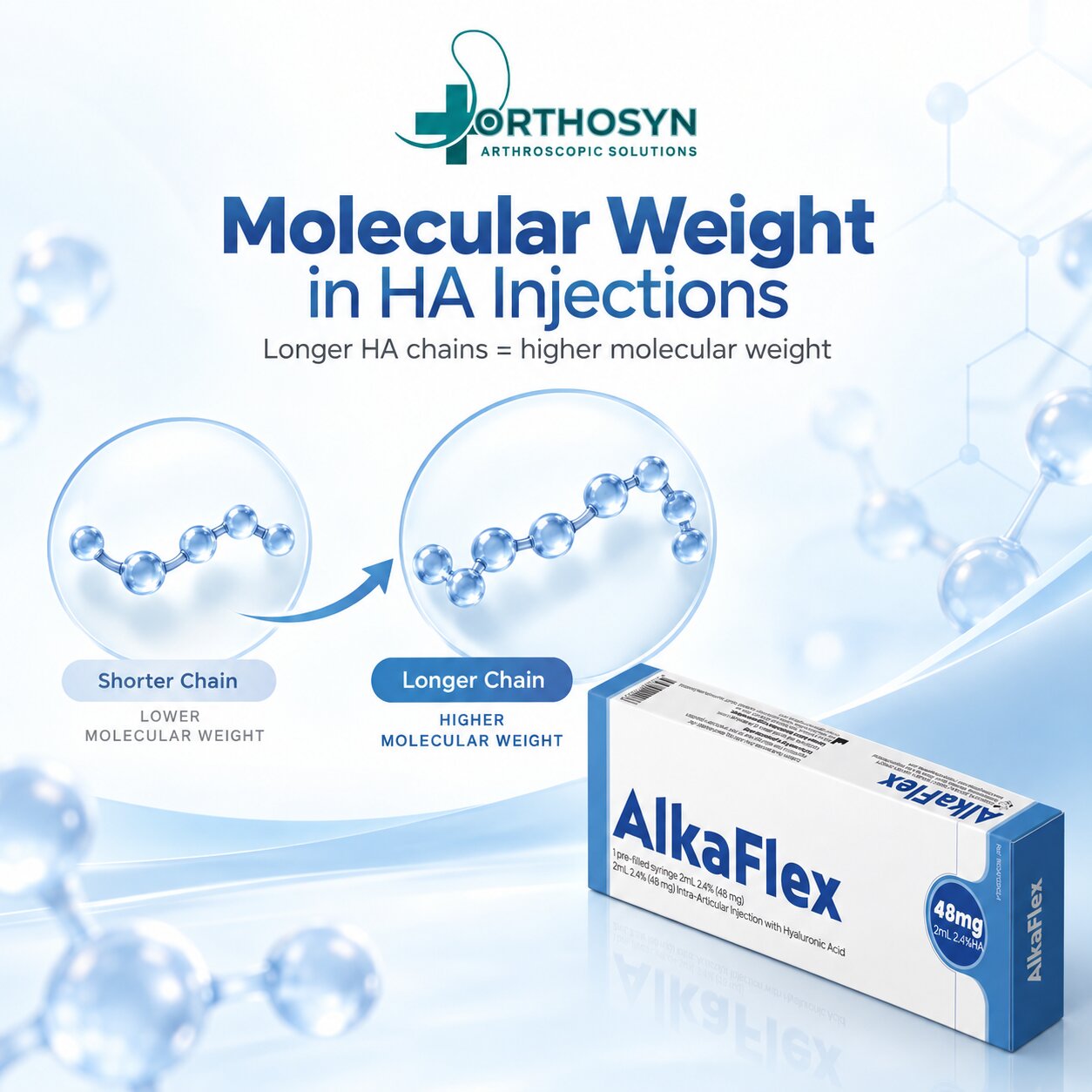
In simple terms, molecular weight refers to the size of the hyaluronic acid polymer chains.
Because hyaluronic acid is made of long repeating molecular units, the length of these chains can vary significantly from one formulation to another.
This matters because molecular weight can influence properties such as:
For this reason, molecular weight is a key parameter when comparing intra-articular hyaluronic acid products such as AlkaFlex Linear and AlkaFlex Cross-Linked formulations.
Hyaluronic acid is a naturally occurring polysaccharide composed of repeating disaccharide units.
These repeating units form long polymer chains.
The longer the chain, the greater its molecular weight.
In technical product descriptions, HA molecular weight is often expressed in:
For example:
1 MDa = 1,000 kDa
So a formulation described as 2.4 MDa contains HA with an average molecular weight of approximately 2.4 million daltons.
The size of HA polymer chains can affect the way the material behaves physically.
Higher-molecular-weight chains tend to interact and entangle differently from shorter chains.
This can influence:
These properties are particularly important in intra-articular formulations because synovial fluid itself is a viscoelastic environment.
Viscosity describes resistance to flow.
Longer HA chains generally create more molecular interaction and entanglement than shorter chains.
As a result, molecular weight can contribute to higher viscosity.
However, molecular weight is not the only factor.
Viscosity is also influenced by:
This means that a higher molecular weight does not automatically guarantee a more viscous final product.
These two parameters are often confused.
Molecular weight describes the size of the HA polymer chains.
Concentration describes how much HA is present in a certain volume.
For example:
A formulation can contain:
These two formulations may behave very differently.
This is why it is important to evaluate:
molecular weight + concentration
together.
MDa stands for megadalton.
A dalton is a unit used to describe molecular mass.
In HA products, molecular weight is often expressed in millions of daltons.
For example:
2.4 MDa = approximately 2.4 million daltons
This is why MDa values are commonly seen in technical descriptions of high-molecular-weight hyaluronic acid.
No.
A higher molecular weight does not automatically mean that one HA product is better than another.
Different formulations are designed for different purposes.
The overall behavior of the product depends on several factors, including:
Therefore, molecular weight should be treated as one important parameter within the complete technical profile.
The term high molecular weight hyaluronic acid generally refers to HA formulations with relatively long polymer chains.
However, there is no single universally used threshold that defines all HA products as low, medium or high molecular weight.
Different studies and manufacturers may use different classifications.
For this reason, the exact molecular-weight value is more informative than relying only on the words “high molecular weight.”
The AlkaFlex Linear portfolio includes formulations based on high-molecular-weight linear HA.
For the linear AlkaFlex formulation, the molecular weight is approximately 2.4 MDa.
This means the HA polymer chains have an average molecular size of around 2.4 million daltons.
This technical characteristic is particularly relevant when evaluating:
Explore AlkaFlex Linear Hyaluronic Acid:
https://orthosynmed.com/product/39/alkaflex-intra-articular-injections-with-hyaluronic-acid---linear-linked
Cross-linked hyaluronic acid is different because the HA polymer chains are chemically connected into a modified network.
This means that the behavior of a cross-linked formulation cannot be described only by the molecular weight of the original linear HA chains.
Cross-linking can significantly influence:
The AlkaFlex Cross-Linked Intra-Articular Hyaluronic Acid portfolio represents this second formulation approach.
Explore AlkaFlex Cross-Linked Hyaluronic Acid:
https://orthosynmed.com/product/44/alkaflex-intra-articular-injections-with-cross-linked-hyaluronic-acid
Molecular weight and cross-linking are related but different concepts.
Molecular weight describes the size of the polymer chains.
Cross-linking describes how those chains are connected to each other.
A linear HA product can have a high molecular weight without being cross-linked.
A cross-linked product may have a complex molecular network that behaves differently from the original linear chains.
Therefore, these terms should not be used interchangeably.
Molecular weight can influence the physical properties of HA, including viscosity and viscoelastic behavior.
These properties are relevant to the way HA interacts with the synovial environment.
However, joint lubrication is not determined by molecular weight alone.
It also depends on:
This is why technical evaluation should always consider multiple parameters.
Higher-molecular-weight HA can contribute differently to the elastic and viscous characteristics of a formulation.
These characteristics are relevant to the way the material responds to mechanical loading.
However, shock absorption depends on the overall rheological behavior of the formulation rather than molecular weight alone.
Cross-linking and concentration are also important.
When comparing HA products, it is useful to ask:
These questions provide a more complete picture than simply comparing one molecular-weight number.
AlkaFlex is Orthosyn Medikal’s international brand for intra-articular hyaluronic acid formulations.
The AlkaFlex portfolio includes both:
with different technical characteristics.
For AlkaFlex Linear, 2.4 MDa high-molecular-weight HA is one of the key formulation characteristics.
This makes molecular weight an important part of the AlkaFlex technical positioning within the intra-articular HA category.
Molecular weight describes the size of hyaluronic acid polymer chains.
It is one of the most important parameters used to characterize intra-articular HA formulations because it can influence:
However, molecular weight should never be evaluated alone.
A complete HA product comparison should also consider:
The AlkaFlex Linear portfolio uses high-molecular-weight HA with an approximate molecular weight of 2.4 MDa, while the AlkaFlex Cross-Linked portfolio uses a different molecular-structure approach based on cross-linked HA technology.
AlkaFlex Linear Intra-Articular Hyaluronic Acid
https://orthosynmed.com/product/39/alkaflex-intra-articular-injections-with-hyaluronic-acid---linear-linked
AlkaFlex Cross-Linked Intra-Articular Hyaluronic Acid
https://orthosynmed.com/product/44/alkaflex-intra-articular-injections-with-cross-linked-hyaluronic-acid